
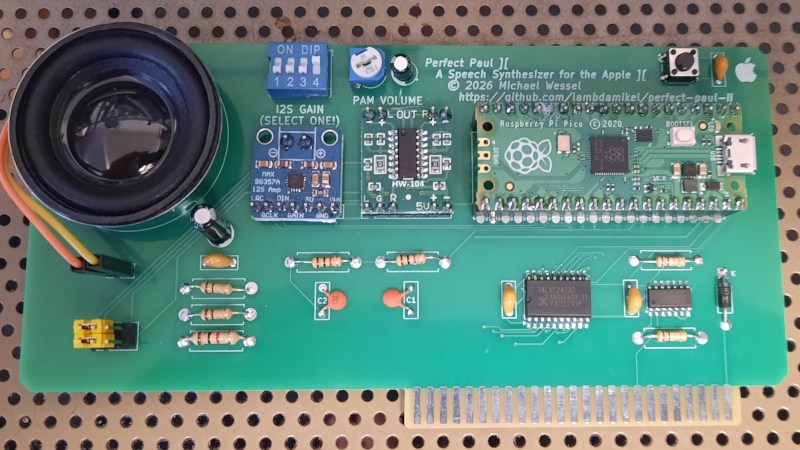
If you had an 8-bit computer in the 1980s and bought a speech synthesiser for it, what you got was invariably an alophone-based synthesiser using the SP0256 or similar. You definitely couldn’t afford DEC’s DECtalk, a high-end standalone speech synthesiser made famous to the masses as the unit used by Stephen Hawking. But now those two worlds can come together, thanks to [Michael Wessel], whose Perfect Paul ][ is a drop-in DECtalk emulator card for the Apple ][.
The PCB includes an RP2040-based Raspberry Pi Pico Zero, plus an I2S DAC and amplifier, speaker, and bus-interface logic. It appears at a set of memory addresses, and interfacing to it is as simple as POKEing DECtalk commands to those addresses. Looking at it, we are guessing this would be easy to bring to other 8-bit era machines.
You can see and hear it sing in the video below the break, and it certainly has the feel of the real thing. We can say with certainty that this would have been a sensation had it appeared back in the early 1980s. This one may be a modern reproduction, but it’s not the first time DECtalk has appeared here; we’ve even brought you a real one.











Hey Hackaday folks, quick correction for you. You mean the ‘Raspberry Pi Pico’. The Zero is not a 2040 based machine. ;)
beat me by 2 hours
The RP2040 zero:
https://www.waveshare.com/rp2040-zero.htm
Although it does look like they meant Pico from the top picture.
I just want the one from Wargames.
Sadly, the Wargames one wasn’t real ;-)
But can it be made real is the real question. (Probably, yes)
John Wood would read his lines for WOPR in reverse order, then in editing they’d reassemble the fragments into sentences. The rest was just some filters and EQ to make it sound artificial.
I’d rather hear Karl Pilkington-bot
“I’m not bothered”
He should be the next Doctor Who, with Gervais as The Master
My dad was a blind Apple II + speech synthesiser user back when this was contemporary and the DECtalk was always the gold standard of the day. We never HAD a DECtalk but my dad could do a great impression of the the different voices 😀
One of my proudest moments in life is that about 25 years ago, for reasons I won’t get into, I was summoned to Cambridge to do a day’s tech support for Prof Hawking.
At the time, his speech synthesis solution was an ISA card (presumably, the ISA variant of the DECtalk that the article mentions). I was told by his research assistant that it only needed power from the ISA connector; ASCII strings sent in over its serial port were converted to speech there, and were output over the speakers. The serial data was generated by a Thinkpad laptop in a ruggedized aluminum enclosure. At the time, Prof Hawking still had limited hand movement, so the software solution on the laptop would display a grid of words/letters. Each grid entry in turn would highlight one-by-one; he would squeeze a small handheld clicker when the desired word was highlighted. The software would then start the highlight process all over again for the next word, and then the next, and so on. Almost unimaginably tedious as a way of composing sentences, so I’m sure he was pleased when the later eye-tracking solution was implemented!
Anyway, going back to the ISA card, I was told two things:
1) his lab had a very limited supply of the cards, they having been discontinued years previously; as each card eventually failed, the research assistant would pull a “new” one from the diminishing stock.
2) even at the time (circa 2000, remember) this was an archaic speech-synthesis solution, far from the contemporary gold standard. Multiple companies (IBM, Intel, Microsoft, et cetera) had apparently offered to provide the Professor with a more modern and natural-sounding speech synthesizer, but he had consistently refused this – because that robotic 1980s voice was him. It was his personality, it was instantly recognizable, and he didn’t want to lose that aspect of himself.
Much later on, long after my encounter, the solution was that someone (IBM?) reverse-engineered that crusty old ISA card and re-implemented it in software, allowing his “voice” to be preserved and future-proofed.
(second time trying to post this – the first time, HaD just returned without actually adding the comment. Apologies if this appears twice.)
One of my proudest moments in life is that about 25 years ago, for reasons I won’t get into, I was summoned to Cambridge to do a day’s tech support for Prof Hawking.
At the time, his speech synthesis solution was an ISA card (presumably, the ISA variant of the DECtalk that the article mentions). I was told by his research assistant that it only needed power from the ISA connector; ASCII strings sent in over its serial port were converted to speech there, and were output over the speakers. The serial data was generated by a Thinkpad laptop in a ruggedized aluminum enclosure. At the time, Prof Hawking still had limited hand movement, so the software solution on the laptop would display a grid of words/letters. Each grid entry in turn would highlight one-by-one; he would squeeze a small handheld clicker when the desired word was highlighted. The software would then start the highlight process all over again for the next word, and then the next, and so on. Almost unimaginably tedious as a way of composing sentences, so I’m sure he was pleased when the later eye-tracking solution was implemented!
Anyway, going back to the ISA card, I was told two things:
1) his lab had a very limited supply of the cards, they having been discontinued years previously; as each card eventually failed, the research assistant would pull a “new” one from the diminishing stock.
2) even at the time (circa 2000, remember) this was an archaic speech-synthesis solution, far from the contemporary gold standard. Multiple companies (IBM, Intel, Microsoft, et cetera) had apparently offered to provide the Professor with a more modern and natural-sounding speech synthesizer, but he had consistently refused this – because that robotic 1980s voice was him. It was his personality, it was instantly recognizable, and he didn’t want to lose that aspect of himself.
Much later on, long after my encounter, the solution was that someone (IBM?) reverse-engineered that crusty old ISA card and re-implemented it in software, allowing his “voice” to be preserved and future-proofed.
Stephen Hawking’s computer voice was recorded and initially programmed by computer scientist Dennis Klatt in 1987. Klatt died in 1988 from cancer, and though Hawking was offered newer voices as time went on he chose to keep Klatt’s voice as his own.
I had a Speech Sync module for my Acorn Electron. It was OK, but I could never get it to pronounce my name – Paul – quite right. Best was either ‘Porl’, or ‘Pawl’. Ultimately it was a pretty useless peripheral as there was no actual software for it.
Funny that this module has it’s own built in computer than is likely many times more powerful than the Apple ][ it’s designed for.
Like it was the TMS5220 (with a TMS6100 ROM). I had a loan of one for my Beeb model B. But I ended up with a copy of the Superior Software’s Speech! program. A software based speech synth. This was pretty good – you could use the *SPEAK command to access the phonemes and get more accurate speech and even accents.
Although, if you live in the New Castle area “Pawl” would have been accurate enough.
Just did a bit of digging, and I’m pretty sure it was a VoxBox powered by an SP0256-AL2 chip. The sound hardware in the Elk wasn’t up to the task of anything as subtle as speech.
I was in fact born a Geordie, but at this point in my life I was living in Scouse land.
Why aye! Vaguely remember ads for the VoxBox, but no experience with it.
If memory serves, and (full disclosure), with help from Wikipedia, a company named Federal Screw Works released a phoneme-based voice synthesizer I.C.—and systems—in the early 1970s, the SC-01, followed by the SC-02. The systems were known as Votrax.
As phonemes are the much-more-basic parts (some would say THE basic parts) of language than allophones, SC-0x-based systems were (and still are) capable of truly synthesising almost any English-language speech, using a relatively small amount of resources.
…still have the SC-01 sent me by Federal Screw Works, in the conductive-foam FSW box.
One of these days…
I do prefer the sound of machine voices back then. They are cute and goofy, whereas new AI speech synthesis is… creepy. Why is it always making weird breathing noises?! It has no lungs, make it stop!
I have no lungs and I must breathe very heavily into the microphone
good point, but to be fair, AI speech synthesis has no vocal cords either. By adding breathing sounds to the synthesized speech it certainly sounds more natural (although sometimes a bit to natural).
I built an SPO256 synthesizer for my Atari 800 back in the Elder Days, It said “This is thw oice of World Control” or “I’m sorry, Dave” a lot. ;-) A lot of creative spelling was required. My Amiga did it all in software and sounded a lot like Hawking. I once did a hex dump on the “SAY” program and it seemed 90% of the code was spelling kludges.
I still have my Echo ][ speech synthesizer working in an apple 2+
Perfect Paul ][ vs. S.A.M.:
https://youtu.be/PsvA-_zbLwo