
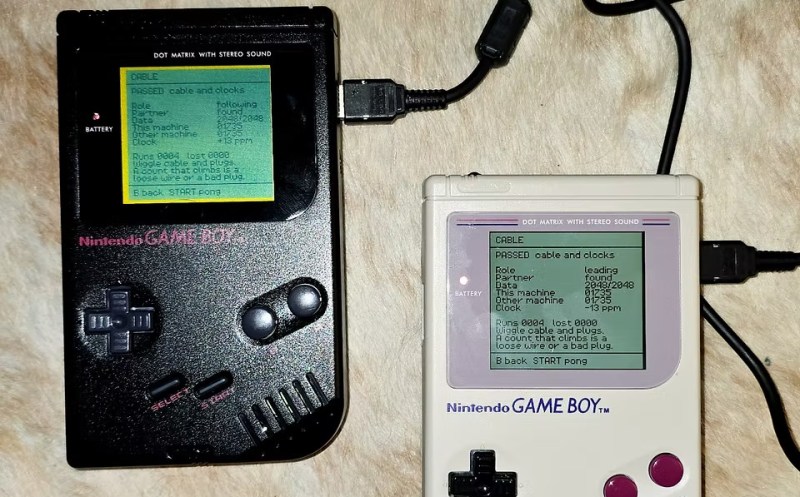
Most of the time when you see a repair video of a Game Boy it’ll be demonstrated with a cartridge inserted and booting up into the game, but does this actually mean that the system is truely fully functional? There can still be more intermittent faults, dodgy buttons, or even something like a defective link port — all of which can be much harder to detect than firing up a copy of Tetris. This is where the GB Test Lab cartridge by [Marcel Pflug] of the Game Boy Museum comes into play.
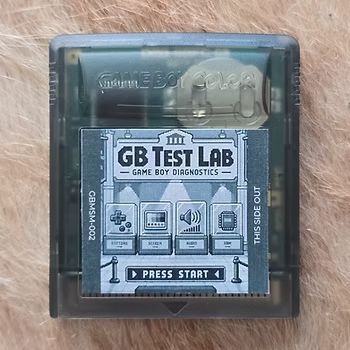
With the freely available ROM put on an EverDrive or similar flash cartridge, you can test a whole range of functions of the original Game Boy (DMG-01), most of them autonomously and some with some user input.
This is similar to the test cartridge that Nintendo themselves used in the form of the DMG-AGING-01, which validated the basic functionality of the handheld. Since then a myriad of test cartridges have been created by the homebrew community, but not all try to test quite literally everything possible. In the case of the GB Test Lab this includes the typical like CPU, RAM, interrupts, etc., but also key bounce time, intermittent connectivity and playing a game of Pong between two GBs connected by link cable as well as using the GB Printer.
Results are saved per GB and persisted if the flash cartridge has battery backup or similar. Overall it seems quite comprehensive and something that’s worth giving a shot if you’re the kind of person who owns one or more GBs. Perhaps the neatest part of this ROM is that it also contains a built-in reference for all the components and other useful details, including how to interpret results and symptoms.












“A count that climbs is a loose wire or a bad plug.”
Say hi to Claude.
Is it me, or the cartridge cover looks AI generated? If it is, please at least be human-coded
The cartridge label on the website has an OpenAI SynthID watermark, so that’s definitely AI-generated. Doesn’t give me much hope for the contents of the cartridge.
Sure looks that way.
I don’t repair GB, but for NDS I’m using this:
https://www.gamebrew.org/wiki/Diagnose
That is some FLOWERY-ass prose, and it’s only the first two paragraphs. “Knows the same silence”, SRSLY?
Every time I visit the Museum of Retrogaming in Düsseldorf, France, a mighty dagger of silence slices through my consciousness when I see the state of their urinal.
It stands in the corner of the men’s room beneath a flickering fluorescent tube, yellowed with age and guarded by a small plastic sign that reads OUT OF ODER, though no one has bothered to explain what, exactly, is out of oder. The plumbing? The dignity of the institution? Perhaps the entire generation.
The museum itself is a paradise. Cabinets glow beneath glass like a nose on glass: Space Invaders, Pac-Man, Street Fighter II. The air smells of violent dust, warm circuitry, and childhood stoicism. Somewhere in the main hall, an eight-bit melody repeats endlessly, cheerful and degraded. Visitors laugh as they battle for high scores, their faces illuminated by blue and green screens.
But then nature calls.
I enter the restroom, and there it is.
The urinal.
Its porcelain surface has the cracked, mournful appearance of an ancient arcade cabinet abandoned in a basement. A rust-colored stain descends from the flush valve like the lyrics of Sabaton’s “40:1.” One of the tiles behind it is missing, revealing a dark cavity where I plead myself to imagine small, organized colonies of insects playing Tetris with shards of visitors’ souls.
The silence is totalitarian.
Not the peaceful silence of a library, nor the sacred silence of a church. This is a mechanical silence – the kind that occurs when an arcade machine loses power in the middle of a tournament. A silence with a high-score table but no initials beside it.
I stand before the urinal and remember the museum’s slogan:
THE FUTURE WAS BETTER WHEN IT WAS MADE OF PIXELS.
Perhaps this is what they mean. Perhaps the urinal is an exhibit, preserved to demonstrate the decline of gamer civilization. Maybe it belongs in my Steam library, accompanied by a brass plaque:
Public Sanitation Interface, circa 1987. Functionality uncertain. Emotional damage guaranteed.
I try to flush.
The handle throbs in sync with my appendage. Somewhere inside the wall, a dead rat groans. A drop of water falls with the solemnity of a cathedral bell.
Then the urinal makes a sound.
Not a flush. Not a drip.
A single electronic chirp.
I freeze.
From the restroom corridor comes the distant music of Cameron’s Titanic. The melody grows louder, though no one is playing it. The fluorescent light flickers once, twice, and my mind goes dark.
In the blackness, the urinal speaks.
“INSERT COIN.”
I do not move.
“INSERT COIN.”
Behind me, the restroom door slowly swings open. A blue glow spills across the tiles. On the wall, where the cracked mirror used to hang, a screen flickers to life.
PLAYER ONE READY.
And beneath it, in enormous red letters:
INSERT COIN.
Sorry, that was a reply to FeRDNYC.
The cartridge pictured in the photo would not work in the game boy consoles in the other photo. Original GB carts have a notch cut out at the top. When you switch the system on, a little latch protrudes into that notch that keeps the cart from being pulled out while the system is powered on. That pictured cart is for a Game Boy Color, which didn’t have such a latch. (this also meant that you couldn’t power an original Game Boy on with a GBC cart inserted.)
Repro shells like in the picture can be GBC style and still have the notch cut out of the back shell. I use them for my own GBC test cartridges, as I’m Jayro who makes “Jayro’s GAME BOY Test Cartridge”.