
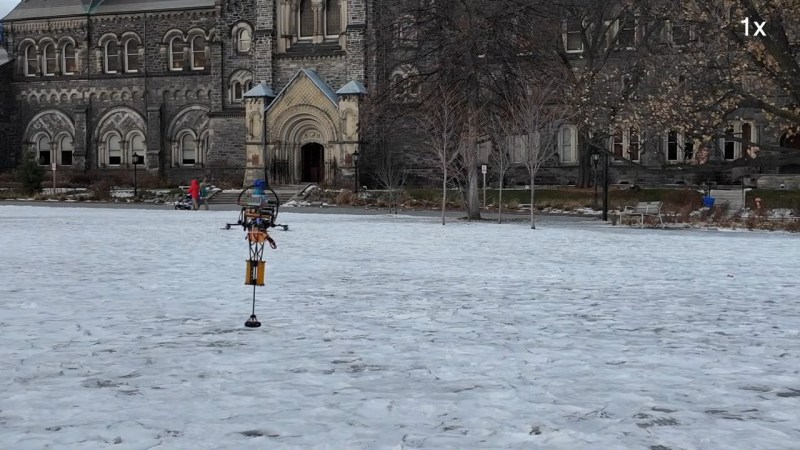
What do you get when you combine a pogo stick, a quadcopter, and engineering students from the University of Toronto? This thing, apparently– a “monopedal hopping robot” that uses a spikey, pivoting foot pad tensioned by what look like elastic bands to keep it upright on all terrain from soft sand to hard ice.
It’s an interesting concept. The thrust from the four propellers is what gives the energy to get the robot moving, but its pogo-like hopping is entirely down to the spring-loaded single legged “landing gear”. Early iterations just used a spike on the end of that leg, but that failed in ways that some might find humorous, which you will see if you watch the video embedded below. Giving the monopod an actual foot with some traction and the ability to pivot and match the terrain works much better– now not only can this robot leap tall fences in a single bound, an errant ice patch won’t send it skittering away.
This isn’t the first one-legged robot we’ve seen; some only use their leg while others have wings, but this odd quadcopter is the first we’ve seen to brave Canadian winter.












As if bouncing betty wasn’t scary enough…
I know a place where they can make good use of an army of hopping claymores.
Especially if you add a random pattern of bounce height, distance, and sideways bumbling towards the overall intended path and combine it with infrared and acoustic target locking.
On the other hand it’d be close to impossible to use as a FPV device: every „driving“ pilot would barf within minutes, I reckon.
The Wallace Tank is now viable.
Look at 0:13, why does it look like they faked the video by moving a static photo of the robot over the background? It looks like the robot is dragging a “halo” around it where it was cut from the background.
Probably just the AI filter that’s built into the smartphone they filmed this with.
Or perhaps rolling shutter plus heavy motion compensation with the video codec, now that I think about it. Still, pretty weird artifact.
I put my money on YT or other video codec compression artifacts.
That would be low bitrate with motion compensation. It has to decide which image blocks belong to the moving object and basically shifts those blocks around instead of recording the actual change in the image. If the object is blurry around the edges or transparent, some of the background moves along with it.
I know that look… It’s between-frame interpolation to make slow-motion from regular footage. It gets confused around thin objects. Doubtful it’s monkey business, they just didn’t give them the budget for a proper high-speed camera.
So it is fake, but only a little bit.
So it is “ekaf”, but only a little bit.
The list of words that I’m not allowed to write without the post getting automatically dropped is apparently growing… interesting.
Reminds me of that one sci-fi story where people on a space station had to keep inventing new slang continuously to confuse an AI that was trying to control them.
Apparently the way Akismet works, if users report something and it gets added to a database, the algorithm treats it as spam, removing the comment automatically.
That might explain the report attacks on the website as well – someone may be trying to abuse the system to make it record the conversation and automatically remove similar speech and possibly particular users, making it difficult to talk about certain topics and express certain opinions. The mass reporting is so the human teams wouldn’t figure out who or what the target is, and every time they fail to restore a message it gets a chance to be added to the list.
That’s called video compression.
It is worth noting that videos are inherently fake, just 2D documentation of something.
Itd be impressive to ACTUALLY send a drone via a webpage.
All images are fa_e but some are also completely made up.
I can’t decide if it would be funnier to be attacked by these robots if they had handguns on them or if they had knives on them and tried to hop into me.