
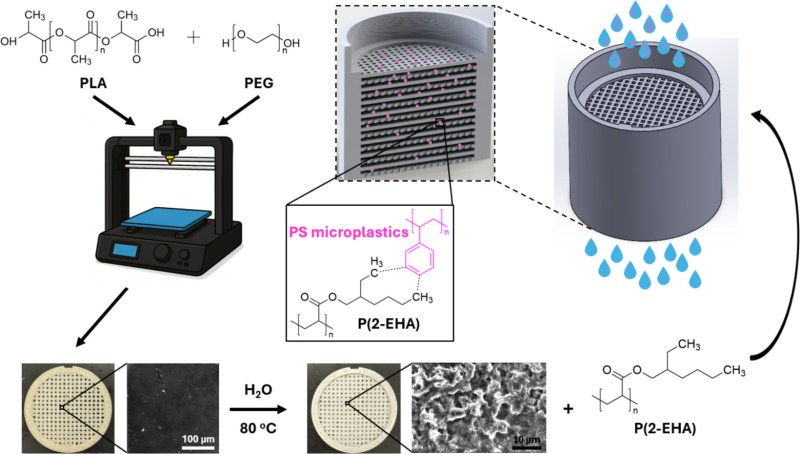
With the rise of synthetic polymers in everywhere from clothing, packaging and beyond, we have also seen a corresponding rise in fragments of these polymers in the environment. These micro- and nanoplastics (MNPs) come in a wide variety of sizes, but have in common that they do not break down very easily, leaving filtration as an important way to keep them out of our potable water sources. A recent paper by [Ethan A. Crawford] et al. in Separation and Purification Technology details a way to use a low-cost, 3D-printed filtration mesh to filter out up to 90% of MNPs using their prototype.
This prototype uses a multi-layer filtration system printed in PLA, creating a flow-through system in which polyethylene glycol (PEG) acts as a sacrificial additive to the PLA. Whereas creating the fine pores required for filtration of MNPs is impossible using FDM printing, the spheres of PEG that form inside the printed filter can be subsequently etched away using nothing but hot (80°C) water, leaving behind a porous surface capable of trapping fine particles.
These pores are characterized in the paper, with the PLA-PEG10 sample showing the best porous structure while maintaining structural integrity of the PLA material. With 20 layers of these filters a filtration efficiency of 90% was achieved, though as the authors note aspects like improving the system and potential reusability still have to be investigated.
We have previously looked at MNPs, including how little we know about how many of them really are inside our bodies right now, and how lab gloves may be contaminating test results.











Does the PLA itself not contribute to adding microplastics in the water being biodegradable?
If you can filter out far more than you put in, then yes, it could be cheap first stage/pass scrubber
PLA is only biodegradable under commercial composting conditions, meaning a temperature of at least the Tg at around 60℃. Since most MNPs are produced due to wear and tear, these PLA-based filters probably would contribute a negligible amount of fresh particles compared to the contaminated water that it would be filtering.
Makes sense, thank you!
Or does it contribute nanoplastics while removing microplastics.
Save the snail darters–but feed it to humans
https://www.acs.org/pressroom/presspacs/2026/august/this-cookie-started-its-life-as-a-plastic-bottle.html
Printing plastics (generating micro plastics) to filter micro plastics…
Are you serious?
Yes, read the data. Its free, the methodology is there as are fancy charts and numbers.
It is still silly. Cellulose-based filters cost practically nothing, can take boiling water with ease and are even biodegradeable. Why mess around with far from optimal materials when you can get coffee filters for <0.01 €/pc ? The only reason is that you cannot publish fancy papers about coffee filters.
Most coffee filters are also out of PLA. Which is “biodegradable” at a comfy 60°C and is otherwise just like plastic.
ok midwit
The polyethylene glycol (a synthetic man made polymer) is washed “away” but gets a pass because it’s soluble.
Polyethylene Glycol readily biodegrades and is mostly non-toxic. You would know that if you did one search engine search and skimmed some of the results and did not use scary man made polymer as your metric.
3d printed parts aren’t food safe either…
Mostly due to the additives in the materials and the metals used in nozzles. The fdm process itself is actually putting in so much temperature and pressure that the output is sterile.
this is dumb. like dumb with a b in it…
ok TDS
Ah, yes. The very strange attraction his followers have to him that makes it impossible for them to see his faults and the damage he is doing.
They see the faults and the damage just fine, they’re simply glad it is happening to you
And then there’s the story elsewhere about ocean life basically using plastics as a substitute raft and how removal would affect that.