
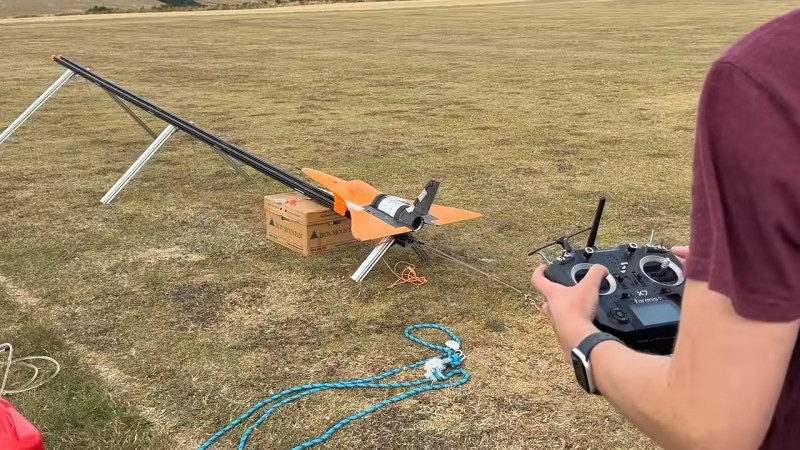
Building anything that flies from scratch is an ambitious undertaking, even if it’s ‘just’ radio-controlled. 3D printing the aircraft isn’t that odd these days, but putting a hot jet engine into a plastic airframe is another ambitous reach. Getting said 3D printed airframe up to the transonic speed of Mach 0.8? Ambition, thy name is Kingchaser. Or at least, that’s the name [The Mach Initiative] give to their very ambitious aircraft, the video about which is embedded below.
The airframe is largely 3D printed from PETG– that’s all the orange bits– but there are carbon fiber rods and an aluminum frame to help take up the strain. The black section around the motor is printed from PPS-CF– that’s Polyphenylene sulfide with carbon fibre–wrapped in carbon fiber to take the heat. This all builds off a smaller PLA version that’s already flown called Kingfisher, which claimed the title of the first 3D printed jet. That flight is on their YouTube channel, if you’re interested.
Now with a bigger aircraft and a much bigger engine– 300 N or 68 lbf of thrust– they’re going for the speed record. If they get even close to the design goal of mach 0.8, they’re absolutely going to leave the world’s fastest drone– a 626 km/h quadcopter we’ve written about— in the dust.
The switch to PETG from PLA, for the record, was to deal with the expected aerodynamic heating at that speed, about 990 km/h or 615 mph. An interesting detail many don’t bother with when it comes to 3D printed airplanes is that the skin has all been polished smooth, since skin drag is dominant at that speed regime. The video is just chock full of those little details that it takes to defeat drag and get to the record speed, and there’s more to come from [The Mach Initiative].
Speaking of remote controlled speed records, we covered another batch of brits take home the land speed record a few years back. May [The Mach Initiative] see such success!











Step 1: Choose an appropriate engine.
Step 2: Build a plane around it.
Step 1: imagine a butterfly as fast as a hawk
Step 2: reconsider
I mean, c’mon, think a bit. The issues with drag and heat emission in small craft, the limitations in efficiency and thrust in engines that size.
Reminds me of the MiG-29.. That basically was/is a rocket with wings.
I went down the rabbit hole of “has anybody tried to make a quadcopter with two pairs of contra-rotating micro gas turbines” the other day. The answer is yes, but it doesn’t really work well, because of course a turbine rotor is just not as insta-responsive as a BLDC motor, so it has a pile of ducted-vector thrust gizmos that spin around very frantically. But obviously it’s the only way you’ll ever get close to the speed of sound with a quad. Not that they have yet, but hopefully someday..
Still very very cool. Still kind of want one.
there were helicopters using ram jets on the tip of the blades. it worked, but was extremely loud.
i think it was the Hiller YH32.
Also falls victim to the fact that you can’t quickly increase or decrease RPM to provide attitude control
All that thrust and still slower than an unpowered glider
https://www.youtube.com/watch?v=GCVK3w5DHbk
What defines an RC model plane? Isn’t a supersonic target drone an RC model aircraft? If not, why not?
Good question, perhaps it is more linked to the usage of bombs, camera’s or honey?
But if I had to guess: if it has wings and is used recreational, “it’s an RC plane, it’s an RC plane” in all other cases it’s a drone?
The USA has some test and target drones that are supersonic. Some use rockets and some use jets. One uses a ramjet and has a speed of Mach3 to Mach4. Maybe these guys should try a ramjet for less weight and better transonic/supersonic performance.
Ramjets are nearly impossible to get to work in a size that small and they need to be supersonic anyway. A target drone would not be a model anyway. Getting something that size to mach 0.8 is feasible. I am curious about the jet engine being used. I know for a fact that high power rocket motors are available that could get that thing to that speed but, the big issue is will it survive aerodynomic loading. I know from flying rockets with 3D printed fins that subsonic is not an issue as far as aerodynamic heating is concerned. Velocity at mach 0.8 is about 600mph at sea level. You only need to exceed that for a couple seconds then slow down. There isn’t enough friction at 600mph to be a heat problem. The problem is drag trying to rip the wings off…
Next step build a model X1, drop it from a scale B29, if 1/4 scale a J class rocket motor could push it supersonic. Problem would be RC system and controls…
Do the testing in some New Mexico desert where ground level is 6500 feet. Model airplanes with ram jets were once popular. They used the Buzz Bomb style with a mechanical shutter. Not some inlet shape that produces a shock wave that acts as a one-way valve. I don’t know the upper limit of the mechanical shutters but that late war Spitfires had to dive to catch a Buzz Bomb at about 400mph at low altitude. I guess I should be saying pulse-jet?
In the UK, civilians are only allowed model aircraft of up to 25kg. I assume anything above that is classed as an actual aircraft.
Arbitrary yes, but it is an answer to your question.
(src: https://www.caa.co.uk/media/csmfqbs1/the-drone-code-march-2026.pdf)
Intent.
So they re-invented Geran drone.
Whatever.
Yep, it looks like it. I wonder if the Russians claimed the boom prize? Nice project though – I’d like to see at what speed the 3D stuff fails at. Also, looks like these guys could really do with a decent drill press.
Typical with content for content’s sake these days is starting with the abstract of ‘what click-worthy thing can we make/do with this latest bit of technology?’, rather than ‘we need to make/do this certain thing, what is the best technology to accomplish that?’
“content for content’s sake” is a big problem on YouTube, but I think you’ve misdiagnosed the issue. These guys want the boom prize and the YouTube content seems secondary to that. That it’s 3D printing is more of a “everything is a nail” thing. They’ve got it, they know how to use it, so they’re gonna use it even if it’s not ideal.
I didn’t mean this example, specifically. You did fine pointing out there was more to this project than just the ‘my only tool is a 3d printer’ content. It was the ‘could really do with a decent drill press’ comment that tweaked my little feelers.
I like model jet planes, I think they’re neat.
I think that the concept of clickbait has messed with your mind and made you incapable of interacting with things without cynicism
Yeah, it’s exactly the same! Just with a different aerodynamic profile, different manufacturing method, and over twice the speed.
Whatever.
RC glider reaches 548mph
https://m.youtube.com/watch?v=4eFD_Wj6dhk
The really cool part is how international the development effort is.
http://www.dskinetic.com/transonicdp.aspx
I read the title and assumed the jet engine itself was 3D printed. Of course its not. Isn’t it possible to make a relatively lightweight sheet metal/casted pulsejet? It seems like its the simplest kind of “jet”
Also
Lèse-majesté
“Integza” on YouTube, that’s one of his “bread and butter” pursuits. He’s made lots of them.
I wouldn’t call Mach .8 “transonic”. That’s about where airliners live, and they are not considered to be “transonic”.
Still, a neat build…
I don’t think there’s a firmly agreed upon definition (like R/C car) but aside from the often quoted “around the speed of sound” definition, if someone bothers to quantify it, I usually see +/-0.2 mach– that is, above Mach 0.8 and below Mach 1.2.
So they’re aiming to barely squeak in by that definition. That would put airliners firmly in the bucket as well.
Awesome project! Did anyone else cringe at the aerodynamics of those servo linkage covers? Also is it just me or does it have too much wing area? If I was going to do this project I would copy the design of a cruise missile, as those also use small turbines and fly at around the same speeds. They’re invariably just a cylinder with tiny wings. I wonder how much drag would be reduced if they went around and used putty to build tiny nacelles around the little screw heads and other small protrusions?
Most supersonic aircraft use a fully articulated elevator. The entire surface moves. This is because the shockwave moves the airflow back, off of the elevator and makes the aircraft uncontrollable. Hopefully you have already thought of that. Think of the secret of the Bell X-1 when they discovered that and attempted to hide the secret. Every conventional supersonic aircraft has one, but I am unfamiliar with the requirements for a delta wing like you are using. It worked for the Concorde, but they had a bit bigger budget to work with.
Transonic is where the aircraft is flying just below the local speed of sound but some part of the plane goes supersonic, usually the canopy or upper surface of the wing.
The air is forced over a protuberance that speeds up the air.
Mach 1 actual airspeed varies with altitude and air temperature.
Very cool. If they actually get transonic and get some local shocks the PETG may get hot enough to see where.
Design should be ok in relatively flat flight, but might lose power when pitching up too much due to the long nose and position of the engine inlet. Net effect will probably be for stall to come on sharply – worse yet if the drop in inlet pressure causes a flameout.