
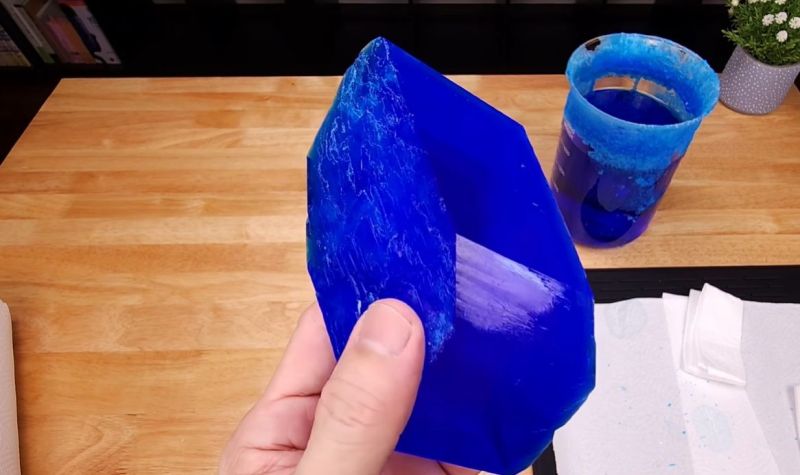
Copper sulfate crystals are probably among one of the prettiest crystals you can grow at home, with even just a simple setup with some copper scrap and vinegar already capable of producing lots of them. Yet what if you want to grow really big ones? In that case the [Crystalverse] has got your back, with a recent video that expands on an older blog post.
In lieu of the copper-and-vinegar approach you can also obtain copper sulfate directly, since it’s a common fungicide, rootkiller as well as drying agent. This means that your local brick-and-mortar retailer or favorite online store probably has a few kg of the stuff available for sale.
As with most large crystal growing procedures the key is to have a saturated solution, which for copper sulfate just takes near-boiling water, to create a mesmerizingly blue liquid if there are no contaminants in it. By adding slightly more copper sulfate there are also crystallization sites on the bottom of the jar to draw these away from your large crystal.
From there it’s the same as with growing other large crystals – even those from sugar – with a seed crystal suspended into the solution, along with a silent prayer to the crystal gods that said seed crystal continues to grow without any defects. One gotcha with copper sulfate crystals is that the intense blue color is largely due to the presence of water molecules. This means that once it dehydrates, it turns effectively white.
Also of note that is the slower the crystal grows, the better the result is likely to be. During the months that it takes for these large crystals to grow, you need to carefully manage the copper sulfate solution, remove competing crystals on the bottom of the container and keep the temperature as constant as possible.












Sorry, you can make copper acetate from copper scrap and vinegar, not copper sulphate. You need some sulfuric acid fior that :D
Could that solution flow through a 3D printer?
As a child I used to make experiments like that. I boiled the water in an old coffee can while adding the powder. Before it came to a boiling point, the bottom was rusted through, spilling the contents over everything… Just make sure it’s not caustic and damage your expensive equipment.
The iron in the coffee can displaced the copper in the solution, causing the bottom to ‘rot through’.
The iron in the can displaced the copper in the solution, causing the bottom to ‘rot’ through.
Good catch, seems my brain mixed up ‘blue crystals’ and ‘blue crystals’ :)
Now I need to know what the functional difference is between the acetate and sulfate versions, and which type of crystal is prettier…
SWAG: sodium hydrogen sulfate – sometimes sold as toilet cleaner or pool acidifier – may be sufficiently acidic to dissolve (slowly) copper metal without having to use H2SO4.
Be very careful Chalcanthite is one of tge most toxic crytsals
I would not be handling that with bare hands, copper sulphate is pretty toxic.
I can taste the accidental contamination already. (It’s bitter if you want to know)
Once you have made your crystal, can you preserve it?
Both to prevent it drying out (and turning white), and to hold in bare hands?
I’m imagining a coating of resin, but I’m not sure how the crystal would react to that.
At least in Pittsburgh Pa, that isn’t necessary. My son and I grew a large one a few years ago and just put it under a glass dome with a wooden base to keep dust off of it and it still looks the same. Perhaps in a dryer climate you would need to do something more.
I have a sizable one, preserved in brilliant blue, in a baby food jar. I think if you have a reasonable good seal on your container, the hydration issue becomes a much less serious problem.
Salt and sugar crystals are cheaper, safer, clearer, and with the help of some saffron or turmeric colouring, maybe even prettier
Would the same said solution spark the growth of any mineral introduced
Can I lick it? I must.
Also are they worth anything? I’m looking for things to make and sell on the internet
Vinager “acidic acid” makes copper acetate, sulfuric acid makes copper sulfate, hydrochloric acid makes copper chloride… this is not copper sulfate this is copper acetate.