
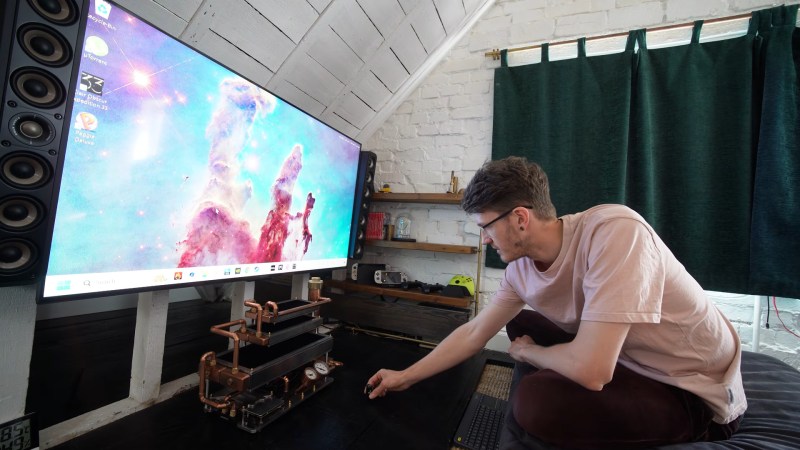
The discerning modern gamer’s quest is to find a quieter computer without sacrificing performance. That proves challenging when modern components are highly efficient at producing monumental quantities of thermal energy. So the typical solution ends up moving enough air through the computer to create a rather tumultuous racket. So why have fans at all? Well, as [Billet Labs] demonstrates, that’s not necessarily a good idea.
The build begins with a block of aluminum which, with a bit of hand-metal work, may become the base of the PC “case.” A dry-fit of the aesthetically modified parts taken from a previous attempt at a fanless PC reveals the steampunk aesthetic that defines the build. On final assembly, a large amount of thermal paste under the flex ATX power supply and 6mm of thermal pads under the motherboard provide passive cooling to the block of aluminum they are attached to
The cooling loop begins with three radiators: a big one, a small one, and a slightly smaller one. But raw metal PC radiators are difficult and expensive to come by these days. Some paint stripping and polishing will fix that problem. A few hand-made mounting brackets complete the aesthetic. All three radiators are stacked above the motherboard, and on top of each other, positioned horizontally to encourage passive airflow through them.
At this point, a normal PC would be plumbed up using standard flexible or, if you’re particularly ambitious, hard piping. But this is no normal PC. Instead, the plumbing uses household copper piping, soldered together. Two gauges sit near the front to show the water pressure and temperature. The reservoir is a larger diameter pipe with one end soldered onto a smaller pipe leading to the pump. The other end is a screw cap, with the corners machined off to match the pipe, to allow for filling of the loop. Soldering this took quite some effort because of the thermal mass in such a large pipe.
Once testing commenced, two issues became quickly apparent. The pressure gauge creates quite the racket as water flows past, and the stacked radiators are inadequate at cooling the PC. Rather show-stopping issues when the goal is gaming in silence. Was all this work for naught? No, the design proved the block of aluminum quite adept at cooling the motherboard and GPU. Moreover, adding a simple 120mm fan between the two smaller radiators and removing the pressure gauge effectively quelled the overheating and ticking issue. The result is a quiet (and quite pretty) living room PC with performance to match.












I seem to remember a story about a person who took a refrigerator and took the guts out of it or something. It was quite a few years ago but it was an interesting build. Also, there was a youtube video of a PC CPU chilled with liquid nitrogen to overclock the CPU to something like 8 GHZ. The problem has always been heat. It has to go somewhere. Scientists say our planet is getting warmer. Space is cold, but that would be one hell of a long ethernet cable. :)
Way back in the ’00s I built exactly one mineral oil aquarium PC, and threw the coil from an old minifridge in for good measure. It thoroughly soured me on the whole idea, but it was good to get it out of my system.
i had a similar experience with a fancy gaming rig, all the bells and whistles, except it broke down a lot and turned into a money pit. been building sff rigs ever since. a different kind of money pit, and i think the machines are a lot more stable for not flying so close to the sun.
https://www.youtube.com/watch?v=OFNUhE5FSs4
Liquid nitrogen to cool Pentium 4 CPU, fridge compressor to cool the north bridge.
Space is not cold.
It’s either remarkably cold or rather hot as determined by how much radiation you’re getting from your nearest star.
The matter in space has not enough density to apply the concept of hot or cold as we usually experience it. Effectively, no convection or conducting of heat away is possible, only radiation.
Space is a very tiny bit cold because there’s a very very tiny bit of stuff in it
Space may be cold, but it’s a great insulator. The space data center fad is idiotic. The thermodynamics just don’t work.
Only beyound Mars orbit. Around here, in the habitable zone, it’s betweeen toasty 100°C in direct sun-exposition and -100°C in a planetary bodies shadow.
Well, to be entirely accurate, the solar wind has a few thousand degrees and also our current neighbourhood’ interstellar gas* (aka a few atoms of dust and hydrogen per m2). But that’s just too less mass to have any thermal influence.
*https://en.wikipedia.org/wiki/Local_Bubble
a lot of people who never ran the numbers says the same thing, people who did run the numbers says the opposite. though id put the data center on the moon, use ground source heat pumps for cooling, regolith for radiation protection. so long as its nothing you need in real time you should be fine. given the moon is tidally locked, seems it would be easy to talk to the constellation of starlink satellites with the right kind of laser uplinks.
I wonder how well it would work to build a little venturi stack like a miniature power plant cooling tower, with all the heat at the bottom and try and get it to rise and accelerate a bit to get some fanless airflow. If it’s a dry house, maybe even make the water cooling open-cycle for evaporative cooling, use it as a humidifier as well. Probably don’t want the mobo underneath in that case…
Der8auer demonstrated that with a 240mm radiator (no fans) and a stack of 3D-printed chimney sections: https://www.youtube.com/watch?v=ZUG73BzZIJ4
Interesting. Straight cross-section, just adding more until it’s absurdly tall.. I wonder if a venturi would do anything significant to the results.
would increase the air velocity slightly and give you more flow. proper fluid modelling would be highly recommended.
just cries out for some engineering
Liked, Subscribed.
chimney cases coming soon.
The AC guys will tell you that you don’t cool anything, you just move heat around. Sounds like an annoying semantic argument until you’re working in it, and then, yep, so true.
Buoyancy pressure is dp = dT x height. If you want to lower dT, increase height! Build a chimney! No height, no pressure
A South Korea company attempted this waaay back early 2010. It was called NoFan. It was a giant radiator shape. It is an easy Google.
They tried even harder. No fan or pump, no motors.
Just heat pipes and convection
You can get a surprising amount of airflow with an esoteric technology known as a “chimney”
That sounds familiar … hmm…
https://hackaday.com/2026/07/31/using-the-chimney-effect-to-drop-passively-cooled-pc-temperatures/
Considering that my M5 Macbook Air with 32gb of RAM is currently running circles on my mid-range gaming PC (5500X3D, 32gb DDR4 3200 and 3070Ti) in the games i’ve been playing, i’ll say buy a M5 Mac Mini and remove the fan.
This is exactly the sort clever thermal engineering we should be encouraging. A “PC” with enough computational power to run open-weight AI models from Q2 of 2026 (8x NVIDIA H-200 GPUs + 1.8TB of DRAM) needs a dedicated 16,000 BTU mini split to cool it. Skip the air blowing around part, and you’re golden!
A active cooling radiator isn’t suitable for passive cooling, becasue that needs
* larger fins for more surface area
* a wider distance between fins
* vertical “channels” for convection cooling
And also no dust mesh in the way.
Put your PC in the next room, run your wires (if you need any), done. Duh.
Put the PC in a swimming pool. Just need enough mass, day night cycle takes care of the rest….
these days thats one usb-c cable. some monitors have kvm functions, one cable to rule them all. but id probibly need a hub (and a closet to put the computer in). given the proper living arrangement i think id just go rack mount for everything.
its amazing what you can do with a large thick radiator and a chimney. plenty of room for the mobo and gpu further up the stack. pumps, res, and rads in the base for optimal circulation. 6 feet of ducting, more if you have high ceilings (wall straps required). big intake filters. perhaps the future of case design. only moving parts are the pumps.