
America’s mad scientists all have one dream: DARPA money. The Defense Advanced Research Projects Agency regularly throws round sweet, sweet tax dollars to push the envelope on any number of things, leading to such spin-offs as the very network carrying these words to you.
Not every DARPA project ends in revolution though — like the latest DARPA Lift Challenge, the goal of which was to see the creation of a vehicle that could perform Vertical Take Off And Landing with a payload four times its own weight. We’ve embedded the ‘look back’ video below.
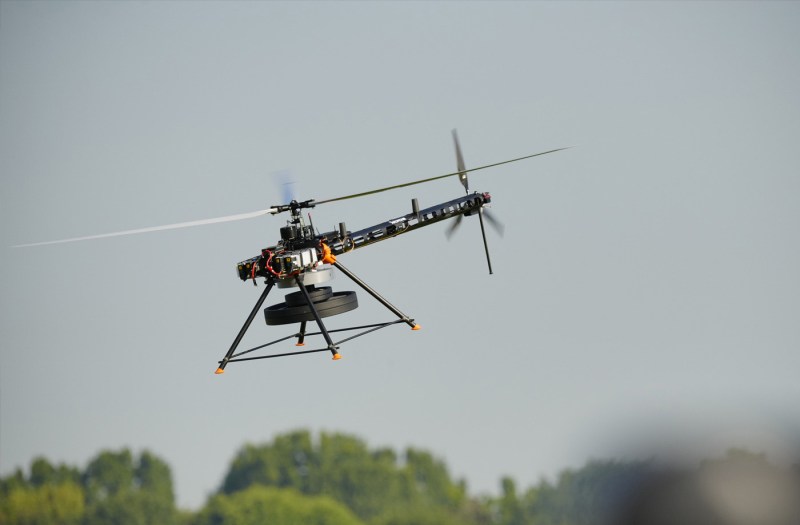
We hoped for something revolutionary, something bizarre, something really, really cool — and there were absolutely entries on the field that met all of those superlatives. But sometimes conventional designs are the convention for a reason, and the winning entry developed by AVIDrone was just a very well made electric helicopter. One big lift rotor, one little tail rotor. Aside from clever details in the solid-state batteries and carbon-fiber construction, it’s a totally normal aircraft — albeit one that can lift 3.84X its dry weight, or 112 lb of payload. Interestingly a battery-powered hexrotor drone took home second place with a 3.64:1 lift ratio. Perhaps the big shock was not seeing combustion engines until third place: another helicopter, this time with a turbine engine. So much for energy density!
Some of the other more bizarre — if less performant — entries did get prizes to further their development, so we’ll likely see them back for the 2028 version of the challenge. Some of the concepts visible were covered here on Hackaday, like turning the drone body into a giant lift rotor, so perhaps one of you will have the bright idea that brings home a million in the next round of the contest.












Oooh, like say antigravity lift. Worth a couple mil.
Dude. We don’t even have Alcubierre drive rocking yet. Hang loose on the gravity control physics, eh?
That would be worth a couple tril
Elaborating on this–if you made an antigravity machine, like any revolutionary propulsion device, it would by its nature also be a revolutionary weapon. Want to get rid of a continent or three? Find some asteroid, strap the machine to it, move it out to the Kuiper belt with zero tangential orbital speed, then turn the machine off with the proper timing. You just let the sun’s gravity accelerate it to planetary extinction event velocity on the way down. The energy needed to drop a perihelion suddenly goes from outrageously high to nothing.
And that’s only the destructive uses. If you totally remove the gravity well tax, many materials and commodities drop to nearly zero scarcity overnight. Well… it would take a few weeks or years to go out and get stuff, but it would suddenly be extremely easy. Relatively. Space is still hard, but the hardest part of it is gravity.
It would probably work for ground to orbit and back where local gravity has a greater effect the inertia. Beyond that you are still pushing things ‘uphill’, it’s just a different ‘hill’.
The way I see it, depending of course on exactly how the fictional device works, once you turn on the “gravity shield” you remove the centripetal force maintaining your orbit. Your lateral momentum thus flings you away from the sun in a direction tangential to that orbit.
You wait until you get to Pluto’s orbit, then switch the gizmo off. At this point, the distance is so extreme that the offset caused by your initial tangential momentum is a tiny rounding error compared to your distance from the sun. The angle between your vector of motion and the path back to the center of mass of the solar system is a tiny sliver. You more or less fall straight back down. Teeny tiny puffs from an RCS system would magnify to significant trajectory and adjustments at that distance.
Sounds a lot like the anti inertia drive, a plot device of E.E. “Doc” Smith in his Lensman books.
We are slowly mastering field manipulation
https://phys.org/news/2026-10-magnetic-sculpting-source-fields-predetermined.html
A.I. is doing a lot of work on math–here in the comments section, are some links I made with respect to macroscopic objects yielding to quantum effects:
https://www.nextbigfuture.com/2026/10/openai-makes-81-of-top-math-discoveries-of-the-last-three-years-released-in-one-day.html
If there is anything to field effect drives–A.I. will either reveal it soon, or rule it out altogether.
@Jeff Wright
If by “doing a lot of the work” you mean “stealing humans hard work” then yes, the plagarism slot machine is doing a lot of the work…
https://en.wikipedia.org/wiki/Navier%E2%80%93Stokes_priority_controversy
Oh yeah. A classic.
If anti-gravity was something that was possible then it would also mean you made a time machine and in fact you could manipulate the laws of physics over a wide range, which makes your suggestion what to do with it sound primitive.
But of course it’s all total nonsense.
Yeah, people rarely consider the full range of ramifications. It would be used for a lot more than just “sweet IRL star wars land speeder…” And yes I also badly want one of those, but unfortunately it ain’t happening
Anti-gravity possible?
https://m.youtube.com/watch?v=XKRMbVpJ3Rc&pp=ygUhc2FiaW5lIGhvc3NlbmZlbGRlciBhbnRpIGdyYXZpdHkg
https://arxiv.org/abs/2602.12266
You know that energy and power are different things, right? Lithium batteries and electric motors can have spectacularly high power-to-weight ratios while still having crap energy density compared to combustible fuels. Electric will win for instantaneous performance; liquid fuels will win for endurance.
I argue liquid fuels win on both accounts. Most people simply lack the ability to realize a high-power liquid fuel solution. It is far easier to adopt nearly-ready-made electronic solutions instead.
I want to see how “VTOL” is defined in this contest. If it doesn’t matter how intact the cargo is or where it goes, placing a grenade under the weight accomplishes the task nicely.
I seem to vaguely remember reading about something called ‘Orion’ which was supposed to be powered by atomic bombs…
Give a sufficient amount of shielding and shock absorption, that would be even better :)
Nuclear Salt Water Rockets would give a smoother ride, but have heating problems.
I like the idea of jacketed thrust…concentric annular aerospikes could use cooler methalox exhaust as the “nozzle” for dicyanoacetylene and FOOF propellants
NSWR paper
https://www.researchgate.net/publication/381162428_Studies_on_the_Nuclear_Salt_Water_Rocket_Concept_by_Means_of_One-Dimensional_Neutronic_Modelling_with_Thermal_Hydraulic_Coupling
Next Big Future had an article on fission-free “chemonuclear” fusion
Maybe hybrid computers can make headway into fields:
https://phys.org/news/2026-10-hybrid-quantum.html
Propulsion just doesn’t get enough love or money
This low level DARPA stuff is nothing compared to early NERVA tests.
Shock is a result of matter being propelled. Aside from the fissile material itself, there’s not much material to be propelled in space. Which would result in the Orion craft being mostly radiation-driven. Just like solar sails, except of carrying their own source.
Dani: the propellant for Project Orion was actually minuscule layers of the shield plate being flash-vaporized and ablating away with each blast of gamma rays. I think that ended up providing most of the thrust for the concept, with radiation pressure itself being a tiny contribution. If I recall correctly..
True, but the contest also had a distance/time aspect with defined maneuvering. Energy density is key under those conditions. Being able to pump out 1.21GW for one second will get it off of the ground, but won’t cover the course.
Why cover this but refuse to cover other, arguably more hacky/interesting, military tech?
Never seen so many silly concepts all in one place. Doesn’t anyone test their whacky idea before they get to the competition?
It was announced less than a year ahead of time, and the FAA limits drones to under 55 lb without special permission, so many teams were using their time in the competition to test how theirs flew at full load
It’s more fun if you save that for the big day
Lovely. I enjoyed watching the recorded test event
I thought the two tethered airplanes concept was pretty cool. Probably needs some better control software, I’d guess.
Go wingbody-rotor or go bust.
Aww…I was hoping for an electric synchropter ( K-Max ) rotor system – much better lift to weight ratio (and Kaman themselves build an AC electric version in the 1950s…though, just like all the bad jokes, it used a very long extension cord).
https://evtol.news/kaman-electric-helicopter
There was one. It did predictable things to its rotor blades.
You can see it at 2:20 of the video shredding itself apart spectacularly.
Would beamed microwaves be illegal? (Instead of batteries)
I don’t think it would work anyway, a tiny light drone would somehow receive a few amps of energy from microwaves? I mean even if you could concentrate such power over a distance in some imaginary scenario you’d fry the damn thing’s electronics surely.
…And you’d have a hard time making the hardware and shielding for such a setup weigh less than a lipo with just enough juice to take off and land again. That’s not going to be a significant portion of your mass. These aren’t long-range endurance drones or anything, they operate on fumes in the tank.
Not microwaves, but NASA ran a power-beaming challenge contest in 2009. LaserMotive won $900k in it.
Evolution won, again. The helicopter has been subject to a lot of selection pressure over the last century.
Couldn’t a rotor additionally utilize the coanda effect for more lift?
One could easily argue that electric won because the rules were written to favor it. Or at least to not penalize it. What if the course had been twice as long? Four times? Or if the development schedule had been twice as long? Or 4 times?
A concept I try to teach at my day job is conservation of stuff when it comes to peoples’ time, money, money, and energy. On a limited schedule, low risk configurations, (Tried and True), will usually win out, because they have already locked out the time part of the equation, leaving only energy (innovation and development effort) and money to play with. So it shouldn’t be surprising an electric helicopter won. Would I have predicted that before hand? No. :) Personally, I design jet engines for a living, so I would have liked to see one of the turbine entries win. But I also know how hard turbine development and integration are, so I had my doubts. I was actually surprised to see as many turbine entries as I did, given their development challenges over the modern combination high power density Li batteries, high power density BLDC motors, and high power density ECU’s.
Hmm, no Ukrainian entries?
I imagine those teams have more pressing concerns at the moment
I think DARPA already knows what those guys are doing – half of NATO are queueing up to buy Ukrainian tech / expertise or already stuck in helping them develop & build it.
The rules prohibed lighter-than-air, “baloons”?
In fact, by definition, they are the best possible.