
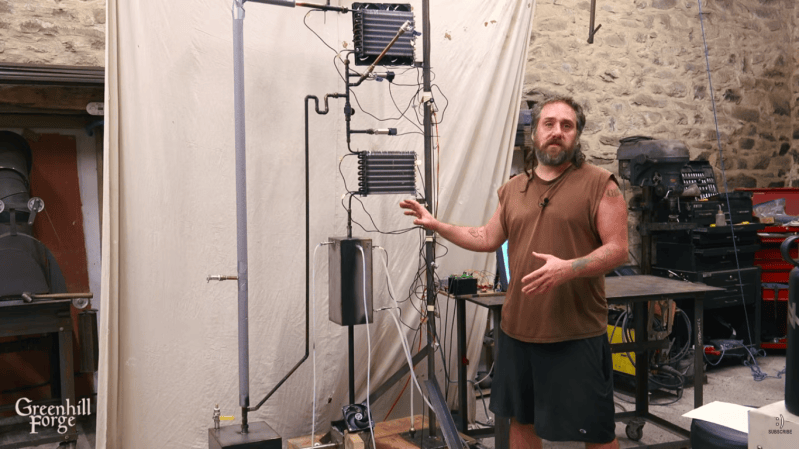
Refrigeration has been a challenge for humanity since the start. Ancient civilizations in dry climates like Persia and Egypt could use evaporative cooling on a large scale with specialized architecture, and with easy access to electricity modern civilization can cool down almost anything it wants. But whether in a refrigerator or heat pump, the electricity demands can get out of hand quickly, and heat-driven systems often require dangerous or hard-to-get chemicals. But [Greenhill Forge] has crafted a system that creates effective refrigeration with only fire and salt… and a bit of electricity.
Heat-driven systems are called absorption coolers. In this design, water is used as a refrigerant and forced to a very low pressure so that it can boil at a low temperature. When it boils it absorbs heat from the surrounding environment, and then that water vapor can be moved and condensed where it gives off that heat. The build has a few distinct loops to make all of this happen. The generator loop holds the heat source and a tank of water mixed with road salt. Boiled water travels up a tube to a condenser. A valve here is opened slightly to allow the water to drip into the absorber section, where it is under low pressure and boils rapidly. The vapor is carried away by the third system, which uses a shower of the salt solution to quickly suck up the vapor and move it away from the cooled area.
There is a small amount of electricity needed to run pumps and fans, but to keep this off-grid this requirement is easily met by a small solar panel or battery. The bulk of the energy is from the fire which boils the saltwater solution. [Greenhill Forge] added a number of temperature and pressure sensors to monitor and control the system as well, and in his firsts tests the refrigeration system was able to get to about 5° C with an ambient temperature around 16° C. That’s not quite the temperature needed for a refrigerator, but not bad for only salt and fire. [Greenhill Forge] has a number of other ingenious off-grid builds like this sawdust stove and a magnetic induction water heater.












Adsorption.
Not absorption.
I don’t think so. By definition, an adsorption cooler must use a solid to adsorb the refrigerant in the condenser phase.
This design appears to use a liquid (calcium chloride in solution), so it is in fact an absorption cooler, as stated, just an unusual one.
and that was supposed to be a reply to [Alan], of course.
We have distributed steam on the base where I work, and an electrical grid with 90 year old feeders. Every time we get asked by engineers about putting a new chiller in to feed a new building, we have the same reply. Fix the absorber in building such and such. The problem with 800 ton plus absorbers is that they take a lot of babying. They create lower delta Ts, but they do it to massive amounts of chilled water.
In turn though, a mechanic channeling a chef has to go through once a day and purge, check vacuum, do some specific gravity magic, etc. it’s a process that’s hard to automate, requires some nuanced auditory skills like listening to salt rocks tumbling in a barrel to ascertain salt concentration in both stages, has flammable gases, etc. But it requires SO much less electricity.
If only we had an industry sucking up water and power that wanted to take some of their waste heat and give it back to us as distributed hot/chilled water, might be nice. Be even nicer if they were mandated to do so and maintain the loop.
Shh.. That would mean more jobs created by that said industry..
You don’t actually want to create more jobs in an industry that doesn’t produce anything but lukewarm air.
If you think data centers do absolutely nothing then you might as well not use the internet or at least no streaming services or websites hosted by most of the big companies.
If you are suggesting purely AI data centers as completely useless then you haven’t paid any attention to the good that AI has done.
Voice-cloning helping an ALS patient.
https://www.youralsguide.com/voice-banking.html
Oh I’m more than happy to embrace all the good AI is capable of. My only problem is with the bad parts, especially the civilisation destroying parts.
The public good is very small next to the private profits and the overall waste of it.
What good is it to help an ALS patients when at the same time millions of others are thrown deeper into poverty and illness because of energy prices? Who do you want to save, and on whose expense?
Good? Good?!!?! Really doesn’t qualify, at least in comparison to the costs – It is an interesting tool that can work well in some niches, but its a bit like those prosthetic blade legs in reality (at least for now). Simply a really really bad idea to actively choose even if in the very very niche goal of running really fast on a flat grippy running track is improved vastly the inconvenience of fake legs 99.99% of the time is not worth it.
The costs of ‘AI’ as it stands are enormous to the point its insane in every way, but even if you just talk in money terms you have the spending rate to build it out that is in the same ballpark (if not vastly higher – estimates vary significantly) as the tax revenue of one of the most inefficient and wealthy so high tax income nations in the world the USA…
Just think how much more tangible good could be done spending even a fraction of that in really useful to the people areas in day to day life. Fixing and upgrading all the infrastructure, in many nations that hasn’t seen real investment since the 60’s at best! Or radical thought free healthcare globally, sure these ‘AI’ might have gone to help solve more medical problems faster, but with millions of folks round the world suffering from things we have already solved if only somebody would make the process available/affordable in to them – one is a clear and massive win, the other speculative and even if you do find cures for a few currently untreatable things they won’t actually be available to anybody but the super wealthy – hardly a win.
Maybe these ‘AI’ once the bubble pops and the pain that will go with it has past it will have left behind something worthwhile enough to keep using for ages, but that is a pretty huge gamble as so far the product produced really hasn’t been close to worth the costs.
Careful. Giving an excuse for a pointless activity is liable to create dependencies that are equally pointless.
Take for example: the state being addicted to taxes from tobacco sales, which are nominally justified for reducing smoking and paying for the public health cost, which they won’t set high enough to really impact tobacco sales or smoking because that would reduce the tax revenue.
AI datacenters are essentially nothing-mills that serve to waste energy and materials so their builders and operators could capture some to themselves. They are like punching a screwdriver through the gas tank of society in order to steal some of the fuel, while most spills on the ground. Making up alternative uses, like capturing the waste heat, doesn’t help anyone because it is still doing a pointless activity for little actual gain. The same energy could be spent much cheaper by directly heating whatever it is you want to heat, and the rest of us wouldn’t have to pay $500 for a stick of RAM.
Imagine if literally punching holes in people’s gas tanks to steal fuel was allowed, provided you could direct the spills to some halfway productive use, like heating homes by the gasoline fumes that rise out of the sewers.
Reminds me of:
https://www.bbc.com/news/articles/cvj6jkx6g1r0o
In reality they skirted the forestry act by trying to claim multiple smaller land use cases that would not individually trigger scrutiny. Now that the damage is already done, the authorities are left with the choice of losing a $15 billion investment or giving Google a symbolic slap on the wrist and letting the work continue.
The cancer has started to spread metastases outside the US.
If only we had district heating loops already in place like other countries where that heat could be distributed. I’ve looked into it many times more from the geothermal angle but America stopped building infrastructure to help the masses decades ago.
The heat from data centers is too low grade for district heating, which need the water at or pressurized slightly above boiling to have it remain hot enough by the end of the loop. Each building along the way drops the temperature, and once it drops below 50C it’s no longer useful for much. Some cities use the remainder for heating up roads. District heating loops are often not real loops – they don’t recycle the hot water because it would cost too much to build and the distance all the way back to the plant would leak most of the heat out anyhow.
Supposing you did put it in the district loop, a good amount of time the hot water would simply go all the way through, since the data center is running constantly while the heating demand varies. That’s the same reason why integrating renewable power like wind or solar into district heating loops is difficult: it does not follow demand.
I’ve often wondered why systems like this are not made directly solar powered given that demand for chilling would be highest when there’s the most energy available from the day ball.
He’s done some experiments with capturing solar heat, so that might be on the roadmap. It makes sense to use a more controllable heat source for the prototype, I think.
There have been tons of solar parabolic trough based solar adsorption coolers made over the years. They were very popular in africa in the 70s.
when using a standard 4 foot x 8 foot sheet of aluminium, using 2 one inch strips along the 8 foot side to secure the sheet, and adhesive to bond the sheet to a series of ribs cut with the proper parabolic curve, creating a trough with a 1m aperature, You get the equivelent of approx. 4,580 BTU/hr of usable heat which results in 825 watts or around 0.25 tons of cooling power per reflector
While you arent incorrect about peak cooling and peak heat coinciding, its fairly common to scale the system up and to use a storage medium to extend the functional period of these systems as thermal soak significantly extends the hours cooling is needed beyond the period of greatest insolation.
In fact, you can use ammonia and get an higher cooling efficiency with 0 electrical draw (you use gravity to move condensed liquid ammonia back to the burner and the vapor goes up naturally). This is what is inside all RV where the fridge is using gas to cool. No need to reinvent the wheel here, and badly, since all the issues in this build shows: salt water is highly corrosive, need for circulation fans and electricity, low cooling power, etc…
Experimenting with a DIY ammonia cooling loop at home seems to be a bad idea in my opinion, unless you have all the proper equipment and safety precautions. Also, for an off grid solution you want something simple that works without the need for “exotic” substances that most likely can’t be sourced locally.
Wasn’t there a corrosion problem inside the tubes?
I remember those from my childhood at the holiday home of some of my parents’ friends. The home had no electricity and I was very surprised that they had a big refrigerator. Always curious little me asked how that worked and was told it was gas driven. They showed me the huge gas tanks (almost my size) in a small cabinet outside the building and told the gas was used for heating, cooking, limited lighting (limited as they mostly used oil lanterns) — and cooling.
At that time I could not understand how they could cool something by heating it … still seems somewhat magic, despite knowing what goes on.
Adsorption.
Not absorption.
Five degrees C. = Best temperature for beer!
Not when it’s 16 C where you’re drinking said beer.
The reason why beer in the UK is served at room temperature is because the rooms are bloody cold.
The other reason is flavor. A well crafted porter or stout changes in flavor as it warms up from you holding it. Molecules like esters and phenols have plenty of extra electrons to bond and break to make new flavors and smells as the beer chemistry changes with temp.
Cheap American beer is sold at near freezing because it tastes like terrible bread at room temp.
I had a weird realisation. If you can control the pressure in the closed loop system, instead of controlling anything else, couldn’t you get a sort of control loop which is driven by the evaporation point of the liquid or whatever chemical that you are using in the loop.
I mean this would require absolutely no temperature sensing at all and physics would ensure that heat is pumped because the pressure ensures that the evaporation point is lower than the ambient temperature.
I guess this is a kind of thermostat in a way.
Yeah, it could be a simple closed loop with a constriction in the middle, so the pressure after the pump becomes high, and the pressure before the pump becomes low after the fluid passes through the constriction,
The high pressure part would heat up from the compression, and the low pressure part would cool down from the expansion automatically for as long as you run the pump. You just charge it up with a suitable fluid, like propane or butane that liquefies at room temperature under reasonable pressure and boils below room temperature in the reduced pressure, and bob’s your uncle.
I’ve seen recently a youTube video of a home made chiller that’s built from some copper tubing. It doesn’t need pumps or anything, the only moving part being a ball bearing that forms a one way valve. The energy source for this demonstration was a candle but even that was enough to rapidly cool a can of soda. The working fluid was butane; this type of refrigeration could easily be powered by the sun.
Incidentally, this reminds me of a puzzle that bugged me for years as a child. We lived for a short while in a part of the world that only had intermittent electricity so the refrigerator in the kitchen was an absorbtion type. As a four year old I was puzzled because my father had to light a small kerosene stove to get the fridge to make ice cubes. It took me years to figure it out.
I’ve seen those videos too; 99.9% of those channels with some guy’s hands building some clever contraption to copyright-free music (usually that one whistling song), are completely made up bunk.
I’ve seen those vids too. I have no idea if they are real or not. Kinda simple enough that you could probably build one easy enough to test if it does work or not. The problem is I have too many projects already to take on another one.