
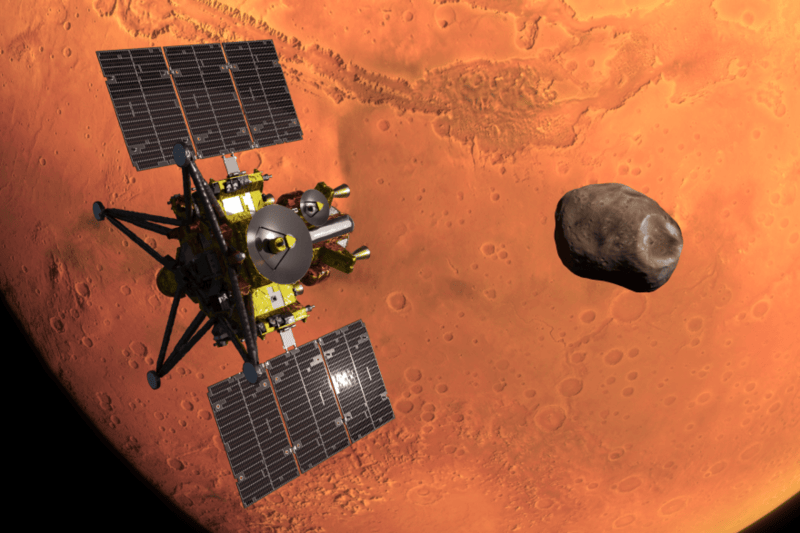
Although for many decades the planet Mars has been prodded, poked, driven upon, flown over and especially orbited by various spacecraft, landers and rovers sent over by a certain humanoid species on Earth, the two moons that orbit Mars have featured significantly more in science-fiction and video games than in scientific literature. This is now about to change when the Martian Moons eXploration (MMX) mission launches on October 19th, which will include a sample return from Phobos.
So far these two moons of Mars – Phobos and Deimos – have only received a few cursory glances by passing spacecraft, leaving many fundamental questions surrounding their formation and composition very much open. With the MMX mission this should change dramatically, with this spacecraft intended to perform detailed measurements of both moons.
In addition a rover – called Idefix – will perform a landing on Phobos for observations of its surface. This will be quite a feat as despite this lander coming in at 25 kg, on Phobos’ surface it will weigh only 15 grams due to the low gravity, or even less than the diminutive dog companion of Obelix, with potential bouncing as we have seen with previous landing attempts on such small bodies.
After launch, the MMX mission will take a year to arrive at Mars, in August of 2027, with Idefix being released in early 2029 for its hopefully soft paws-down on the surface of Phobos where it can scurry about for a while until the main MMX spacecraft lands later for its sample retrieval and return part of the mission. If everything goes well, this would mean that a sample of Phobos should be landing in Australia in 2031.












Oh mon dieu. It will be 25 kg anywhere in this world. The MASS is expressed in kg and the weight in Newtons. This is something 5th grader would learn forever in my country.
During the very middle of the RAMpocalypse we’re sending whatever little of precious silicon we have to be forever left in space. No wonder RAM and GPU prices are truly insane. A powerful gaming rig is now a luxury good -.-“
“A powerful gaming rig” always has been a luxury good.
the funny thing is that all that RAM and those GPUs are either in storage or unofficially promised but will probably end up sold for pennies on the dollar given the lack of a business model for LLMs. no, the $20/month you are paying for chatgpt is nowhere near enough to cover the expense of doing your inference. you would never pay the true cost. not financial advice: sell your nVidia stock
The cope is strong with this one 🤬
Officially promised. Production is booked out for a couple years.
What the hell is this gibberish
The whole crust of our planet is more or less made of silicon. Try again?
… huh
is it 15 grams mass ie earth weight or is it 15 grams weight under Phobos’ piffling gravity??
Lost in translation. Weight is not measured in grams.
The original article gets it right: “Idefix will only weigh the equivalent of 15 grams on its surface”. That would be a weight of about 0.15 newtons.
The implicit “mass as weight implies an equivalent at Earth” is really common – it’s easy if the context is obvious.
I get that people like to be pedantic and criticize stuff like this, but in actual practice engineers and scientists are super sloppy. Saying “equivalent of” all the time just serves to slow down communication.
Tell that to all the kitchen scales out there marked in grams. Tell that to all the weight scales, reading people’s weight in kilograms. Tell that to all the shipping companies out there, shipping stuff by the metric ton (1000 kilograms.)
The original definition of the gram was the weight of a specific volume of water:
https://en.wikipedia.org/wiki/Gram
It is officially a unit of mass, but the entire world uses it as a unit of weight.
With scales it’s a question of interpretation. Yes, most scales these days measure the mass via weight, but it’s just an implementation detail.
After all, they don’t actually measure the force, they measure the strain caused by the weight. Except that they don’t do that either, they measure the resistance in load cells, …
So from a weight-centric point of view, the scale that shows 1/6th in lunar gravity is working fine. From a mass-centric view, it’s broken and you need to use the proper Moon-calibrated one (or use balance scales).
Another example would be mercury or spirit thermometers. I’m not saying it’s 41 mm outside even if the column of liquid happens to be that tall, I’m going to say 5 °C.
I don’t know what you’re talking about. I do all my baking in units of Ohms.
There is a built-in assumption that the scales will only be used on planet Earth.
If you’re not operating under this assumption, you need to be more clear.
“In space, nobody knows your weight” coming to a theater near you!
ok so i didnt read that far, does that make the title click bait?
i am of the opinion that gram is mass. pound may be mass or force.
Weights 15 grams, huh? But how many lumens long is it? How many ohms did it cost to build?
Confusing weight and mass is supposed to be a disease of Americans and our foot-pounds-per-slug-degree-Rankine nonsense. I thought you were raised better than that. Shaaaaaame.
Being able to understand unit usage from context is a skill.
Clickbait…. Grams is a mass unit. Not Dependant on gravity. I read hackaday because I expect them to get things like this right…..
This is one those situations where the lesser-used SI prefixes can shine. Googling for Phobos gravity it seems we’re talking about 14 cN.
I’ve seen ratchet strap loads quoted in deca-Newtons, another fine prefix we could use more of.
why centinewtons, how much is that in dekanewtons or hectonewtons or yottanewtons or zeptonewtons
Let the “lesser used SI prefixes” die, especially the dopey ones near 10^0
And no, just because they’re powers of 10 doesn’t make it easier, if you have to Google the scaling, it doesn’t matter
We learned those in school (Finland). Just in case my education was a fluke, I asked my 15-year old and he rattled off the list from milli to kilo without pausing for breath.
Anyway, the joke was that cN is the closest thing to to a gram-weight-on-Earth (the usual 2% off) and daN is the same for kilograms.
Maybe the superior American education is defeating my puny metric mind, but I’m pretty sure that 25 kg on earth is 25 kg on any moon as well as in freefall.
Goal achieved, maximum comments for minimal effort.
and after all this commentary about grams not being a measure of weight, but mass…. no one has asked why it is harder to make something fly if it weighs less.
“sorry, we couldn’t take off because the plane was not heavy enough” said no pilot ever.