
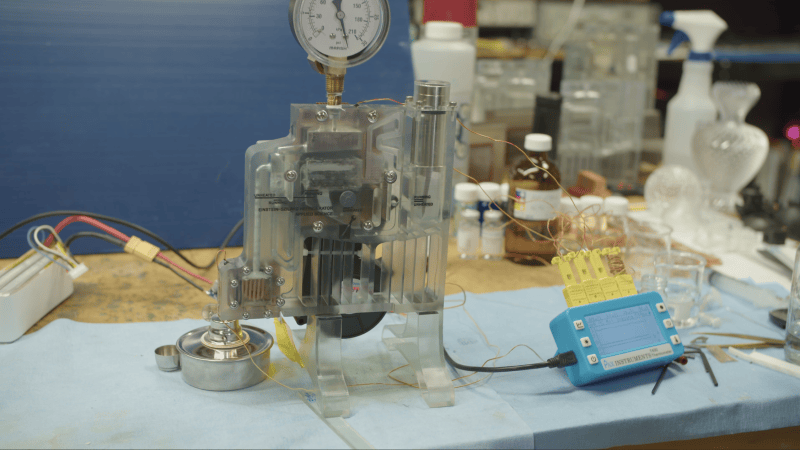
A clear plastic block is shown on a workbench. The plastic block has channels running through it, with liquid flowing through the channels. A pressure gauge is mounted to the top of the block, and an alcohol burner is placed near the base.

3D Printed Einstein-Szilard Refrigerator Cools With Fire

They may not deliver the highest efficiency, but absorption refrigerators have earned a persistent place in camper vans and industrial plants thanks to a few distinct advantages: they can operate using waste heat alone as an energy source, and they can be quite reliable due to their lack of moving parts. It can be a bit hard to understand their working principles, though, which is why [Ben Krasnow] built a transparent Einstein-Szilard refrigerator.

Most absorption refrigerators use ammonia and water as their working fluids; since the ammonia gas needs to condense at room temperature, the refrigerator requires pressures above what can be comfortably held in a glass or plastic enclosure. The Einstein-Szilard design, by contrast, uses a third liquid as its refrigerant. A strong solution of ammonia in water is separated by boiling, and the ammonia gas induces the refrigerant to evaporate by decreasing its partial pressure. The refrigerant and ammonia gasses then mix with water, in which the ammonia dissolves, leaving the refrigerant vapor to condense and start the cycle again. The newly reformed water-ammonia solution flows back into the boiler.

The refrigerant is usually butane, but since [Ben] was powering this pressurized system with an open flame, he opted instead for nonflammable perfluoropentane. The refrigerator body itself was 3D printed in clear resin, with a copper block transferring heat from the flame to the boiler chamber; ammonia solutions do dissolve copper, so this isn’t a long-term solution, but it works for a demonstration. The single internal path of the refrigerator presented some difficulties: since almost no pressure builds up between different parts of the system, a bubble in the wrong place can easily airlock it. In the end, [Ben] managed to get it working well enough to reach five degrees Celsius below the ambient temperature. Conveniently, he notes that, for alcohol at a sufficiently high concentration, you could cool your drink by burning a portion of it.

Ammonia-based refrigerators are a tough build for most hackers, but we have seen a salt-water-based absorption refrigerator before. For more less-known refrigerators, check out our article on strange cooling methods.

Continue reading “3D Printed Einstein-Szilard Refrigerator Cools With Fire” →
Off-Grid Refrigeration Using Fire And Salt

Refrigeration has been a challenge for humanity since the start. Ancient civilizations in dry climates like Persia and Egypt could use evaporative cooling on a large scale with specialized architecture, and with easy access to electricity modern civilization can cool down almost anything it wants. But whether in a refrigerator or heat pump, the electricity demands can get out of hand quickly, and heat-driven systems often require dangerous or hard-to-get chemicals. But [Greenhill Forge] has crafted a system that creates effective refrigeration with only fire and salt… and a bit of electricity.

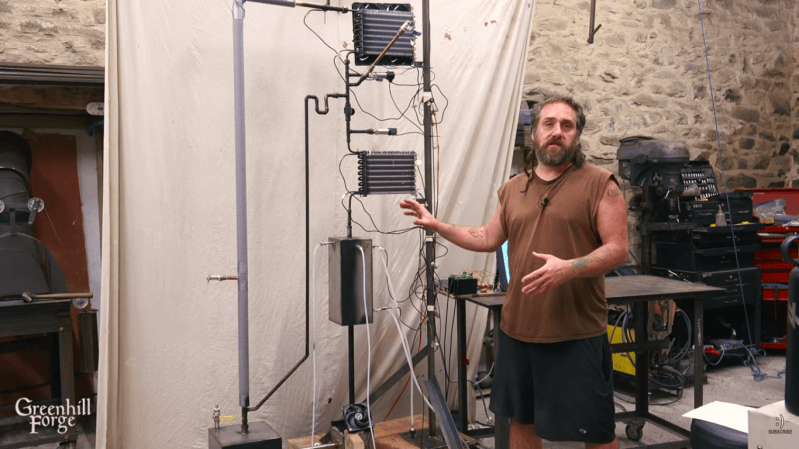
Heat-driven systems are called absorption coolers. In this design, water is used as a refrigerant and forced to a very low pressure so that it can boil at a low temperature. When it boils it absorbs heat from the surrounding environment, and then that water vapor can be moved and condensed where it gives off that heat. The build has a few distinct loops to make all of this happen. The generator loop holds the heat source and a tank of water mixed with road salt. Boiled water travels up a tube to a condenser. A valve here is opened slightly to allow the water to drip into the absorber section, where it is under low pressure and boils rapidly. The vapor is carried away by the third system, which uses a shower of the salt solution to quickly suck up the vapor and move it away from the cooled area.

There is a small amount of electricity needed to run pumps and fans, but to keep this off-grid this requirement is easily met by a small solar panel or battery. The bulk of the energy is from the fire which boils the saltwater solution. [Greenhill Forge] added a number of temperature and pressure sensors to monitor and control the system as well, and in his firsts tests the refrigeration system was able to get to about 5° C with an ambient temperature around 16° C. That’s not quite the temperature needed for a refrigerator, but not bad for only salt and fire. [Greenhill Forge] has a number of other ingenious off-grid builds like this sawdust stove and a magnetic induction water heater.

Continue reading “Off-Grid Refrigeration Using Fire And Salt” →









