
Off-Grid Refrigeration Using Fire And Salt

Refrigeration has been a challenge for humanity since the start. Ancient civilizations in dry climates like Persia and Egypt could use evaporative cooling on a large scale with specialized architecture, and with easy access to electricity modern civilization can cool down almost anything it wants. But whether in a refrigerator or heat pump, the electricity demands can get out of hand quickly, and heat-driven systems often require dangerous or hard-to-get chemicals. But [Greenhill Forge] has crafted a system that creates effective refrigeration with only fire and salt… and a bit of electricity.

Heat-driven systems are called absorption coolers. In this design, water is used as a refrigerant and forced to a very low pressure so that it can boil at a low temperature. When it boils it absorbs heat from the surrounding environment, and then that water vapor can be moved and condensed where it gives off that heat. The build has a few distinct loops to make all of this happen. The generator loop holds the heat source and a tank of water mixed with road salt. Boiled water travels up a tube to a condenser. A valve here is opened slightly to allow the water to drip into the absorber section, where it is under low pressure and boils rapidly. The vapor is carried away by the third system, which uses a shower of the salt solution to quickly suck up the vapor and move it away from the cooled area.

There is a small amount of electricity needed to run pumps and fans, but to keep this off-grid this requirement is easily met by a small solar panel or battery. The bulk of the energy is from the fire which boils the saltwater solution. [Greenhill Forge] added a number of temperature and pressure sensors to monitor and control the system as well, and in his firsts tests the refrigeration system was able to get to about 5° C with an ambient temperature around 16° C. That’s not quite the temperature needed for a refrigerator, but not bad for only salt and fire. [Greenhill Forge] has a number of other ingenious off-grid builds like this sawdust stove and a magnetic induction water heater.

Continue reading “Off-Grid Refrigeration Using Fire And Salt” →
Road Salt? Bah! New Roadway Material Promises A Better Solution To Snow And Ice

If you’ve ever lived somewhere it gets properly cold, you’ll know that winter’s icy grasp brings the inevitable challenge of keeping roadways safe. While road salt and gritting have long been the go-to solutions, their detrimental environmental impact and the potential for infrastructure degradation are well-documented.

However, a game-changing new development might just offer a brighter, greener solution. Just imagine it—roads that stay ice free without requiring regular attention. 

Continue reading “Road Salt? Bah! New Roadway Material Promises A Better Solution To Snow And Ice” →

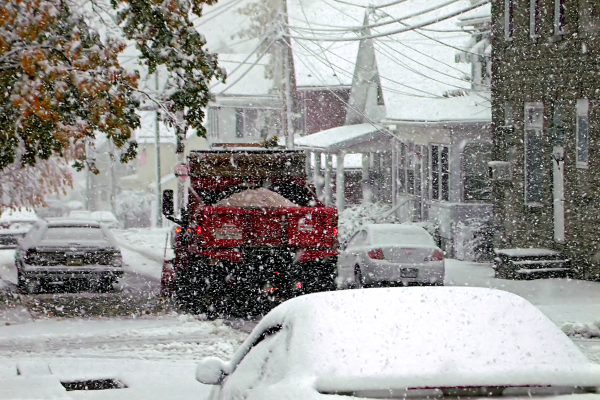
An snowy city street.

The Road Is Peppered With Rock Salt Alternatives

Every winter, millions of tons of rock salt is sprinkled across roads in the US, mostly in the Midwest and Northeast regions. It’s a cheap and effective way to prevent accidents. Rock salt is chemically the same as the stuff that sits next to the pepper, except it isn’t as finely ground, and it doesn’t have sodium or potassium iodine added to it to prevent goiters. Both table salt and rock salt melt ice by lowering the freezing point of water. So does sugar.

Much of what we salt the Earth with every winter comes from underground networks of salt crystal that formed when various ancient seas dried up. As natural as it may be, rock salt is bad for the environment. For one thing, chloride is forever, and can’t easily be decoupled from the soil and water it taints when it washes away. Rock salt also corrodes concrete, makes its way into the groundwater, and is bad for pets. Worst of all, its efficacy drops along with the temperature. At 15° F (-9° C), rock salt loses more than 86% of its melting power.

Disposable Detroit

All this salt is not great for cars, either — it’s bad for the paint and eats up the frame. In the saltiest parts of the US, aka The Salt Belt, cars only last a handful of years before they become Flintstones mobiles. Well, not really, but salt is terrible for the brake lines and most of the undercarriage. Consumer woes aside, there’s a real environmental impact to manufacturing all these disposable cars to meet the demand.

But the problem is that we need to use salt, or at something like it. Even though millions of people are staying home a whole lot more, the trucking industry still relies on salted highways and local roads. So if you like stocked grocery stores and stuff arriving from the Bezos Barn in a timely fashion, you can see the problem. So what are the alternatives? Are there any?

Continue reading “The Road Is Peppered With Rock Salt Alternatives” →