
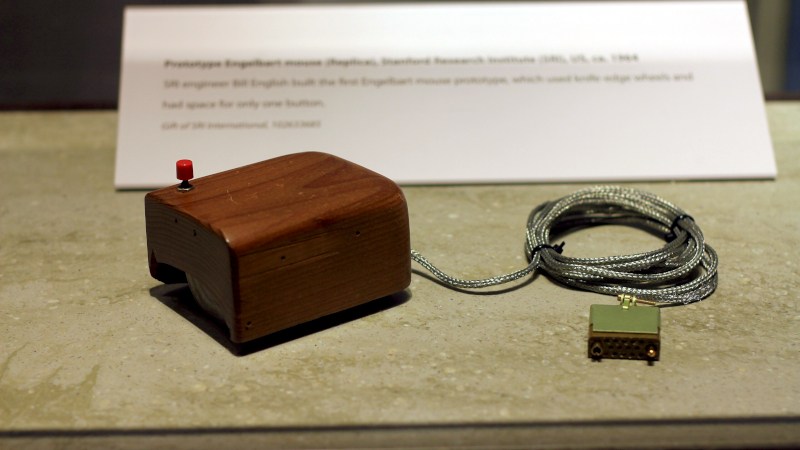
Many readers will be familiar with Douglas Englebart’s 1968 so-called “Mother of All Demos”, in which he described many of the devices and technologies we would be using two or three decades later. Among these was a primitive computer mouse, but while famous it was by no means the earliest pointing device. At the recent Vintage Computer Festival Berlin, [Dmitriy Kostiuk] delivered a fascinating lecture of the history of the pointing device.
It’s a long video that we’ve placed below, and it’s an exhaustive examination of the topic from the earliest examples to the 1990s when mice became commoditized. It’s a surprise to find that the first pointing device was a trackball built for a 1950s Canadian warship, with a surprisingly modern-looking optical encoder. Englebart’s 1966 wooden block with its pair of wheels and potentiometers had a less-well-known and much more stylish competitor in the same year from Telefunken.
We visit the various design iterations as the form of what we’d call a mouse today took shape. It’s unexpected to find that those Sun mice with the spotty mouse pad weren’t from Sun at all, they were from Mouse Systems. The first mice from Microsoft and Apple make an appearance, as do some awful designs for 8-bit computrs. Remembering those in particular perhaps it’s as well we didn’t have the cash to buy such a disappointing product for ourselves.
The video is long, but interesting. Give it a watch.
Header image, Douglas Englebart’s prototype, Michael Hicks, CC BY 2.0.











May favorite part in the mouse history is “Pirates of Silicon Valley [1999]: Xerox NYC Rejects Palo Alto’s GUI & Mouse” https://www.youtube.com/watch?v=R0j7zdVJnus
Want to post it again?
The Telefunken 1968 ball mouse:
https://www.e-basteln.de/computing/rollkugel/rollkugel/
It was a commercialized product, not a prototype.
Interesting design decision to put the button square on the top and center… Wonder what that feels like
From a small hole in the wall 😲
I’ll let myself out……..
Through the small hole in the wall?
My favorite part of the history was in the Pirates of Silicon Valley:
https://www.youtube.com/watch?v=R0j7zdVJnus&t=1s
To German readers, the title is “Die Silicon Valley Story”.
Now to be confused with the “Die, Silicon Valley!” story.
My favorite part of the history was in the Pirates of Silicon Valley. It’s on YouTube: “Pirates of Silicon Valley [1999]: Xerox NYC Rejects Palo Alto’s GUI & Mouse”
(Looks like I cannot post Youtube links here anymore)
I watched the whole thing, but i had seen almost all of the mice before from reading blogs. those old sites are mostly dead or dying now which is sad, but i cannot expect things to stay forever.
I did have an idea for a capacitive trackball, so i asked chatgpt and it suggested curving a pcb into a ball shape, coating it with resin. there wouldn’t be any point, apart from curiosity.
My mouse (XL-755BK) came from A4Tech company in China. It was manufactured around 2007 and I still keep it in perfect working condition by replacing faulty switches every few years. Used it when I was a teenager playing
de_dust2andcs_italyon CS 1.6 v23 downloaded from cs.rin.ru. Used it for making SolidWorks projects at the university. Now I’m a Senior Embedded Software Design Engineer working at Sii Poland and this mouse serves me just as good as when I was a teenage wigger listening to NWA religiously.I got invited to Douglas Engelbart’s private wake which was attended by the who’s who of the creation of the Internet.
Everyone parked at a local school and then went in little groups by van to the estate where the wake was held. I rode up with the former director of AI research at SRI and his wife, and when we reached the gate at the bottom of the road up to the estate there was an older gentleman waiting. The former SRI director said, “Hey! There’s Bill!”
We stopped and Bill got in the van, sat down next to me, and introduced himself, “Hi, I’m Bill English.”
I shook his hand and in that moment realized I was shaking the very first hand to ever touch a computer mouse, because that hand carved the first mouse out of a block of rosewood. Mind blown.
The other fact I learned that day and directly from Jake Feinler herself, was that the SRI scientists smoked a lot of weed on the weekends together and they also took a lot of synthetic mescaline. I’m guessing the mescaline came from the very same SRI research program which gave us One Flew Over the Cuckoo’s Nest, the Merry Pranksters, the 1960s San Francisco psychedelic scene, and the lyricist for half of the Grateful Dead’s songs. Visions from those SRI scientists taking those substances gave us the Internet, according to the woman who was both Google and GoDaddy when that was a one person job.
One event that I don’t feel gets enough respect in the annals of pointing device history is the debut (and widespread availability) of the click/scroll wheel. Coming, as it did, hot on the heels of the WWW and the first browsers, I’m not exaggerating when I say that it completely revolutionized the way I interacted with content on screen.
Being able to quickly scroll through a document without having to move the mouse, and with middle click on web links bound to “open in new tab”, my browsing habits evolved from navigating pages/sites to “spidering” them. The tension inherent in every web link (do I go to this new page, or continue reading the one I’m on?) instantly vanished in favor of sending interesting links to load in background tabs for later perusal. Which meant I actually started reading through entire pages without getting diverted down some rabbit hole by the first interesting link I came across.
+1 on that comment. I still find it superior to Apple’s Magic Mouse. And you can get a fairly good one on a $20 mouse.
To someone who grew up with Windows 3.10 on an 16-Bit PC with a Genius Easy Mouse that’s quite a statement.
I mean, I didn’t even had a Windows key on my PC/AT compatible Cherry keyboard.
And the third mouse button on my serial mouse was largely unused, as well.
To scroll up/down quickly, I simply used page up/page down buttons on the keyboard.
Personally, I think that the “trackball” was very underrated!
No, not that thing on the 486 laptop. The real one. The big one sitting next to the keyboard! 😃
The trackball was such an elegant solution, a fine alternative to the mouse.
Too bad it became/stayed a niche.
I started with a C= 64, then moved to an Amiga 2000, so my first mice were 2-button, mechanical-ball affairs. Then at school the Sun workstation labs introduced me to both 3-button and optical-tracking mouse features. (Though Sun’s mirrored mousepads were their own special kind of hell.) Systems where the GUI was run on top of X11 also featured middle-click paste, another feature I quickly found I couldn’t live without (even enabling chord emulation of middle-click, when stuck using a mouse with the 2-button setup that was still far more common at the time.)
So, that’s where I’m coming from: I’ve been there almost from the beginning. Since they became widely available in the mid-1980s, a mouse has been central to the UX of every computer I’ve owned or used. I saw every iteration and evolution that followed. By the time the first scrollwheel mice came along, I had more than a decade of history with their predecessors. And I will still assert, unequivocally, that the impact of the click scrollwheel on the desktop GUI paradigm was seismic like nothing before or since.
For two main reasons; one universal, and one, perhaps, more specific to my situation (and many others’).
First: The PgUp / PgDn keys were created at a time when computer terminals were typically limited to displaying uniformly-sized lines of text. Those keys are optimized for that format. (And, indeed, when I’m in a terminal window I exclusively use Shift+PgUp / Shift+PgDn to scroll — I never touch my mouse for any reason, because the text terminal is a keyboard-optimized interface.)
But throughout the 1980s, computers gained the ability to create and display documents with increasingly complex, non-uniform layouts. Rather than being text-only, documents featured charts, graphs, and images interspersed with the text content. A variety of typefaces in a range of font sizes facilitated headings and caption text, pull quotes and sidebars, and all sorts of other features for more visually dynamic document presentation.
And in the context of those features, keyboard PgUp / PgDn scrolling is suddenly inadequate. Jumping up and down a document in increments of one screen-height at a time means headings, images, and illustrations regularly get bisected by a screen border and awkwardly split across two “pages”. So, long before the wheel mouse appeared, already scrolling mostly involved left-click dragging a scrollbar up and down at the edge of the window. But when the scroll wheel arrived, the same fine-grained vertical motion could be achieved without having to move the pointer to the scrollbar or click and drag any part of the interface. The scrollbar moved all by itself, as if by magic. Scroll wheels created an entire society of telepaths who had the power to move a window’s contents with our minds.
The second reason wheel scrolling was so impactful is more specific to X11-based GUIs. On Windows and Mac OS at the time, and to some extent even today, scrolling a window begins with a left-click. Whether you want to use PgUp / PgDn, the scrollbar, or the scroll wheel, typically you have to first click somewhere in the window to activate it and focus the scrollable content.
But nearly every X.org/Wayland window manager offers, at least optionally, some version of a hover-focus feature, where the wheel will scroll whatever scrollable widget is underneath the pointer. And typically that mode can be configured to operate without raising the hovered window. So, picture this. You’ve got your document editor open to write something, and there’s some reference material you’re reading in another window. Maybe they’re kinda side-by-side but a bit overlapping, maybe the reference is fullscreen and the editor is in front of it.
Properly-configured, you can keep keyboard focus in your document editor, never losing your place as you’re writing. Whenever you need to scroll the reference window, you just slide the mouse pointer from the editor to the reference anywhere within its window borders. Then you spin the wheel upwards or downwards, and slide the pointer back inside the editor window to continue typing. You never once have to click the left button for anything, and you never have to deal with the reference window raising up to cover your editor or stealing the keyboard focus away from the document you’re typing into.
Total game-changer. Like nothing before or since, in the realm of pointing technology.
Makes me kind of want to carve a wood shell (with a silly button jutting out the top) for a modern bluetooth mouse’s guts. What would a period-correct scroll wheel be? A disc of knurled brass?
There was a graphics terminal available commercially in very late 1969 that had a mouse, graphics tablet and joystick for under $8000 at the time.
This was the Computer Displays Inc. ARDS 100A, here is an ad for it in DATAMATION December 1969:
https://archive.org/details/bitsavers_datamation_42955706/page/n17/mode/2up
Thank you! 🙂👍