
When it comes to abiogenesis, i.e. the formation of the first biological cells on Earth, there are many theories on how this got kickstarted. One of the more popular theories involves the primordial Earth being seeded with the organic building blocks by comets hurtling through the atmosphere. Although organic compounds have been discovered on such comets, the question of whether these compounds could survive hurtling through Earth’s atmosphere and the rapid deceleration upon impact remained unanswered.
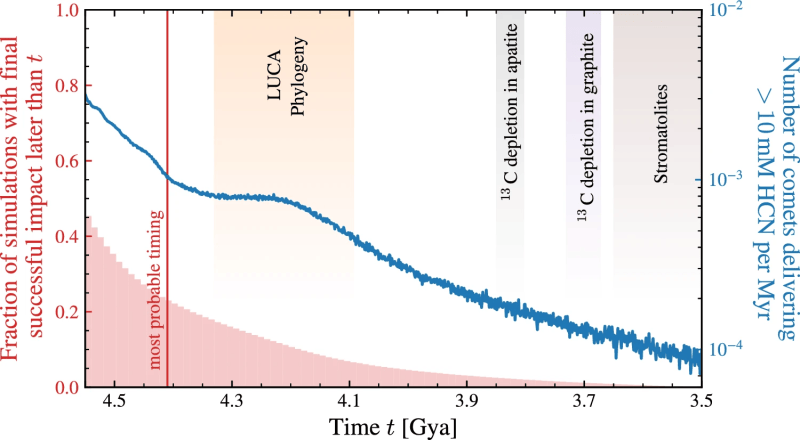
Now a study by [Richard J. Anslow] et al. in Scientific Reports posits that the answer here is a very probable ‘no’. Using detailed cometary impact simulations and our current understanding of the formation and presence of these volatile organic molecules on comets it was found that the possibility of such molecules surviving the impact was extremely low.
The focus here was on hydrogen cyanide (HCN), with simulations showing a negligible amount of it surviving to make it onto Earth’s surface. Naturally from there other influences like hydrolysis will further dilute and degrade such molecules, making their effect on any biological activity highly unlikely. Meanwhile this comet-based delivery method was much more effective on a historical Mars – one capable of retaining liquid water – with more than five times successful deliveries of HCN.
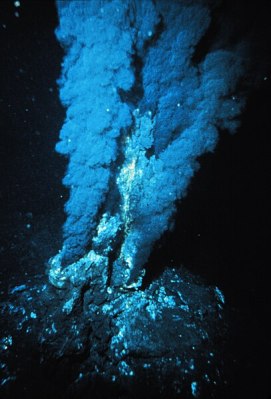
Realistically, the much more likely source of such ingredients and the energy for the formation of the first biological cells on Earth would have been found near hydrothermal vents, which even today provide a rich mixture of chemicals that sustains entire ecosystems that are quite unlike those found here on the surface. For smaller planets like Mars the cometary route could however been a viable method for biological activity, which provides exciting prospects for similar bodies like Europa once we start exploring its oceans.












I think the day humans crack this puzzle is going to be a terrifyingly amazing day. I await biological utilities and machines and tools that will replace current mechanical ones. The biological “toy” creatures made by Sebastian in Blade Runner (1982), I think they were named Bear and Kaiser? Something like that.
Unrelated but the process of “abiogenesis” (thanks for the new word) always reminds me of this one russian YouTube video series titled “homonculus” that I watched years and years ago. It was about a man injecting errr a “fluid” into a chicken egg and documenting a creature developing within it. Needless to say, it was fake but highly entertaining.
Literally everything arrived by comet.
I wonder where all the phosphorus came from? Is Earth’s orbit just where most of that element settles out in a protoplanetary disk?
A lot of terrforming schemes do not account for phosphorus. Even if we could manage to change Mars significantly and keep its atmosphere from blowing straight off in the solar wind again (no magnetosphere) we’d have to export every bit of phosphorus to make up every strand of DNA in every life-form. There is no native source. And all the phosphorus exported from Earth would mean that much less life here. It’s kind of the fire code limit for the solar system, you can’t have more life than you have phosphorus. Unless it’s non-DNA-based…
Nevermind I’m totally wrong, Mars has 10x the amount of phosphorus in its crust lol
Evolution/biology can only take you so far back, chemistry only so far forward.
For them to meet requires fluid mechanical forcing.
Look at the smokers in the photograph above.
I think those are nature’s version of the UNILEVER nozzles described in the TED TALK here:
https://www.leaneast.com/god-complex-mistake
The ironic thing is that this trial and error process actually worked better than intelligent design, in that an engineer actually tried to design the nozzle but failed.
Long ago, tides were more severe…there may have been more smokers.
The plumes are updrafts…like thunderstorms.
Each smoker is a little different…just like the encrustations in your faucet.
In severe weather, the tornado can form. One in Minnesota back in 1986 looked to have a double helix shape.
It might be that one smoker–for a brief time–developed in such a way as to spin up DNA perhaps….a piece breaks off, encouraging more vorticity.
A quiet planet can have oxygen and water–snd be sterile. Good for us, but not for abiogenesis.
Violent planets are better for spawning life, but aren’t good for complex life like us.
It could be that vorticity is key.
The warm pond model just seemed to be one religious concept replacing another.
Vortex action kicks things off–then things get splashed by huge waves into soda lakes/ponds so the ocean doesn’t break it apart again–THEN the pond model takes over.
Vortices might also be good for fusion.
The 1986 MN tornado experienced vortex breakdown that causes multiple vortices. But when the breakdown bubble was just above the ground, you had one super concentrated suction vortex.
A non magnetic way to focus plasma?
Maybe rocket nozzles need that Unilever deal. RATLOG has a rocket engine that will have far fewer parts because the whole engine spins.
That could be a hub for rotating stations or used as a Sterling engine or gyroscope
What, no, proto cells had no cell core. And DNA only rellay started to matter, after cells invented propagation & death. Even now, most things regulation ae still in RNA, DNA is only used for storage, due to it’s complex splicing. Similiar to a tar archive.
Also of note that early forms of life evolved soon as the earth crust cooled down enough and the complex intricacies of cell metabolism are the result of multiple mergers of proto-cells over the span of billions of years.