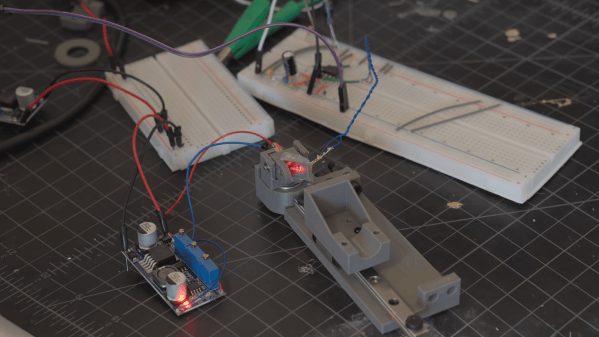
For measuring extremely small displacements, there’s no substitute for an interferometer: these instruments use interference between two beams of light to track shifts in optical path length, reaching resolutions measured in nanometers. Unfortunately, such sensitivity usually makes alignment difficult; in theory, at least, a self-mixing interferometer using a single laser diode offers a simpler approach. However, as [Zachary Tong] discovered, it’s still far from straightforward to implement.
Instead of an external optical path, a self-mixing interferometer uses the laser cavity itself as a reference: the measurement beam is reflected back into the diode, where interference fringes appear as variations in the laser’s output power. The measurement circuit simply needs to supply a constant current to the diode, then measure the laser’s output power using a photodiode; in this case, the photodiode was packaged with the laser. The greatest difficulty arose from the laser diode’s multiple longitudinal modes. A laser can have multiple resonant modes at slightly different frequencies, and over longer displacements, shifts between resonant modes created a pulsing, oscillating effect in the measured signal strength; to make matters worse, this also changed the distance between interference fringes. This made it very difficult to accurately measure displacement using this setup; it took a machine-learning model to get any decent results.
Continue reading “Building An Interferometer With A Single Laser Diode”