
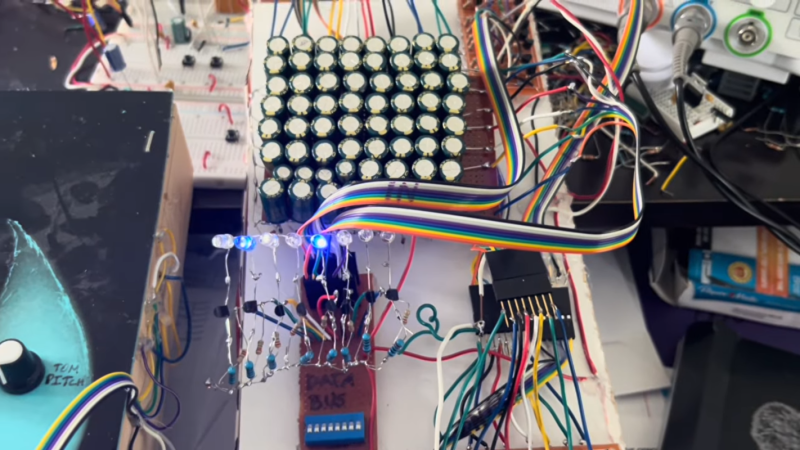
Before the past year, many of us took computer memory for granted. It was one of the lower-cost parts of a PC build and was usually available in whatever quantity one desired. As its cost has skyrocketed, a lot of PC builders and other users of computers in general are taking a deeper look at memory, how much is really needed, and what its functions truly are. [Igor] is working on a drum sequencer project which needs a small amount of memory, and has built this dynamic RAM from discrete components.
The first video goes into the construction of the memory array and how its addressed. It’s only eight bytes total, and using fairly large electrolytic capacitors to store data means that a gigabyte of this memory would take up well over a thousand acres, but it’s still enough memory for [Igor]’s needs. In addition to the capacitor, each bit uses a pair of diodes to determine if a read or write is occuring, and a set of transistors on the read and write busses to perform those actions. Worth noting here is that dynamic RAM like this needs to be refreshed because the capacitors lose charge over time, but these large capacitors can hold charge sometimes overnight, as [Igor] has confirmed experimentally.
There’s a followup video to the construction of these modules as well, where [Igor] demonstrates a number of ways this module can be used, from controlling LED arrays, 7-segment displays, and then installs it into his drum machine. With 64 bits available it’s capable of creating up to eight beats with eight samples available per beat. Although there are complete machines available for all of this, we appreciate his goal of not buying any pre-manufactured hardware and instead constructing it all from the ground up. There are analog drum machine options available in this same style as well.












you know, this whole RAM shortage crisis is all the results of buzz-generating lies told by AI companies about the vast resources they were going to need to build out vast numbers of data centers. but it’s becoming clear those data centers will never be built. when this fraud is ultimately exposed, memory prices will collapse. this whole AI madness makes no sense. LLMs are essentially a commodity product with zero network effects. racing to build it gives a company no advantage because there is no customer lock-in. also, data centers full of GPUs that last only three years to provide such services makes zero economic sense.
Don’t worry. Cryptocurrency will fill the void, and we all can go back to complaining.
I can’t wait for ram prices to collapse! I hope you’re right!
I remember when ram cost $300 for a couple of 4MB sticks. Whether or not that works out as more expensive now with everything considered matters very little because the effect is the same: I couldn’t afford ram back then and I can’t afford it now. If it drops back to previous levels, I will buy 4X what I think I’ll need in 10 years. If it collapses and becomes dirt cheap, I’ll buy 10X what I think I’ll need in 10 years. I like AI, but I hate what the profiteering companies have done to the computer parts market.
just to be clear, the only profits being made right now are the suppliers of hardware to LLM-based companies, which are flooded with a lot of stupid money (and some smart money that always follows, followed by more stupid money). these LLM-based companies have made a lot of promises and said a lot of things to keep the money flowing. but they have never made a profit and it is impossible to see how they will. the moment they charge customers enough for them to break even, those customers switch to another LLM-based company, since doing so is much less painful than switching from Facebook to WeHugTreesAndThinkYoureBeautiful.com
Unfortunately all that extra RAM will likely be useless on any newer hardware. It would be like installing USB 1 wall chargers in every wall outlet when it came out… great that year… then bigger devices came out the required more power, and newer power delivery systems over USB came out. Basically that investment quickly depreciated in value, so while it’s still functional for the devices of its day, it quickly becomes irrelevant to the new devices you actually want to use.
I have the feeling that once this AI data center silliness crashes down, companies are going to be very invested in the consumer again and the personal computing world will have a new tech boom of improvements that we haven’t seen for a very long time.
i suspect a lot of the RAM shortage is caused by people speculatively gobbling up supplies they do not actually have an immediate use for. all that will start appearing when the market figures out that there is no ROI for AI investments.
What started the problem was Sam Altman signing ‘Letters of Intent’ with Samsung and SK Hynix which gave him total control over 60% of their output, which equates to around 40% of the global supply.
And he’s not actually required to buy any of it. He just needed that agreement to inflate OpenAI’s value prior to the IPO.
Which is beginning to look very shaky indeed with:
Multiple lawsuits.
S&P Global rejecting the rule changes which would allow them to enter the S&P
500 immediately after the IPO.
Leaked financial information showing losses of $21 billion last year and predicted
losses of around $30 billion this year.
Softbank being refused a margin loan backed by their OpenAI stake.
Everyone else just panicked and grabbed what they thought they needed for there own use.
Never going to build them?
I know of 2 near me where they have already broken ground.
I still expect the bubble to pop and a whole lot of used equipment to show up on the usual auction sites as well as new stuff going on sale because they over-produced. But I don’t think those datacenters are going un-built.
the market is so deeply irrational right now that there will be lots of buildings built that never see a single rack put into them. they will eventually become self-storage facilities. in fact, it might be worth speculatively buying devalued real estate near them. THIS IS NOT FINANCIAL ADVICE!!
Homeless shelter, with a certain bill not passing.
On the DiPDoT YouTube channel, they are building a relay-based computer in an Altair-style chassis/front panel. He is using electrolytic capacitors for memory and has recently posted videos of it in operation.
I can’t scrub through the narration in the video to find: Why such huge capacitors?
To change a bit’s state would take just this side of an eternity, plus a huge amount of energy lost to heat.
Dr. Semiconductor’s DRAM array capacitors were quite a bit smaller: https://hackaday.com/2026/04/22/making-ram-at-home-in-your-own-semiconductor-fab/
yeah that was my first thought at all…i figure it’s a result of simple ignorance. when i say that, i hope it’s obvious that i’m projecting :) it was ony 10-15 years ago the first time i truly properly used capacitor. it’s not that hard but if you come from the background of just throwing big electrolytics between +5V/GND to bypass power line noise then it’s easy to have a kind of stupid view of them :)
I wonder if it’s related to the expected number of changes required and/or simplicity.
You could do it with a few microfarads, or even picofarads, but you would need more complex refresh logic, faster refresh cycles, etc.
if you only need to ‘program’ it once per session, or make a few changes after it’s been ‘programmed’ then bigger capacitors start to make sense.
It is a major mistake to use electrolytic capacitors due to their losses and retained charge. If MOSFETs or FETs are used, such capacitances are unnecessary because the only issue to deal with is self‑discharge.
No: The minimum capacitor size is dictated not by leakage, but by the sensitivity (SNR) of the sense amplifier and the capacitance of the read lines:
You need the capacitor just big enough to drive the readout line with sufficient voltage for the sense amplifier to reliably read it. Any bigger just slows things down and wastes power.
DIY on PCB and you’re looking at 1 nF or less. On a chip it’s in the few fF.
Electrolytics here are ridiculous in the extreme,unless there’s some other driving reason.
It depends. There are circuits wherein larger storage capacitance allows greater refresh time. Also, larger storage capacitance gives a greater margin against crosstalk.
Larger capacitance inevitably yields higher power draw: it takes more power to change the bits. Larger caps also take up more space. There’s very strong incentive to minimize cap size.
Big DRAMs do dedicate a few percent of their time to refreshing. That’s the advantage of banking (ranks): refreshes can happen when another rank is serving memory access requests.
If you’re getting “crosstalk” then I submit that bigger caps are just a bandaid for a design flaw.
For surviving short power outages?
That was my thought as well. I haven’t watched the video yet but if the caps are as oversized as everyone is implying I’d wager they’d keep anything in memory at the point power was cut for a long time.
Though given the application I’m not sure that makes a lot of sense?
If I wanted to store only 8 bytes I should consider ferrite cores such as described on https://youtu.be/-bLtO3DCuRQ .
(He has a kit for 64 bits on his website).
Bring back bubble memory.
https://www.datainsightsmarket.com/reports/bubble-memory-1667146
I remember reading about those at the time and thinking it was a brilliant idea for ‘offline’ storage. It being a serial access device similar to an 8-track cartridge or a Sinclair MicroDrive :)
Add to that the complex power and hardware support needed and the long ‘seek’ times waiting for the required ‘bubbles’ to come round…
IBM has been trying to bring back it’s descendent.
https://www.ibm.com/history/racetrack-memory
With all of the retro computer activity, I’m surprised no one I know of has used the Atanasoff–Berry computer regenerative capacitor memory type. Wrap a flexible PCB using SMD capacitors around a spinning drum:
Regenerative capacitor memory
https://en.wikipedia.org/wiki/Regenerative_capacitor_memory
Replace all those noisy failure-prone mechanical contacts with MOSFET switches, and you have DRAM, and then you don’t need a bulky drum, or a motor to spin it.