
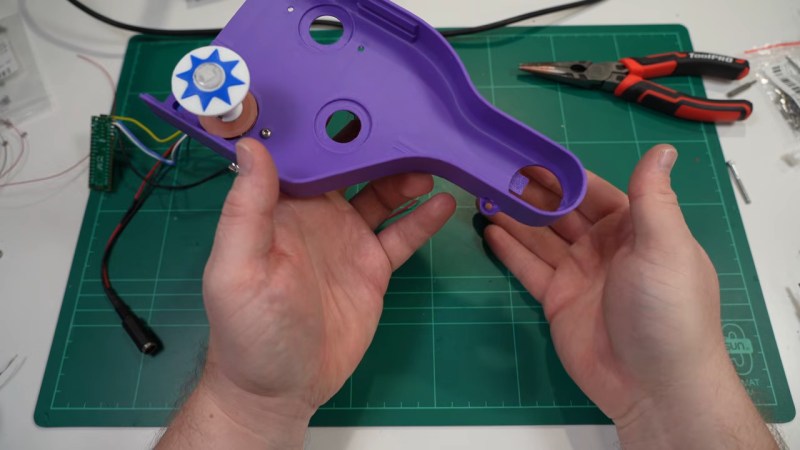
Unless you’ve managed to avoid touching a Windows computer until after the Windows XP era, it’s pretty good odds you’ve played Space Cadet Pinball. Some of you may have even paid for the Mac port of Full Tilt! Pinball, the actual game the Windows freebee was supposed to demo. Unofficial ports exist for Linux as well, which means the one place nobody has ever played the game is, ironically, on a pinball table. [CNCDan]aims to change that in a video embedded below.
Ironically given [CNCDan]’s name, the parts he starts with — the two sorts of pop bumpers, the drop targets, slingshots, and delayed-drop hole– are all largely 3D-printed. While some of these parts are available commercially, it turns out that the scaling of the virtual pinball machine doesn’t match anything on offer, and rather than compromise [CNCDan] decided to do it himself, an attitude we absolutely respect.
All that’s left are the flippers– his first prototype wasn’t powerful enough–and a couple minor mechanisms before building the table. To do that, he’ll need high-resolution art worth printing. Not surprisingly, a game dating from 1995 doesn’t have high resolution assets available with which to do that. That kind of creativity isn’t in [CNCDan]’s wheelhouse, so if it is in yours and you want to collaborate, or know someone who does, you can reach [CNCDan] at his YouTube page. At the very least, he can pay you in playtime.
[CNCDan] often goes beyond his namesake, like with his SteamDeck-like handheld, or his 3D printed VR headset. Still, no guesses how he’s going to build the cabinet.










I know he’s trying to build it all himself. I haven’t done the research, but you’d think there were standard off the shelf pinball components he could use. Or at least standard designs. I mean, he’s not making his own switches and solenoids, so at some level there are off the shelf components. But, having said that, I’d love to play it.
Space cadet pinball was a pretty good game. [ Also fairly easy to hack. Although perhaps not as straight forward as something like adding words to bookworm. ]
It took quite a while to get all the stages completed to illuminate all the lights, implicating all the tasks would be a great way to make this feel authentic to the game.
Personally, since the ball is metal, I think I’d have just used it to complete the circuit, being a fan of the old mechanical pinball machines, it feels a bit overkill to try and use hall effect sensors. That being said, great start. I wouldn’t mind owning a real version of this game. Not my introduction to pinball nor videogames by a long way, but undoubtedly many hours playing well spent. The exe will usually run without issue on other versions of Windows.
There absolutely is! The “Homebrew” pinball scene has taken off big time in recent years, and most people use reproduction standard Williams parts like flippers, slings, bumpers, drop targets, etc which are widely available, inexpensive, and proven to work. I think every real pinball company today (that isn’t Stern) uses reproduction Williams-designed parts at this point.
The standard, off-the-shelf Williams parts don’t have the correct proportions. Or maybe the game doesn’t have correct proportions to represent a real machine. Either way, rather than compromise he’s DIYing to get a table as screen-accurate as physically possible — plus, it’s more fun that way.
The original game never felt 100% physics driven. I’m sure there are full-physics 3d pinball games where you can create your own tables. So IMO it would be a good idea to start with that, to see if it is really playable and fun in reality. No point in recreating it in real life, if the result sucks to play.
Someone on YT mentioned an implementation for Future Pinball, but the latest version is from 2010 and it seems 20+ years old. So who knows how good the physics are. There has to be a better version… Maybe we could get vibecoding a 3d spacecadet pinball table a new AI benchmark?