
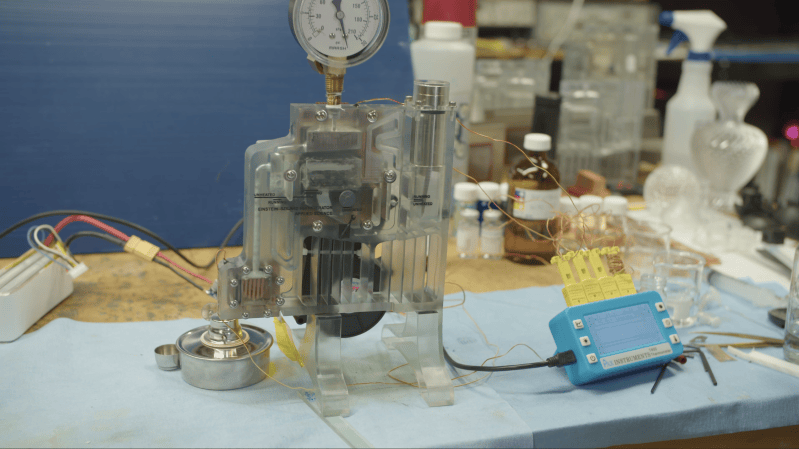
They may not deliver the highest efficiency, but absorption refrigerators have earned a persistent place in camper vans and industrial plants thanks to a few distinct advantages: they can operate using waste heat alone as an energy source, and they can be quite reliable due to their lack of moving parts. It can be a bit hard to understand their working principles, though, which is why [Ben Krasnow] built a transparent Einstein-Szilard refrigerator.
Most absorption refrigerators use ammonia and water as their working fluids; since the ammonia gas needs to condense at room temperature, the refrigerator requires pressures above what can be comfortably held in a glass or plastic enclosure. The Einstein-Szilard design, by contrast, uses a third liquid as its refrigerant. A strong solution of ammonia in water is separated by boiling, and the ammonia gas induces the refrigerant to evaporate by decreasing its partial pressure. The refrigerant and ammonia gasses then mix with water, in which the ammonia dissolves, leaving the refrigerant vapor to condense and start the cycle again. The newly reformed water-ammonia solution flows back into the boiler.
The refrigerant is usually butane, but since [Ben] was powering this pressurized system with an open flame, he opted instead for nonflammable perfluoropentane. The refrigerator body itself was 3D printed in clear resin, with a copper block transferring heat from the flame to the boiler chamber; ammonia solutions do dissolve copper, so this isn’t a long-term solution, but it works for a demonstration. The single internal path of the refrigerator presented some difficulties: since almost no pressure builds up between different parts of the system, a bubble in the wrong place can easily airlock it. In the end, [Ben] managed to get it working well enough to reach five degrees Celsius below the ambient temperature. Conveniently, he notes that, for alcohol at a sufficiently high concentration, you could cool your drink by burning a portion of it.
Ammonia-based refrigerators are a tough build for most hackers, but we have seen a salt-water-based absorption refrigerator before. For more less-known refrigerators, check out our article on strange cooling methods.
Thanks to [spacedog] for the tip!












Solid state cooling
https://techxplore.com/news/2026-10-solid-state-cooling-advances.html
Might those be combined for heat shields/re-entry?
That describes novel mechanisms for heat pumps.
The heat power density on a heatshield during reentry is roughly the same as the surface of the sun.
Never mind weight budget, even if those heat pump techniques could survive the sheer amount of power, where would you pump the heat TO? You’ll also need in the ballpark of a gigawatt of power to drive it. Where would that come from?
Reminds me of a passage in Niven’s Ringworld, where the surface of their craft is cooled by pumping heat internally into a chamber, to be dealt with later, as long as it didn’t reach a critical failure point.
Niven also thought superconductors conducted heat infinitely well too.
But, in a universe where a ringworld will work, well, maybe superconductors did work that way.
I’m curious what the sort of efficiency you can expect from a system like this and how well it’d combine with solar heating. Like maybe a vanta black solar collector plus one of these could be more efficient than standard A/C.
I was also curious so went and did some reading. Looks like the ammonia based cycle gets a COP somewhere around 0.45 to 0.6, and the compressor based one can get a COP of around 16.
So not super competitive if being powered by the same source. Meaning it’s best to just get a solar panel to power your home fridge.
However if you can reuse waste heat say from a furnace, or are off grid in an RV, that’s a completely different story as there are other things that are more important the efficiency.
I don’t know exactly how this relates to the natural gas absorption air conditioning systems of 50 years ago, but at the time they were cost effective competition for compressor systems and fairly common.
Only problem we had with ours was when little round pellets filled the safety gas cutoff valve. Taking it apart and removing them put it back in service. Ultimate cause was the use of copper tubing to supply the gas. After replacement with a proper gas line it was never a problem again. Never did learn what caused the sand size balls to form. Would love to know. I always suspected the mercaptin.
mmm…lithium bromide ac unit…pesky at times
mmm…to this… NH₃ + H₂O ⇌ NH₄⁺ + OH⁻…impressive 3d print!