2600 And Why Publishing Sucks

26002600: The Hacker Quarterly is the premier (print) infosec publication out there, and depending on who you talk to, the best publication out there that has anything to do with modifying electronics, infiltrating networks, and all the other goodies we post on a daily basis. They’ve also been around for longer than most of our readership, and to lose them would be a terrible loss for anyone who calls themselves a hacker.
Being a print publication, they are completely at the mercy of their distributors. Any sort of media is a very, very dirty business, so when 2600’s distributors recently decided to not pay them for a few previous issues… well, that’s a problem.

2600’s most recent distributor, Source Interlink, was recently dropped as the distributor for Time, throwing the entire company into panic mode. Source Interlink then rebranded itself as TEN: The Enthusiast Network, distributing a disturbing amount of hotrod magazines to bookstores across the country. With this change in names and a little corporatespeak, TEN: The Enthusiast Network has yet to pay 2600 what they’re due.

This isn’t the first time 2600 has faced near oblivion thanks to a distributor. They almost went out of business in 1997 when their distributor declared bankruptcy. 2600 have proven themselves to be resilient folk, though, and all bets are on them making it through this little impasse. Still, they’re still out six months worth of revenue, deep in debt, and they’re putting on a huge conference in a few weeks. It’s really not good timing.

If you’d like to help 2600, buy July’s issue, make them number 1 on Kindle, or buy a ticket for HOPE X. Hackaday is going to have a booth there (awesome!), and we’ll be putting a post up on that when  the already amazing list of speakers is finalized.

Xkcd’s Virus Aquarium Made Real

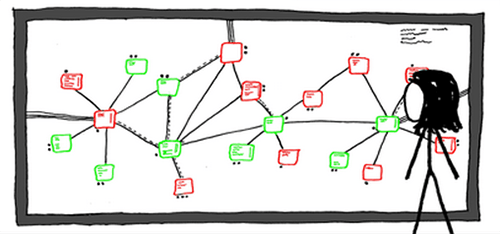
A surprising number of projects here are in some way influenced by the webcomic xkcd, but usually not as directly as this. Comic 350, “Network” is the tale of a very odd stickman who keeps multiple VMs running an unprotected, old version of Windows. Between the VMs, they have virtually every virus and are, effectively, a computer virus aquarium.

Now it’s a real thing, and best of all, it’s open to the Internet for normal humans to view, complete with screencaps of all seven nodes updated every 30 seconds, the ability to view all processes on each node, and anyone on the Internet can upload any file to a node. All the files uploaded to the nodes are executed, so you get to see in real-time what the effects of “1TB_of_porn_this_took_a_while_to_upload.exe” are on node 3.

The idea of a virus aquarium is cool, but this actually gets much, much more interesting when the project metas itself. Every 24 hours, a virus scanner runs on each node. As of right now, all the nodes are clean making this not a virus aquarium, but a script kiddie aquarium. On at least one node, TeamViewer is running but your guess is as good as mine as to how anyone will get that working.

Continue reading “Xkcd’s Virus Aquarium Made Real”

An Online Course For FPGA And CPLD Development

FPGA

Over on the University of Reddit there’s a course for learning all about FPGAs and CPLDs. It’s just an introduction to digital logic, but with a teacher capable of building a CPLD motor control board and a video card out of logic chips, you’re bound to learn something.

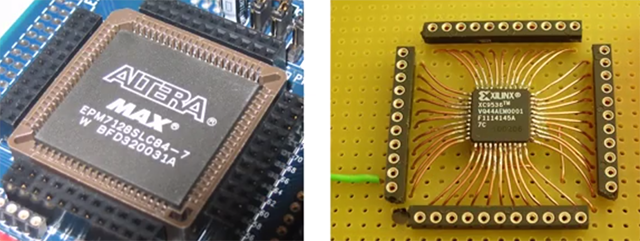
The development board being used for this online course is an Altera EMP3032 CPLD conveniently included in the Introduction to FPGA and CPLD kit used in this course. It’s not a powerful device by any measure; it only has 32 macrocells and about 600 usable gates. You won’t be designing CPUs with this thing, but you will be able to grasp the concept of designing logic with code.

Future lessons include building binary counters, PWM-controlled LEDs, and a handheld LED POV device. In any event, it’s a great way to learn about how programmable logic actually works, and a fairly cheap way to get into the world of FPGAs and CPLDs. Introductory video below.

Continue reading “An Online Course For FPGA And CPLD Development”

Astronaut Or Astronot? Nobody Won The Voters’ Lottery (This Week, Anyway)

Yesterday we said we’d be giving away an awesome oscilloscope to a random person on Hackaday Projects if they have voted for their favorite project in The Hackaday Prize. We’re doing one of these a week, and today, at least, nobody won.

We’re going to be doing this every week, so register at Hackaday Projects and vote for your favorite projects entered in The Hackaday Prize. We’ll do this again next week.

Homebrew Programming With Diodes

diode

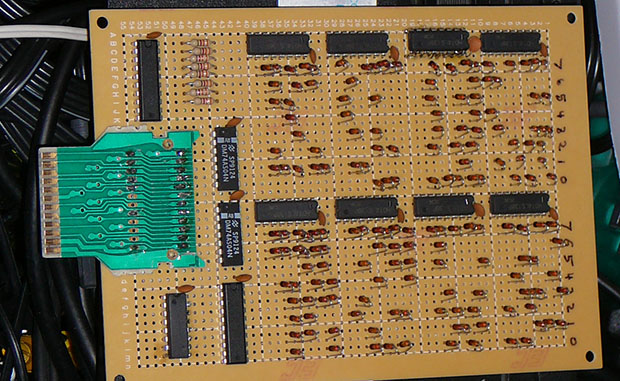
Diode matrices were one of the first methods of implementing some sort of read only memory for the very first electronic computers, and even today they can be found buried deep in the IPs of ASICs and other devices that need some form of write-once memory. For the longest time, [Rick] has wanted to build a ROM out of a few hundred diodes, and he’s finally accomplished his goal. Even better, his diode matrix circuit is actually functional: it’s a 64-byte ROM for an Atari 2600 containing an extremely simple demo program.

[Rick] connected a ton of 1N60 diodes along a grid, corresponding to the data and address lines to the 2600’s CPU. At each intersection, the data lines were either unconnected, or tied together with a diode. Pulling an address line high or low ([Rick] hasn’t posted a schematic) pulls the data line to the same voltage if a diode is connected. Repeat this eight times for each byte, and you have possibly the most primitive form of read only memory.

As for the demo [Rick] coded up with diodes? It displays a rainbow of colors with a black rectangle that can be moved across the screen with the joystick. Video below.

Continue reading “Homebrew Programming With Diodes”

The Hackaday Prize: Vote!

pilotsuit2Last week we rolled out Astronaut or Not, where Hackaday readers vote on aspects of the project entries of The Hackaday Prize. But why save all the prizes for the entries? What about the voters?

Starting tomorrow at exactly 1000 EDT (GMT -4), we’re going to choose someone registered on Hackaday Projects at random. If that person has voted, we’re giving them a Rigol DS1104B 100 MHz Digital Oscilloscope. If they didn’t vote yet, nothing!

This will continue about every week or so until someone has won.

Voting is open, so vote now for the best project concept for The Hackaday Prize. Make sure you don’t miss out when your number is drawn!

Congress Destroys A Hobby, FAA Gets The Blame

As ordered by the US Congress, the FAA is gearing up to set forth a standard for commercial UAVs, Unmanned Aerial Systems, and commercial drones operating in America’s airspace. While they’ve been dragging their feet, and the laws and rules for these commercial drones probably won’t be ready by 2015, that doesn’t mean the FAA can’t figure out what the rules are for model aircraft in the meantime.

This week, the FAA released its interpretation (PDF) of what model aircraft operators can and can’t do, and the news isn’t good: FPV flights with quadcopters and model airplanes are now effectively banned, an entire industry centered around manufacturing and selling FPV equipment and autopilots will be highly regulated, and a great YouTube channel could soon be breaking the law.

The FAA’s interpretation of what model aircraft can and cannot do, and to a larger extent, what model aircraft are comes from the FAA Modernization And Reform Act Of 2012 (PDF). While this law states the, “…Federal Aviation Administration may
not promulgate any rule or regulation regarding a model aircraft…” it defines model aircraft as, “an unmanned aircraft that is capable of sustained flight in the atmosphere; flown within visual line of sight of the person operating the aircraft; and flown for hobby or recreational purposes.” The FAA has concluded that anything not meeting this definition, for example, a remote controlled airplane with an FPV setup, or a camera, video Tx and Rx, and video goggles, is therefore not a model aircraft, and falls under the regulatory authority of the FAA.

In addition, the FAA spent a great deal of verbiage defining what, “hobby or recreational purposes” in regards to model aircraft are. A cited example of a realtor using a model aircraft to take videos of a property they are selling is listed as not a hobby or recreation, as is a farmer using a model aircraft to see if crops need water. Interestingly, receiving money for demonstrating aerobatics with a model aircraft is also not allowed under the proposed FAA guidelines, a rule that when broadly interpreted could mean uploading a video of yourself flying a model plane, uploading that to YouTube, and clicking the ‘monetize’ button could soon be against the law. This means the awesome folks at Flite Test could soon be out of a job.

The AMA, the Academy Of Model Aeronautics, and traditionally the organization that sets the ‘community-based set of safety guidelines’ referred to in every law dealing with model aircraft, are not happy with the FAA’s proposed rules (PDF). However, their objection is a breathless emotional appeal calls the proposed rules a, “a strict regulatory approach to the operation of model aircraft in the hands of our youth and elderly members.” Other than offering comments per the FAA rulemaking process there are, unfortunately, no possible legal objections to the proposed FAA rules, simply because the FAA is doing exactly what congress told them to do.

The FAA is simply interpreting the Modernization And Reform Act Of 2012 as any person would: FPV goggles interfere with the line of sight of an aircraft, thus anyone flying something via FPV goggles falls under the regulatory authority of the FAA. Flying over the horizon is obviously not line of sight, and therefore not a model aircraft. Flying a model aircraft for money is not a hobby or recreation, and if you’re surprised about this, you simply aren’t familiar with FAA rules about money, work, and person-sized aircraft.

While the proposed FAA rules are not yet in effect, and the FAA is seeking public comment on these rules, if passed there will, unfortunately, exactly two ways to fix this. The first is with a change in federal law to redefine what a model aircraft is. Here’s how to find your congresscritter, with the usual rules applying: campaign donations are better than in-person visits which are better than letters which are better than phone calls which are better than emails. They’ll also look up if you have voted in the last few elections.

If passed, the only other way these rules will align with the privileges model aircraft enthusiasts have enjoyed for decades is through a court ruling. The lawsuit objecting to these rules will most likely be filed by the AMA, and if these rules pass, a donation or membership wouldn’t be a bad idea.