
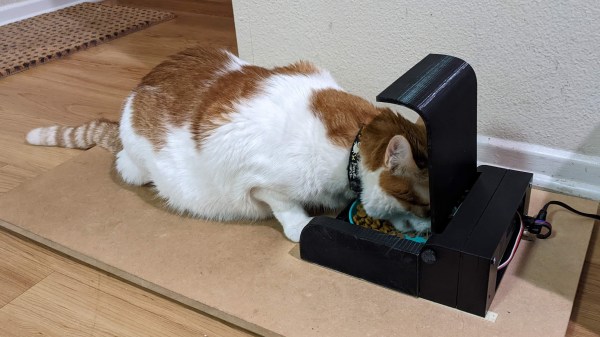
An orange and white cat eats from a bowl with a hinged cover. The cat and the bowl are on top of an MDF platform.

Load Cells To Get The Right Pet The Right Food

If you have more than one pet, you may know how hard it is to tell how much each furry friend is eating. If you introduce prescription foods, then this minor annoyance can have a major impact on your pet’s health. Facing this dilemma, [tomasdiazwahl] set out to make a pet feeder that feeds his pets exactly what they need when they approach the feeder.

Using the ever-popular Arduino Uno, the feeder is connected to a platform that uses load cells to detect the pet’s weight. The weight data is then used to identify which animal is looking for food. Once the pet is identified, the correct food bowl opens. It seems this prototype only has one food chamber to keep unauthorized pets from eating the special food, but the basic idea should be extensible to two or more chambers. While some existing solutions read the pet’s microchip or NFC collars to determine who’s at the feeder, [tomasdiazwahl] decided against these given the fickleness of trying to reliably get a reader at the correct position relative to the pet. As long as you don’t have multiple pets with the same weight, it should work just fine.

This project has a nice mix of woodworking, 3D printing, and electronics showing what can be accomplished when you aren’t afraid to mix techniques. We also really appreciate that [Tomasdiazwahl] spent the extra time to include a testing procedure and safety mechanism into the project. Designing a device to improve your pet’s health shouldn’t come with a safety risk!

This isn’t the first cat feeder we’ve covered that uses weight to tell the difference between the pets, and if you want a simpler project to start with, check out this Simple Auger Pet Feeder.
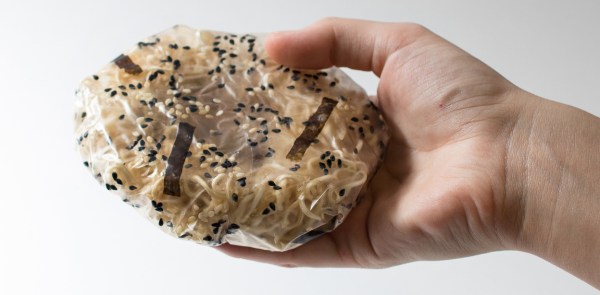
A hand holds a round disc of noodles wrapped in a translucent film with herb specs embedded in it.

Reimagined Ramen Comes In Edible Package

Hackers and college students alike reach for ramen when they want to fuel up on a budget, but, if you’re concerned about packaging waste, the plastic film and foil packets start to weigh on your conscience. [Holly Grounds] was sick of this compromise and came up with a way to have your packaging and eat it too.

[Holly] first experimented with different bioplastics until she developed a recipe for “an edible, tasteless starch-based bioplastic, that dissolves in contact with boiling water.” With that accomplished, she next integrated flavoring into the bioplastic wrapper so that there’s no foil packet. She found that herbs and spices worked, but larger solids like shrimp couldn’t be incorporated into the film.

For the finishing touch, she fashioned the noodles into a disk so they fit better in a bowl for cooking. To cook the noodles, you remove a puck from the wax paper sleeve holding multiple servings, add boiling water, stir, and enjoy. [Holly] says that her ramen packets are quicker to prepare than existing packets since there are fewer steps and the shape is optimized for cooking. That’s a win-win for the planet and convenience.

If you want to see another pasta packaging marvel, we’ve previously covered Flat Pack Pasta. Have your own project to reduce packaging waste? Submit it to the Save the World Wildcard round of the Hackaday Prize which closes on October 16th!

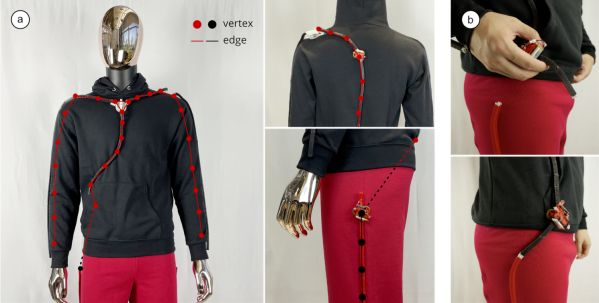
An image of the track system of the Calico wearable on top of a garment. Different possible positions of the device (elbow, shoulder, etc) are shown by red dots overlayed on the top of the image.

The Calico Wearable Rides The Rails

If you’re feeling underwhelmed by yet another smartwatch announcement, then researchers at the University of Maryland may have just the wearable for you. Instead of just tracking your movement from one spot, Calico winds around you like a cartoon sidekick.

Using a “railway system,”(PDF) the Calico can travel around a garment to get better telemetry than if it were shackled to a wrist. By moving around the body, the robot can track exercise, teach dance moves, or take up-close heart measurements. Tracks can be magnetically linked across garments, and Calico can use different movement patterns to communicate information to the user.

This two-wheeled robot that rides the rails is built around a custom PCB with a MDBT42Q microcontroller for a brain which lets it communicate with a smartphone over Bluetooth Low Energy. Location is monitored by small magnets embedded in the silicone and plastic living hinge track, and it can use location as a way to provide “ambient visual feedback.”

The researchers even designed a friendly cover for the robot with googly eyes so that the device feels more personable. We think animated wearables could really take off since everyone loves cute animal companions, assuming they don’t fall into the uncanny valley.

If you love unusual wearables as much as we do, be sure to check out Wearable Sensors on Your Skin and the Wearable Cone of Silence.

Continue reading “The Calico Wearable Rides The Rails”









