FON Or How To Get A Cheap Linksys WRT54G

fon

FON hit the news recently because it acquired some venture capital from Google and Skype. Its goal is to create a global network of access points run by home users. The users can either offer access for free or resell their bandwidth. The actual FON software is based on DD-WRT, a Linux based firmware for the Linksys WRT54G wireless router and others. DD-WRT features a captive portal, QoS, and many additional features. FON is selling 3,000 routers with their software pre-installed for 25USD/EUR plus shipping. This is a great way to pick up a WRT without paying Linksys’s Linux penalty and it comes with a great firmware already installed. Oh, unless you have broadband from a friendly company like Speakeasy, becoming a fonero is probably a violation of your “terms of service”.

Continue reading “FON Or How To Get A Cheap Linksys WRT54G”

BackTrack Live CD

backtrack

First Whoppix and Auditor then Whax and now finally everything has come together to form remote-exploit’s latest Live CD project BackTrack. The very first beta of the new system was released today. I downloaded it and tested it on my 600m. It had a nice uncluttered feeling right from the beginning by not offering the scads of boot options found in Knoppix. The system came up really quick and stopped at the command prompt instead of going to a GUI which is another nice touch. The CD also doesn’t automatically bring up the network interfaces since you may have something special in mind. The default windowing environment is KDE, but Fluxbox is included if you’re on a diet. Kismet started up and set up my Intel 2200 card without any assistance. I really think the team has put together a great product and I look forward to future releases. Try it out for yourself.

[thanks steve]

Continue reading “BackTrack Live CD”

POV Pendant

pov

Reader [Franz Gabel] purchased a POV kit from ladyada and started modifying it for his own application. He assembled the POV without a PCB so it could fit inside a small metal pipe and attached a leather lanyard. He’s still in the early stages of the project. It is fully assembled, but he’s working on additions like a docking station to recharge and download new messages. He’s also developed a Flash based system for generating new .c files based on text input. Here is his forum post about his project (Coral CDN, so ladyada doesn’t break my arm).

Continue reading “POV Pendant”

Shmoocon 2006: Wrap-up

shmoocon

Well, we’ve come to the end of my Shmoocon 2006 coverage. The conference wasn’t all presentations though, there were a lot of other fun activities:

The Hacker Arcade featured arcade games that had been modified to generate USB tokens that you could later redeem for prizes. The folks at 757.org modified a skill crane so that it could be controlled from the web. Of course, toys like this at a hacker convention spawned some creative solutions. David Rhodes scripted the skill crane’s web interface so that it would try every possible coordinate pair and ended up with an armful of prizes. Another attendee discovered that the USB tokens weren’t case sensitive and generated a couple hundred thousand prize tokens.

Hack or Halo was different from your standard tournament. You could take the other team on in either Halo 2 or drag race hacking. From what I heard it’s pretty easy to get up to speed and be competitive, just know your way around a sniffer, Metasploit, and an energy sword and you’ll be good to go.

Grey Frequency managed to find all twenty different conference badge outlines needed to make a fully interlocking set. Shmooballs were handed out to attendees so that they could physically manifest their disagreement with the speaker; speakers were given paddles. During the closing ceremony a t-shirt cannon was brought out to help distribute swag.

I’d like to thank The Shmoo Group for putting together an excellent conference, the boys from Midnight Research Labs for keeping things interesting when I wasn’t in talks, and atlas, RenderMan, Jason Scott, Abend and all the other speakers who have stopped by to leave comments on Hack-A-Day.

Continue reading “Shmoocon 2006: Wrap-up”

Client/server Door Opener

door opener

You can thank reader [Alexandre Novello]’s laziness for generating this hack. Actually, as a self-proclaimed “software guy” he would have never approached this project if it wasn’t for the situation he was in: having to walk across the room to open the door for people, a door which has an electric opener right next to it. He’s got a thorough write-up on how he built the client and server portions of his software in Delphi. He also covers the hardware switch which is attached to the server via parallel port.

Continue reading “Client/server Door Opener”

Shmoocon 2006: Cardbus Bus-Mastering: 0wning The Laptop

shmoocon

David Hulton (h1kari) talked about the implications of cardbus bus-mastering. It goes pretty much hand-in-hand with David Maynor’s USB direct memory access work. The idea is using bus-mastering to take over other PCI devices, download passwords and keys from memory, unlock screensavers, and plant memory-based or firmware-based trojans. So, what kind of device could do all this? David works for Pico Computing which is developing cardbus based FPGAs. They’re pretty cool little devices and for dedicated tasks like brute force cracking they’re really efficient. Check out OpenCiphers for details on using FPGAs with modern cryptography. Unfortunately h1kari didn’t have a demo, but David Maynor was there to talk about his USB stuff. An interesting tidbit was what USB device he used for his exploration: a Motorola MPx200. It was released before the USB 2.0 spec was finalized so the phone was designed to have its USB firmware upgraded, handy for hacking.

Continue reading “Shmoocon 2006: Cardbus Bus-Mastering: 0wning The Laptop”

USB Interface For Parallel LCDs

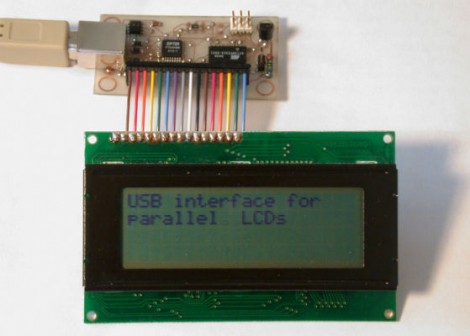
Pontus Frönder has put together a really simple USB interface for any LCD that uses the HD44780 controller. He used a USB chip from FTDI that creates a virtual COM port on the host computer. This is connected to an Atmel ATtiny2313 which controls the LCD. The AVR has two PWM outputs that are used to control the backlight and contrast. If the current draw of the backlight is low enough it can be driven directly from the USB and since it looks like a standard serial display you can talk to it using programs like LCD Smartie.

Continue reading “USB Interface For Parallel LCDs”