Turning Anyone Into A Casuality

Triage

EMTs and other first responders don’t just sit around waiting for a disaster to happen. If they need to train for a disaster – environmental, terrorist, or otherwise – they put together a mass injury simulation, or their version of a war game. As you can imagine, coordinating one of these simulations is a nightmare, but [David] came up with a way to simulate a casualty with a few XBees, a Parallax Propeller, and a few RFID cards.

This triage training simulator consists of an ‘acting coach’ on each simulated victim that includes a speech-to-text module that speaks instructions into the actors ear, a pulse simulator and a readout for vital signs that correspond to twelve major injuries. When an EMT triages a victim, they swipe an RFID card for each medical procedure they perform – intubating is one card, while a bandage is another – and all this is sent back to the coordinator’s tablet.

The coordinator has direct control over each of the actors through a two-way radio link, and can initiate changes in each victim, monitor a paramedic’s responses, and “escalate” the situation by setting off another simulated bomb.

All this is created with off-the-shelf hardware, vastly reducing the cost of this type of training device. An amazing application of what we usually consider to be just robot parts, and we’re happy for [David] to share it with us.

Continue reading “Turning Anyone Into A Casuality”

Pill Dispenser Tattles To The Internet When You Don’t Take Your Pills

pill-taking-reminder-hardware

Here’s another entry in the Parallax microMedic 2013 contest. [Tim] calls it his Propeller-based Internet Logging Pill Dispenser (PDF file), or P.I.L. Box for short.

The hardware is a base unit into which a normal plastic pill organizer is placed. We like this design, as many pharmacies will fill pill boxes for you and this doesn’t complicate that process. You simply pull out the correct box at the beginning of the week and put it in the base unit. You can see one white LED is shining on the Monday slot in the box. This lights up starting an hour before the set pill taking time. This way if you walk by it reminds you. There is also a voice tailor made to scare the elderly that comes out of the speaker, and a simple messages spelled out on the set of seven segment displays. The base unit detects when you press the button to open the pill box and counts that as a properly administered dosage.

Now, if you forget to take the pill it’s not a good thing. The server, which is running on the laptop, will rat you out. It uses the Twitter API to alert whomever is following it — meant for a relative or caregiver — that a dosage was missed. Let’s hope they’re good at keeping up with their Twitter feed!

We remember seeing one other microMedic entry so far, this heart-shaped heart simulator. But we’re going to look around and see how many other good ones we’ve missed.

Continue reading “Pill Dispenser Tattles To The Internet When You Don’t Take Your Pills”

Heart-shaped Heart Simulator

Heart

A few years ago, [Addie] over at Tymkrs put together a spooky little Halloween project: a small Propeller board that emulates the electrical signals in a heart. As a cardiac nurse, she thought her project could use a little improvement, and after two years she’s finally done. It’s a heart-shaped board that simulates electrical signals moving through the heart.

There are several key areas that conduct electrical signals through the heart – the sinoatrial node, atrioventricular node, and bundle branches all work like players in an orchestra to keep a heart beating like it should. If something goes wrong with one of these, the heart goes into tachycardia or fibrillation – not good, by any measure. [Addie]’s board simulates all the different ways a heart can go wrong with LEDs standing in for the electrical signals in a real heart. The name of the game here is to look at the LEDs and tell what state the heart is in.

The PCB heart is just one part of [Addie]’s heart simulator. The simulated heart can also plug into a neat little heart-shaped project box wired up with a solenoid, LCD display, headphone jack, and other electronics to turn this electronic heart into a complete study tool for heart rhythms. The nurses in [Addie]’s unit love the thing, and it looks like [Addie] might have a real cardiac training tool on here hands here.

Continue reading “Heart-shaped Heart Simulator”

A Handful Of Parts Used To Form An Electrocardiogram

minimal-ecg

It’s difficult to image a more bare-bones approach to building an ECG. [Raul] used an Arduino nano to collect samples and push them to a computer for graphing.

An Electrocardiogram measures electrical activity around your heart. The white circles above are the sensors which he picked up in a box of fifty for 11 Euros (under $15). Stick them on your skin in just the right places and they’ll report back on what your heart is doing.

He used a AD8221 to amplify the signals. He mentions that this is an ins-amp, not an op-amp. We didn’t find a concise reference explaining what that is. It might be a good topic for the comments section. The signal from that chip feeds into an LM324 op-amp before being dumped into the Arduino.

Simplicity comes at a price. This measures very small electrical impulses and has very little in the way of shielding and filtering. Because of this you may need to do a rain dance, say a prayer, burn a candle, and stick needles into a doll to get a reliable signal on the other end.

Here’s another version that doesn’t require special sensors.

Measuring Ketosis With An Arduino

key

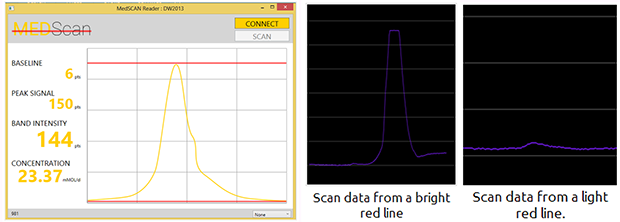
A bit of biology and nutrition before we roll into this: Ketosis is when your body runs on fat reserves instead of carbohydrates. This is the basis of diets such as Atkins, and despite the connotations of eating hamburger patties and butter, you can actually lose weight on these diets. One problem with a keto diet is the difficulty of measure how many ketones your liver is processing; this can be done with a urine sample, but being able to measure small amounts of acetone in your breath would be the ideal way to measure ketosis. [Jens] came up with a device that does just that. It’s called Ketosense, and it will tell you how well your keto diet is doing by just having you blow into a sensor.

[Jens]’ device consists of an Arduino, LCD display, and two sensors – one for acetone, and another for temperature and humidity. By carefully calibrating a TGS822 sensor, [Jens] was able to measure the acetone content of an exhaled breath along with temperature and pressure. This gave him a reading in parts per million, and with a short bit of math was able to convert that into something that made sense when talking about ketosis, mmol/l.

Without access to a lab that can measure blood ketone levels, it’s difficult to say if [Jens] device really works as intended. If he were to find his way into a lab, though, it would be possible to correlate his sensor’s values with blood ketone results and improve the accuracy of his sensor.

Building An IR Mouse Interface For The Disabled

[Chris Young] has a physical disability that means he can’t use a mouse very well. He typically uses Dragon Naturally Speaking for moving his mouse using voice commands but has found that it lacks some features he needs and can crash at times.

His solution to this problem was to create a device that will translate IR signals from a simple remote into mouse actions and movements. He is using an Arduino micro for this task, and as you can see in the video it seems to have worked out well for him. He has code and schematics available on his site if you would like to recreate this yourself.

[Chris] has actually built several accessibility devices for himself and others. You should check out his blog for more, including his thoughts on the cost of commercial accessibility equipment vs DIY. If you think you would like to try making a device to help someone with a physical disability access a computer, hop on over to thecontrollerproject.com and join up on the forums.


via thecontrollerproject.com

[Ricky’s] Rugged DVD Player

1Ge9hh

[Ricky] absolutely loves watching DVDs. He is epileptic and is cognitively functioning at a level roughly that of a 6 year old.  His younger brother [Ronnie] noticed that [Ricky’s] DVDs as well as his DVD player never lasted very long due to some rough handling. [Ronnie] stepped up to make [Ricky’s] life just a little bit easier by building this super rugged DVD watching station.

He started by ripping out the front pcb of the DVD player that has all the buttons. [Ricky] can wear through a set of standard buttons in no time, so [Ronnie] extended these to arcade buttons. Then he mounted everything into a custom cabinet that can withstand a considerable amount of abuse.

Now they can load 5 disks in and [Ricky] can watch what he pleases without worry of destroying the player.

[Ronnie] mentioned that he’d like to make a more complex control system using some kind of microcontroller, but frankly I find the simplicity of this to be perfect. Maybe a media pc loaded with movies might be a decent next step. You can see [Ronnie’s] build log here.

If you’ve ever considered making something like this to improve someone’s life, you should check out thecontrollerproject.com where people with special needs can connect with people who can build interfaces.