Towards A Low Cost, Desktop CT Scanner

For [Peter Jansen], the most interesting course in grad school was Advanced Brain Imaging; each class was a lecture followed by a trip to the imaging lab where grad students would take turns being holed up in a MRI machine. A few years into his doctorate, [Peter] found himself in a very opportune situation – his local hackerspace just acquired a shiny new laser cutter, he had some free time on his hands, and the dream of creating a medical imaging device was still in the back of his mind. A few weeks later, the beginnings of an open source CT scanner began to take shape.

This isn’t an MRI machine that [Peter] so fondly remembered from grad school. A good thing, that, as superconducting magnets chilled with liquid helium is a little excessive for a desktop unit. Instead, [Peter] is building a CT scanner, a device that takes multiple x-ray ‘slices’ around an axis of rotation. These slices can then be recompiled into a 3D visualization of the inside of any object.

The mechanics of the build are a Stargate-like torus with stepper motor moving back and forth inside the disk. This, combined with the rotation of the disk and moving the bed back and forth allow the imager to position itself anywhere along an object.

For the radioactive detector, [Peter] is using a CCD marketed as a high-energy particle detector by Radiation Watch. Not only does this allow for an easy interface with a microcontroller, it’s also much smaller than big, heavy photomultiplier tubes found in old CT scanners. As for the source, [Peter] is going for very low intensity sources, most likely Barium or Cadmium that will take many minutes to capture a single slice.

The machine operates just above normal background radiation, so while being extremely safe for a desktop CT scanner, it is, however, very slow. This doesn’t bother [Peter], as ‘free’ time on a CT scanner allows for some very interesting, not seen before visualizations, such as a plant growing from a seed, spreading its roots, and breaking the surface as a seedling.

[Peter] still has some work to do on his desktop CT scanner, but once the stepper motor and sensor board are complete, he should be well on his way towards scanning carrots, apples, and just about everything else around his house.

Artificial Leg Comes With A Normal Gait!

steppingouti

Did you know over 50% of amputees take at least one fall per year due to limited prosthetic mobility? That compares to only about a third of all elderly people over the age of 65!

[Professor Mo Rastgaar] and his PhD student [Evandro Ficanha] set out to fix that problem, and they have come up with a microprocessor controlled prosthetic foot capable of well, to put it bluntly, walking normally.

Working with a scientist from the Mayo Clinic, the pair have created a prosthesis that uses sensors to actively adjust the ankle to create a normal stride. Commercially available prosthetics can do this as well, but can only adjust the foot in an up-down motion, which is fine — if you only plan on walking in a straight line. In addition to having an ankle that can also roll side-to-side and front-to-back based on sensor feedback, they have also moved the control mechanism up the leg using a cable-driven system, which lightens the foot making it easier to use.

We find the test apparatus almost as interesting as the prosthesis itself. The researchers had to come up with a way to measure the performance of the prosthesis when used to walk in an arc. The solution was the turn-table treadmill seen above.

If you have time, check out the video demonstration on the main article’s page which covers the leg and the treadmill build.

[via Reddit]

Self-stabilizing Spoon For People With Parkinson’s

Here’s a really cool story we just picked up — a gyroscopic steady-spoon, designed for people with Parkinson’s disease or other tremor inducing ailments.

The creator [Anupam Pathak] is close to people who suffer from tremors, and seeing the problem up close and personal, he set out to create a solution. He started the company called Liftware, and has so far released the Lift spoon. It features an embedded microchip, sensors and a few small motors. It’s capable of stabilizing tremors of up to 2 inches, which in several medical studies resulted in approximately a 70% tremor cancellation rate!

If you haven’t seen the effects of Parkinson’s on anyone, watch the video after the break. You’ll have your heart strings pulled a bit seeing how difficult eating can be, but then amazed at the ingenuity and effectiveness of the Lift Spoon. We can only imagine the paradigm shift this will be for people suffering from tremors.

Continue reading “Self-stabilizing Spoon For People With Parkinson’s”

Electrooculograph (EOG) From A Video Stream

[Michael] from Lucidcode is at it again, this time with an Android app called Halovision.

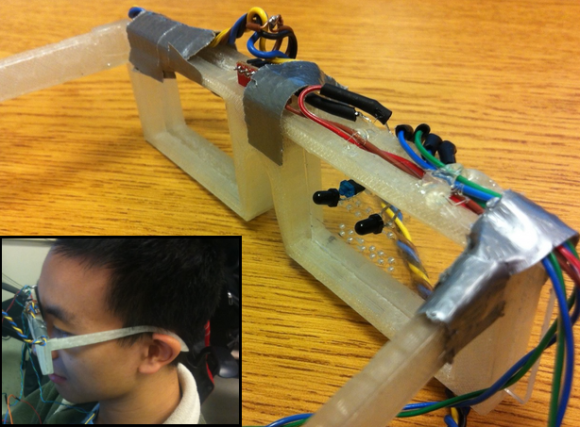
In case you don’t remember, this is the guy who has been working on the Lucid Scribe Project, with the end goal of communicating from inside your dreams! Here’s the basic gist of it. If we can use a sensor to detect REM (rapid eye movement) or body movement during sleep, we can tell if we’re dreaming — then it’s just a matter of using an audible cue to inform the sleeper of the dream, so they can take control and become lucid.

The first way they did this was by using commercial EEG headsets to detect REM. We covered a hack on modifying one so it would be more comfortable to wear at night, but what is really exciting is [Michael’s] new app, Halovision — No EEG required

It’s an Android app that uses the camera to detect movement during sleep, and it is only the first plugin planned for Lucid Scribe. The algorithm is still in its experimental stages, but it is at least somewhat functional at this time. They note it’ll only work for day-time naps or with a bright night light, but this could be easily solved with an IR webcam and a few IR LEDs.

It will be interesting to see where this all goes, has anyone else been following or participating in Lucid Scribe?

Couch To 5K With 1K To Spare

In a market full of Fitbits, Misfits, and Fuelbands, it’s easy to get carried away with sophisticated personal fitness tracking technology.  That’s why [André] took a totally different approach with his super simple run tracking device, the C25K machine.

C25K stands for “Couch to 5k” which is a slimmed down exercise schedule designed to gradually bring people who have otherwise no exercise routine up to a level of fitness where they can run a 5k in just 9 weeks.  To keep participants from wearing themselves out too early, the routine specifies a sequence of running and walking periods to be completed in series on specific days.  Though simpler than most fitness plans, it’s still a lot to keep track of especially when you’re sweating so hard you can barely see your stopwatch.

André found a solution using a bare-bones circuit based on the ATTiny2313.  After loading the C25k calendar into its firmware (which takes up less than half of its 2K of flash), he needs only to toggle the dipswitch to select the appropriate day of the program, and the little device (scarcely larger than a key fob) will beep to let him know to switch from running to walking or back again.

Definitely a great project for any hobbyist looking for a geeky way to get in shape.

A Pick And Place Tool From Medical Equipment

neb

A vacuum tool is an invaluable tool if you’re working with tiny SMD parts, and even with tweezers you might have a hard time placing these nearly invisible components on their pads for soldering. One tool that’s really great for these parts is a vacuum pen, usually made from an old aquarium air pump. [Jon] may have found a much more suitable piece of equipment to scavenge for a vacuum pen build – a nebulizer.

Nebulizers provide asthmatics with low pressure, low volume air to atomize medication for inhalation. Inside the nebulizer is a small diaphragm pump, just like the small aquarium pump teardowns we’ve seen. In just five minutes, [Jon] tore his thrift store nebulizer apart and reversed the flow of air, turning something that blows into something that sucks.

After the suction part of the build was finished, [Jon] needed a way to pick up small components. He did this by blunting a large hypodermic needle and fastening it to the end of a Bic pen with heat shrink tubing. After drilling a small hole in the pen body, he had a very nice looking SMD vacuum pump.

Wheelchair Hack Lets Two-year-old Explore On His Own

[Shea’s] son [Alejandro] was born with Spinal Muscular Atrophy which limits his ability to move. The ability to explore one’s environment as a toddler is really important to development so [Shea] and his wife have been looking into assistive technology. Their health insurance paid for a medical stroller when he was nine-months old and has told the family they need to wait five years for a powered wheelchair. Rather than wait, [Shea] took it upon himself to hack a wheelchair his son could control.

He found a used adult-sized motorized wheelchair on eBay for about $800. Not cheap, but way more affordable than a brand new unit. This type of chair is made to be controlled with a joystick, an option not available to his son at this point. Foot control was an option if he could figure out how to build an interface.

After unsuccessfully trying to repair a broken digital kitchen scale [Shea] was inspired to reuse the sensors as pedal inputs. [Alejandro] has limited foot strength and the sensitive strain gauges are perfect for picking it up. Above you can see the sandal-based interface he built. The two feet working together affect steering as well as forward and reverse. The pedal system is connected to the wheelchair using a Digital to Analog converter chip to stand-in for the original analog joystick. After the break we’ve embedded a video of [Alejandro] exploring the outdoors in the finished chair.

In this case it’s fortunate that [Shea] has the skills to build something like this for his son. We hope this will inspire you to donate your time an know-how to help those in your own community who are in a similar situation. This really takes the concept of The Controller Project to the next level.

Continue reading “Wheelchair Hack Lets Two-year-old Explore On His Own”