
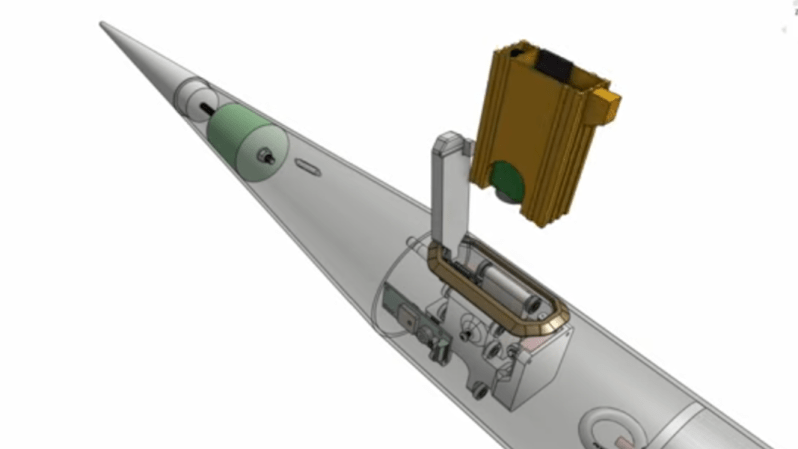
For those who haven’t been following along, [BPS.space] aka [Joe] is on a journey to launch a home-built rocket past the line where it will officially reach outer space. But one does not simply launch a rocket to outer space on the first try. The process is long and involves not only building a series of rockets, but designing and building propellant mixtures, solving aerodynamic problems, gaining several model rocket certifications along the way, and a whole host of other steps. He’s also documenting the entire process on video as well, which involves some custom camera work like this rocket selfie camera which will take an image of his rockets at apogee.
Like most problems in high-power rocketry, extremely tiny problems have a way of causing catastrophic failure, so every detail needs to be considered and planned for in the final design. For a camera that needs to jettison itself from the rocket at a precise moment after experiencing an incredible amount of forces, this is a complicated problem to solve. The initial design involves building a sled for a small deconstructed GoPro which uses springs and a servo to launch itself out of the rocket. The major problem with the design is that even the smallest torque on the sled will cause the camera to point in a random direction by the time it’s far enough from the rocket to take a picture. [Joe] tried a number of design iterations but could not get these torques to vanish.
One of the design limitations with this camera is that it won’t have any sort of parachute or tether itself to the rocket, so it will hit the ground at its terminal velocity. To keep that velocity down and improve survivability chances of the footage, the mass has to stay low. Eventually he settled on a semi-active control system by mounting a brass weight on a small motor, giving the camera module enough stability to stay pointed at the rocket long enough to take the video. Even though it hasn’t flown yet, admitting his first design wasn’t working at compromising on this solution which adds a bit of mass seems to be a good design change. We’ve been following along with his entire process so be sure to check out his actual rocket motor builds and teardowns as well.












Kármán Line is 100km. https://en.wikipedia.org/wiki/K%C3%A1rm%C3%A1n_line
Otherwise, an interesting article.
BPS.space’s long term goal is to get to the Karman line. Nobody said this rocket is doing that.
Too much advertising. Wanted more rocket details less 3d printer sponsor. At least a balance.
Interesting too will be an article about permissions needed to such high rising efforts.
Launch it in international waters off a boat – no permissions required?
Have you not been paying attention as the US has been blowing up fishermen?
“Fishermen” in speed boats loaded down with bags of fentanyl headed for US shores. Other than that small tidbit, you got it right. Congratulations. Great project though. I hope he succeeds.
That is awfully hard to prove if you have just blown up all the evidence and killed all the witnesses.
Depending on where you are, the permissions may amount to mere notification, or nothing at all.
For the US:
https://www.faa.gov/air_traffic/publications/atpubs/pham_html/chap31_section_2.html
(waiver/authorization is not always required; this emphasizes the cases where they are required, but does mention the exceptions)
Simplified for understanding, but not authoritative (and doesn’t cover Class 3 rockets):
https://www.nar.org/FAARegulations
When you’re a star, they let you do it.
I also know of KegRocket. Any other notable private rocketry projects?
SpaceX? Blue Origin? Virgin Galactic?
I know that’s not what you’re asking for, but basically all the big players are private now. It’s cheaper for governments to buy space on rockets than to make their own.
Publicly traded companies are not private projects.
Copenhagen Suborbitals.
Woah, thanks.
I actually watched the video all the way through whilst having breakfast this morning, except for the hard wired advert, which i skipped. It was a nice video, but came away with the problem that Joe was facing was caused by the release catch and all he had to do was mount the whole thing permanently upside down. … or am i missing something? Nothing wrong with upside down video.
Did he consider using a fisheye or 360 degrees camera ?
Joe is right on…he could be working with any of the companies but he has set a goal and has been headed towards it along the way hooking up with I hope a woman who is his GF. He sure deserves a cool woman, maker, creator, engineer, who is often in the background of his videos but has her own YouTube presence. He landed a booster like SpaceX using a gimbelled terminal guidance (he is often flirting with ITAR but is a member of Friends of Amateur Rocketry) this is serous group overseeing high power amateur rocketry and university space and areospace competitions. He is being very careful and professional from making and mixing his own ablative lining, a custom solid rocket formula, tests everything, documents everything, a PPE and safety adherent. His success will be his CV to do or found his areospace company. The flight computers and he uses commercial backups but his main flight computer is of his own design and made using his own components on the PCB he laid out himself. He’s made some adjustments to its improved the antennas improved the design of the layout of the GPS and GPS antennas on the exterior for better telemetry and GPS satellite reception. He has his own inertial movement sensors and barometric pressure devices on his flight computer and then he has a backup commercial one that he uses as a benchmark against his own. He has really done a good job at getting where he is arrived while at the same time keeping it fun for himself and keeping it interesting. When he makes an attempt for the Carmen line after he feels like he has achieved or earned the right to shoot a rocket of that power that far and with all of the sensors and special features that he wants to have a part of his shot he will do it. That will probably Mark the end of his career as a content creator and begin his career as a founder of an aerospace company that very will likely turn into something very akin to SpaceX he’s the next Musk. I don’t know if he even knows that himself but I believe that he is.
I just wish more would look at different morphologies:
https://up-ship.com/blog/?p=350
https://falsesteps.wordpress.com/2016/10/10/stcaem-cab-a-mouthful-of-a-mars-mission/
Maybe not good for solids, but having parachutes down the length of a tube with tanks ejected on risers instead?