Building A Rubik’s Cube That Solves Itself

If you’re really good, it’s possible to solve a Rubik’s Cube in under 10 seconds. For the rest of us, though, it can be an exceedingly tedious task. For that reason, you might like a Rubik’s Cube that can solve itself, like the one [zeroshot] is trying to build.

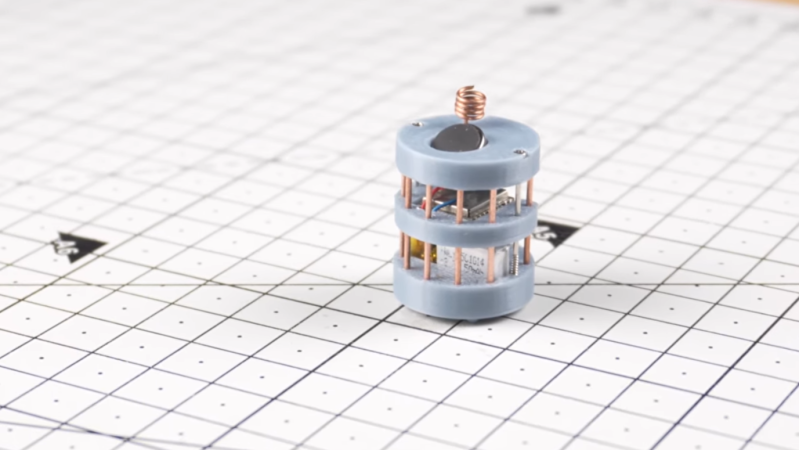
What [zeroshot] built is essentially a very small robotic platform inside the center section of an existing Rubik’s Cube. It uses five gear motors that are assembled into the cube’s core, which have enough torque to rotate the individual faces quite easily. While six motors would allow more efficient solves in fewer moves, it was easier to fit just five motors inside the cube, and they’d still get the job done. The motors are controlled by an ESP32, hooked up to a bank of DRV8833 motor drivers. For now, the cube is still a work in progress. While the core can move the faces, [zeroshot] is trying to figure out how to best tackle the problem of feedback in the limited space available. After all, the ESP32 needs to know where the faces are if it’s to make the right moves to reach a solved state. Soldering wires between individual modules can be quite space inefficient; this is one build that might benefit from being integrated onto a single tiny PCB.

We’re used to seeing robots that grab a Rubik’s cube and solve it for you; we haven’t seen a lot of cubes that solve themselves. Regardless, this feat has been achieved before. Video after the break.

Continue reading “Building A Rubik’s Cube That Solves Itself”

Record-Breaking Robots At Guinness World Records

If you ever wanted to win a bar bet about a world record, you probably know about the Guinness book for World Records. Did you know, though, that there are some robots in that book? Guinness pointed some out in a recent post.

Ever wonder about the longest table-tennis rally with a robot or the fastest robotic cube solver? No need to wonder anymore.

Our favorite was the fastest robot to solve a puzzle cube. This robot solved the Rubik’s Cube in 103 milliseconds! Don’t blink or you’ll miss it in the video embedded. Of course, the real kudos go to the team that created the robot: [Matthew Patrohay], [Junpei Ota], [Aden Hurd], and [Alex Berta].

Another favorite was the smallest humanoid robot. In order to win this record, the robot must be able to move its shoulders, elbows, knees, and hips just like a human. It also has to be able to walk on two feet. This tiny little guy meets the requirements and stands only 57.6 mm (2.26 in) tall! Created by [Tatsuhiko Mitsuya] in April 2024, this robot can be controlled via Bluetooth.

We’ve seen entries in this category before — check them out in Almost Breaking The World Record For The Tiniest Humanoid Robot, But Not Quite.

Continue reading “Record-Breaking Robots At Guinness World Records”

A photo of the robot and the controller

A Simple $25 Robot Based On The ESP32

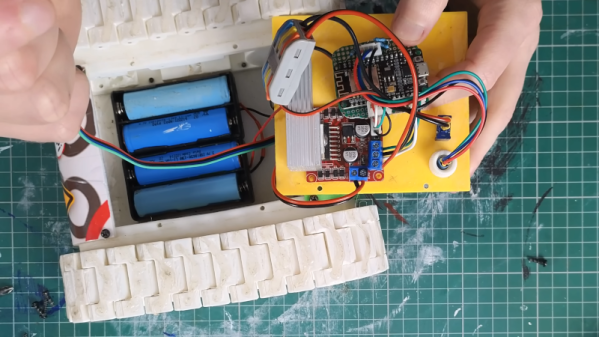
[Paul McCabe] wrote in to let us know about his $25 robot. This small wheeled robot is based on an ESP32 and made using cardboard and hot glue.

You drive the contraption using a Bluetooth game controller thanks to the Bluepad32 library, which boasts a long list of supported hardware. [Paul] provides a Bill of Materials (BoM), complete with current component pricing. We don’t know about you, but it struck us as funny that the microcontroller is less expensive than the battery! Ah, the times we live in. Also [Paul] assumes you already have an appropriate Bluetooth controller and doesn’t include that in the total cost.

Continue reading “A Simple $25 Robot Based On The ESP32”

Robot Phone Home…Or Else

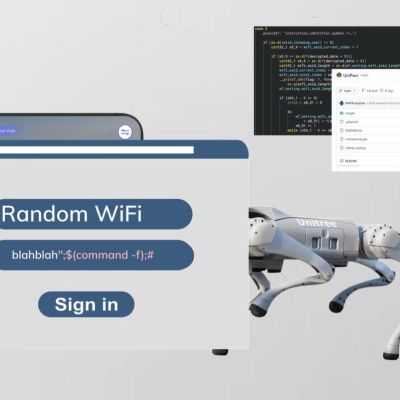
We would have enjoyed [Harishankar’s] tear down of a robot vacuum cleaner, even if it didn’t have a savage twist at the end. Turns out, the company deliberately bricked his smart vacuum.

Like many of us, [Harishankar] is suspicious of devices beaming data back to their makers. He noted a new vacuum cleaner was pinging a few IP address, including one that was spitting out logging or telemetry data frequently. Of course, he had the ability to block the IP address which he did. End of story, right?

No. After a few days of working perfectly, the robot wouldn’t turn on. He returned it under warranty, but the company declared it worked fine. They returned it and, indeed, it was working. A few days later, it quit again. This started a cycle of returning the device where it would work, it would come home and work for a few days, then quit again.

You can probably guess where this is going, but to be fair, we gave you a big hint. The fact that it would work for days after blocking the IP address wouldn’t seem like a smoking gun in real time.

Continue reading “Robot Phone Home…Or Else”

High Performance Motor Control With FOC From The Ground Up

Testing the FOC-based motor controller. (Credit: Excessive Overkill, YouTube)

Vector Control, also known as Field Oriented Control or FOC is an AC motor control scheme that enables fine-grained control over a connected motor, through the precise control of its phases. In a recent video [Excessive Overkill] goes through the basics and then the finer details of how FOC works, as well as how to implement it. These controllers generally uses a proportional integral (PI) loop, capable of measuring and integrating the position of the connected motor, thus allowing for precise adjustments of the applied vector.

If this controller looks familiar, it is because we featured it previously in the context of reviving old industrial robotic arms. Whether you are driving the big motors on an industrial robot, or a much smaller permanent magnet AC (PMAC) motor, FOV is very likely the control mechanism that you want to use for the best results. Of note is that most BLDC motors are actually also PMACs with ESC to provide a DC interface.

Continue reading “High Performance Motor Control With FOC From The Ground Up”

Printing An Air-Powered Integrated Circuit For Squishy Robots

There’s no rule that says that logic circuits must always use electrically conductive materials, which is why you can use water, air or even purely mechanical means to implement logic circuits. When it comes to [soiboi soft]’s squishy robots, it thus makes sense to turn the typical semiconductor control circuitry into an air-powered version as much as possible.

We previously featured the soft and squishy salamander robot that [soiboi] created using pneumatic muscles. While rather agile, it still has to drag a whole umbilical of pneumatic tubes along, with one tube per function. Most of the research is on microfluidics, but fortunately air is just a fluid that’s heavily challenged in the density department, allowing the designs to be adapted to create structures like gates and resistors.

A transistor or valve using a silicone membrane. (Credit: soiboi soft, YouTube)

Logically, a voltage potential or a pressure differential isn’t so different, and can be used in a similar way. A transistor for example is akin to the vacuum tube, which in British English is called a valve for good reason. Through creative use of a flexible silicone membrane and rigid channels, pulling a vacuum in the ‘gate’ channel allows flow through the other two channels.

Similarly, a ‘resistor’ is simply a narrowing of a channel, thus resisting flow. The main difference compared to the microfluidics versions is everything is a much larger scale. This does make it printable on a standard FDM printer, which is a major benefit.

Quantifying these pneumatic resistors took a bit of work, using a pressure sensor to determine their impact, but after that the first pneumatic logic circuits could be designed. The resistors are useful here as pull-downs, to ensure that any charge (air) is removed, while not impeding activation.

The design, as shown in the top image, is a 5-stage ring oscillator that provides locomotion to a set of five pneumatic muscles. As demonstrated at the end of video, this design allows for the entire walking motion to be powered using a single input of compressed air, not unlike the semiconductor equivalent running off a battery.

While the somewhat bulky nature of pneumatic logic prevents it from implementing very complex logic, using it for implementing something as predictable as a walking pattern as demonstrated seems like an ideal use case. When it comes to making these squishy robots stand-alone, it likely can reduce the overall bulk of the package, not to mention the power usage. We are looking forward to how [soiboi]’s squishy robots develop and integrate these pneumatic circuits.

Continue reading “Printing An Air-Powered Integrated Circuit For Squishy Robots”

Open Source Controller For Old And Expensive Industrial Robots

The Zynq-7000 usage at the core of the robot controller. (Credit: Excessive Overkill, YouTube)

Industrial robots like robotic arms are basically everywhere, albeit usually out of the public’s eye in factories. This also means that they get replaced and scrapped all the time, making for many opportunities to snap up an industrial robot that once cost as much as a pretty fancy car for essentially peanuts. Over the years the bloke behind the [Excessive Overkill] YouTube channel did this a lot, which also revealed the main issue with these ‘cheap’ robots: the electronics and associated software, with the manufacturer rarely going out of their way to appease to hobbyists trying to fix up one of these units, never mind for free.

That said, if you’re persistent enough, you can reverse-engineer these beasts to the point where you can develop your own controller hardware and software solution. This is exactly what was done, resulting in an open source controller, found on the ExcessiveMotion GitHub page, that should allow you to control many of these industrial robots. At the core is a Zynq-7000 hybrid FPGA-ARM SoC chip, running real-time Linux (with preemptive scheduling patch) on the SoC side and custom HDL on the FPGA side to handle the hard real-time tasks.

The controller during testing. (Credit: Excessive Overkill, YouTube)

The controller is made to be modular, with a backplane that can accept various interface cards in addition to the current RS-485 and RS-422 interfaces that are commonly used in industrial settings, such as here for controlling the individual servo drives of the robots. To make assembly and testing interesting, the first controller and integration with a robot was made ready for display at the Open Sauce 2025 event, requiring things to be rushed along, including reverse-engineering the servo protocol for a small-ish industrial robot suitable for public display and use, as well as developing the kinematics for the robotic arm.

With the controller now demonstrated, clearly this is the perfect time to rush out and get one of these fun industrial robots for a few hundred bucks. Currently the controller is still being finalized, with the author asking for feedback on what it should be able to support. If you have a particularly unusual industrial robot lounging around without the requisite controller, this might be your chance to revive it.

Thanks to [Hans] for the tip.

Continue reading “Open Source Controller For Old And Expensive Industrial Robots”