Phone-grabbing robot

This Bedtime Bot Enforces Better Sleep Hygiene

[Will Dana] is engineering his way to better sleep hygiene. Not satisfied with a simple bedtime reminder notification — such things are easily dismissed, after all — [Will] is offloading self-control onto a robot which will take his phone away at bedtime.

Scrolling in bed is allowed up to a prescribed time. At that time, a rack and pinion-mounted arm rises up from behind his mattress, presenting an open hand, ready to accept the object of his addiction. At this point, a countdown begins. If he does not hand over the device in a matter of seconds, the robot escalates by flashing obnoxiously bright lights in his face.

The nocturnal technology detox is not absolute, however. A button allows [Will] to temporarily retrieve his phone after it has been confiscated. This safety override accounts for the Inevitable situation where he will need to send a last-minute text before nodding off. The flashing light disincentive countdown is restarted upon retrieval, ensuring that [Will] does not cheat his own system for additional scroll time.

As a brief sidebar, [Will] does a nice job explaining how pulse-width modulation works for the purpose of controlling the speed of the rack and pinion mechanism.

For more of [Will’s] projects see this iPad suspension system a Lamp that tracks the location of the ISS and a drum that uses the piezoelectric effect to charge mobile devices.

Continue reading “This Bedtime Bot Enforces Better Sleep Hygiene”

The Zen Must Flow From Arrakis Sand Table

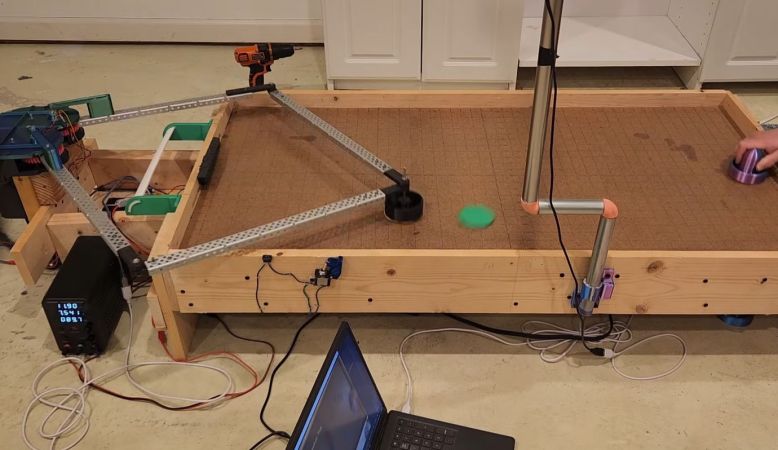
In Dune, the Fremen people of Arrakis practice an odd future hybrid religion called “zensunni.” This adds an extra layer of meaning to the title of [Mark Rehorst]’s Arrakis 3.0 sand table, given that the inspiration for the robotic sand table seems to be Zen gardens from Japan.

The dunes on the tabletop version of Arrakis owe nothing to sand worms, but are instead created a rolling metal ball. With all workings happening below, it looks quite magical to the uninitiated, but of course it’s not magic: it’s magnets. Just beneath the tabletop and its sands, the steel ball is being dragged along by the magnetic field of a powerful neodynium magnet.

That magnet is mounted in a CoreXY motion system that owes more than a little bit to modern 3D printers. Aside from the geometry, it’s using the standard G6 belt we see so often, along with a Duet3D mainboard, NEMA 17 steppers, and many 3D printed parts to hold its aluminum extrusions together. Thanks to that printer-inspired motion system, the ball can whirl around at 2000 mm/s, though [Mark] prefers to run slower: the demo video below shows operation at 1000 mm/s before the sand has been added.

This build was designed for ease of construction and movement: sized at 2’x4′ (about 61 cm x 122 cm), it fits through doors and fits an off-the-shelf slab of coffee table glass, something that [Mark] wishes he’d considered when building version two. That’s the nice thing about jumping in on a project someone’s been iterating for a while: you’ve got the benefit of learning from their mistakes. You can see the roots of this design, and what has changed, from the one he showed us in 2020. 

Naturally you’re not limited to CoreXY for a sand table, though it is increasingly popular — we’ve seen examples with polar mechanisms and even a SCARA arm.

Continue reading “The Zen Must Flow From Arrakis Sand Table”

Using Multiple Quadcopters To Efficiently Lift Loads Together

Much like calling over a buddy or two to help with moving a large piece of furniture and pivot it up a narrow flight of stairs, so too can quadcopters increase their carrying capacity through the power of friendship and cooperation. However, unless you want to do a lot of yelling at your mates about when to pivot and lift, you’d better make sure that your coordination is up to snuff. The same is true with quadcopters, where creating an efficient coordination algorithm for sharing a load is far from easy and usually leads to fairly slow and clumsy maneuvering.

Simplified overview of the motion planner by Sihao Sun et al.

Recently. researchers at the Technical University of Delft came up with what appears to be a quite efficient algorithm for this purpose. In the demonstration video below, it’s easy to see how the quadcopters make short work of even convoluted obstacles while keeping themselves and their mates from getting tangled.

The research by [Sihao Sun] et al. appears in Science Robotics (preprint), in which they detail their trajectory-based framework and its kinodynamic motion planner. In short, this planner considers the whole-body dynamics of the load, the cables, and the quadcopters. An onboard controller for each quadcopter is responsible for translating the higher-level commands into specific changes to its rotor speeds and orientation.

Along with tests of its robustness to various environmental factors, such as wind, the researchers experimented with how many simultaneous quadcopters could work together with their available computing capacity. The answer, so far, is nine units, though they think that the implementation can be further optimized.

Of course, sometimes you just want to watch synchronized drones.

Continue reading “Using Multiple Quadcopters To Efficiently Lift Loads Together”

If IRobot Falls, Hackers Are Ready To Wrangle Roombas

Things are not looking good for iRobot. Although their robotic Roomba vacuums are basically a household name, the company has been faltering financially for some time now. In 2024 there was hope of a buyout by Amazon, who were presumably keen to pull the bots into their Alexa ecosystem, but that has since fallen through. Now, by the company’s own estimates, bankruptcy is a very real possibility by the end of the year.

Hackaday isn’t a financial blog, so we won’t get into how and why iRobot has ended up here,  although we can guess that intense competition in the market probably had something to do with it. We’re far more interested in what happens when those millions of domesticated robots start getting an error message when they try to call home to the mothership.

We’ve seen this scenario play out many times before — a startup goes belly up, and all the sudden you can’t upload new songs to some weirdo kid’s media player, or the gadget in your fridge stops telling you how old your eggs are. (No, seriously.) But the scale here is unprecedented. If iRobot collapses, we may be looking at one of the largest and most impactful smart-gadget screw overs of all time.

Luckily, we aren’t quite there yet. There’s still time to weigh options, and critically, perform the kind of research and reverse engineering necessary to make sure the community can keep the world’s Roombas chugging along even if the worst happens.

Continue reading “If IRobot Falls, Hackers Are Ready To Wrangle Roombas”

Dual-Arm Mobile Bot Built On IKEA Cart Costs Hundreds, Not Thousands

There are many incredible open-source robotic arm projects out there, but there’s a dearth of affordable, stable, and mobile robotic platforms with arms. That’s where XLeRobot comes in. It builds on the fantastic LeRobot framework to make a unit that can be trained for autonomous tasks via machine learning, as well as operated remotely.

XLeRobot, designed by [Vector Wang], has a pretty clever design that makes optimal use of easy to obtain parts. In addition to the mostly 3D-printed hardware, it uses an IKEA cart with stacked bin-like shelves as its main frame.

The top bin holds dual arms and a central stalk with a “head”. There’s still room left in that top bin, a handy feature that gives the robot a place to stow or carry objects.

The bottom of the cart gets the three-wheeled motion unit. Three omnidirectional wheels provide a stable base while also allowing the robot to propel itself in any direction and turn on a dime. The motion unit bolts to the bottom, but because the IKEA cart’s shelf bottoms are a metal mesh, no drilling is required.

It’s all very tidy, and results in a mobile robotics platform that is cheap enough for most hobbyists to afford, while being big enough to navigate indoor environments and do useful tasks.

Continue reading “Dual-Arm Mobile Bot Built On IKEA Cart Costs Hundreds, Not Thousands”

Does 3D-Printed Foam Make Good Custom Tires?

Wouldn’t it be nice to 3D print an entire custom tire for small robots? It sure would, so [Angus] of [Maker’s Muse] decided to investigate whether nifty new filaments like expanding TPU offer anything new in this area. He did more than just print out a variety of smooth tires; he tested each with a motorized platform attached to a load cell, driving on a dusty sheet of MDF to simulate the average shop floor, or ant weight combat robot arena.

Why bother making your own wheels? As [Angus] points out, when one is designing their own robots from scratch, it’s actually quite difficult to find something off the shelf that is just the right size. And even if one does find a wheel that is just right, there’s still the matter of fitting it to the shaft. Things would be so much easier if one could simply 3D print both wheel and tire in a material that performs well.

Like TPU, but squishier.

Here’s what he found: Siraya Tech’s TPU air filament (about 70A on the Shore hardness scale) performed the best. This is TPU plus a heat-activated additive that foams up during extrusion, resulting in a flexible print that looks and feels more like foam than usual TPU. It makes a promising tire that performs as well as it looks. Another expanding filament, PEBA air (also from Siraya Tech) didn’t look or perform as well, but was roughly in the same ballpark.

Both performed better than the classic DIY options of 3D-printed plain TPU, or laser-cut EVA foam. It’s certainly a lot less work than casting custom tires.

What about adding a tread pattern? [Angus] gave it a try. Perhaps unsurprisingly, a knobby tire has worse traction compared to a smooth tire on smooth MDF. But sometimes treads are appropriate, and as [Angus] points out, if one is 3D printing tires then adding treads comes at essentially zero cost. That’s a powerful ability.

Even if you are not interested in custom wheels, that foaming TPU filament looks pretty nifty. See for yourself in the video, embedded just below. If you find yourself finding a good use for it, be sure to drop us a tip!

Continue reading “Does 3D-Printed Foam Make Good Custom Tires?”

Pi Zero Powers A Little Indoor Rover

Not every robot has to be big. Sometimes, you can build something fun that’s better sized for exploring your tabletop rather than the wastelands of Mars. To that end, [philosiraptor] built the diminutive PITANK rover.

As you might guess from the name, the rover is based on the Raspberry Pi Zero 2. It uses the GPIO pins to output PWM signals, commanding a pair of servos that drive the tracks on either side of the ‘bot. The drivetrain and chassis are made from 3D-printed components. Controlling the robot is handled via a web interface, which [philosiraptor] coded in C# to be as responsive as possible. So you can see where you’re driving, the ‘bot is also kitted out with a camera to provide a live video feed.

Given its low ground clearance and diminutive size, you’re not going to go on big outdoor adventures with PITANK. However, if you wish to explore a nice flat indoor environment, its simple tracked drivetrain should do nicely. We’ve featured a great many rovers over the years; if you’ve got a particularly special one, don’t hesitate to notify the tipsline!