Sustainability Hacks: Solar Panels Built From Old Windows And Factory Rejects

diy_solar_panels

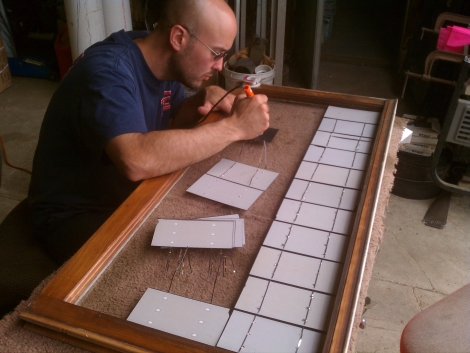
The crew over at The Tech Junkies recently took another look at solar power and thought that the pricing had come down enough for them to consider powering their entire shop via the sun. Cheaper or not, they still didn’t want to pay retail for solar panels, so they decided to build their own instead.

They scoured eBay for a bit and scored a nice batch of “production error” solar cells for about $0.25/watt, which is a great deal. After unpacking and sorting the cells, they began fitting them into a set of old window panels they had sitting around their shop. The cells were wired together using tabbing wire, and after a quick test to ensure everything was working correctly, the panel was permanently set using epoxy.

In its current state, they estimate that their panel can generate 35 watts of power, though they have a few design changes in mind to raise that number a bit. The total cost was roughly $375 for enough materials to build 9 panels, which is pretty reasonable.

Be sure to check out their blog for a quick overview of what it takes to build a solar panel if you’re thinking of putting together one of your own.

Solar-powered RepRap Prints Even When The Power Is Out

solar_powered_3d_printer_reprap

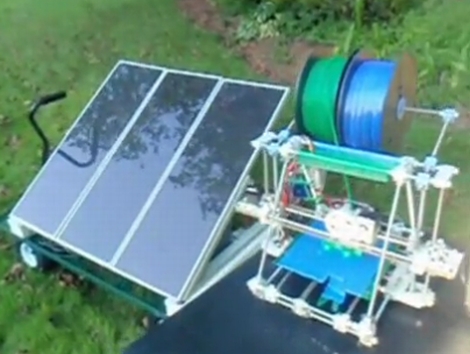
[Mark] wrote in to share a little creation that he is calling the first solar-powered 3D printer in existence. While we can’t say that we totally agree with him on that title, we will give him the benefit of the doubt that this is the first solar-powered RepRap we have seen thus far.

You might remember [Mark] from his previous exploits, but rest assured that there’s little possibility of anyone losing an eye with this one. He has taken his RepRap outdoors, and with the help of a solar panel plus a few batteries from Harbor Freight, he has the world’s first solar-powered RepRap*.

The trick behind keeping the RepRap running for such a long time with the sun as its only power source lies in the RAMPS board [Mark] uses. He has the 1.3 revision of the shield, which enables him to print objects loaded from an SD card rather than requiring a computer to be connected at all times.

So, if you happen to need the ability to print 3D objects where an extension cord cannot possibly reach, check out [Mark’s] setup and get to building!

* Maybe. Perhaps.

Continue reading “Solar-powered RepRap Prints Even When The Power Is Out”

Building A Solar Power Heliostat

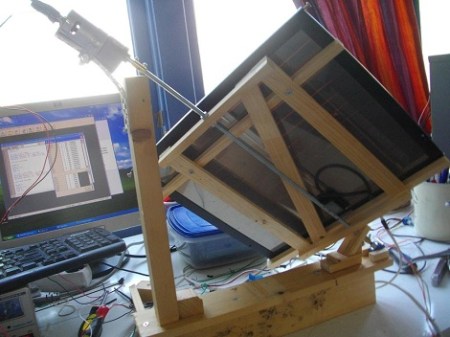
[Frits] has been working on an solar panel heliostat (in Dutch, check out the translated page here).

The heliostat uses a small PICAXE to control the motor, along with an DS1307 real-time clock to make sure the motors start at dawn. Instead of using optical encoders or magnetic sensors, the angle of the heliostat is measure with a pot attached to the drive shaft. [Frits] did a lot of data collection to figure out that this method is accurate to about 1 degree – just fine for something that doesn’t need to be exact.

According to [Frits] this heliostat will put out 12 to 50 percent more electricity than a fixed panel. Although the build does seem a little bulky, putting it on a  house with a roof pitch of 23.5° would greatly reduce the horizontal profile.

A video of a solar panel rotating at 15 degrees/hour isn’t that interesting, so [Frits] posted a clip of 6 mirrors slewing around fairly fast to demonstrate his system. Check it out after the break.

Continue reading “Building A Solar Power Heliostat”

Selective Solar Sintering With Sand

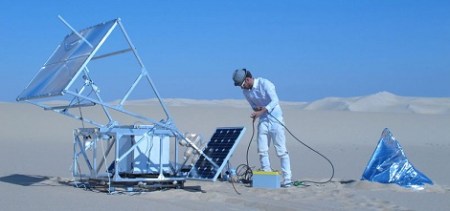
[Markus Kayser] built an amazing solar powered SLS printer, but instead of using lasers and powdered plastics his machine uses the power of the sun to heat sand into complex shapes.

[Markus]’ printer uses the same concept as his earlier solar cutter – burning things with a magnifying glass. Interestingly, the printer isn’t controlled with stepper motors and reprap electronics – it’s completely cam driven. The solar panels only power the motor attached to the frame moving on bearings made from skateboard wheels.

We’d guess that [Markus] is using a little more than 2 square meters of Fresnel lenses in his project. Since solar irradiance is about 120 W/m² (PDF warning), [Markus] is concentrating a lot of energy onto a point the size of a quarter, which would be necessary to heat up sand to its 1500° C melting point. The resolution isn’t what you could get with a laser, but [Markus] was able to print an amazing bowl along with other complex 3d shapes.

Check out [Markus]’ video of the solar sinter printer after the break. There’s also a video of his previous experiment with the solar cutter.

Continue reading “Selective Solar Sintering With Sand”

A Simple DIY Solar Tracker

solar panel

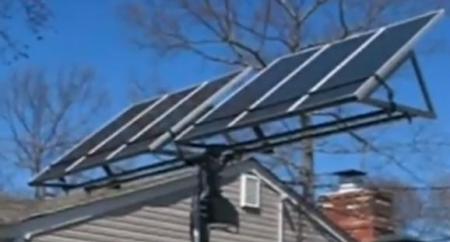
The sun is a great source of energy, however, efficiently collecting this energy can be hard to do.  One thing that can improve the results of solar use is to actually track the sun’s movement. [fanman1981] hooked up his own homebrew solar tracker using some pretty clever techniques.

For this hack he used two Harbor freight 45 Watt solar kits, some struts on the bottom, and a Dish Network satellite dish bracket hooked up to an “old school” antenna motor.  Although one might think this device tracks the sun using some sort of sensor, it’s actually just a matter of hooking up the device to rotate at timed interval with a remote control.  This interval is figured out with the benefit of some charts on livingonsolar.com.

To see it in use, check out the video after the break.  He gives a good explanation about how everything was put together, but if you just want to see it move, fast forward to around 5:26, really quite impressive.

Continue reading “A Simple DIY Solar Tracker”

EReader Battery Never Goes Flat (in The Sun)

solar_powered_kobo

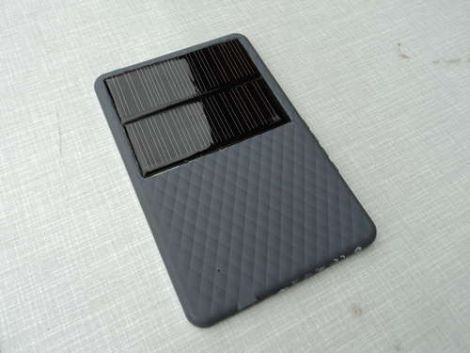
Instructables user [flapke] has a Kobo eReader and wanted to add some solar cells to it in order to charge the battery for free. The modification is similar to others we have seen recently, though his work was done so well that it almost looks stock.

He started out by sourcing a pair of solar panels from DealExtreme that purported to supply 5.5v @ 80mA. Like most of us are inclined to do, he tested them before use and found that they actually put out around 50mA instead. While the performance was a bit off, they still fit his needs pretty well, as the charge current needed to be at or less than 100mA to avoid damaging the battery.

He opened the Kobo’s case, and carefully removed a section of the back panel to make room for the solar panels. Once they were soldered together in parallel, he wired them to the eReader’s battery through a Schottky diode to prevent the battery from draining.

While we think his solar modification is a great way to ensure that he never runs out of juice while reading by the pool, we would certainly add a bit of extra charge circuitry to ours to prevent damage to the battery. What do you think?

Auxiliary Battery Pack For Field Operations

portable_battery_pack

Ham operator [Ken – wa4mnt] wrote us to share a small project that he uses nearly every time he goes out in the field. His portable sealed lead acid battery pack (PDF) always ensures that he has a 12v power source at his fingertips, both for fun as well as in emergency situations.

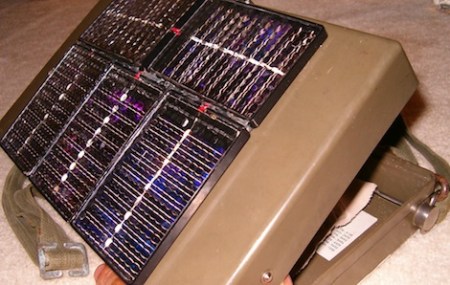
The battery pack is pretty simple, and includes a 12v, 17ah battery strapped into a light aluminum chassis which he fabricated. The battery is secured with zip ties, so it can easily be swapped out or replaced without much fuss. The frame also sports a tiltable 4w, 17.5v solar panel that keeps the battery topped off and ready to go at all times. He stuck a voltmeter to the top of the battery to keep an eye on things, and he employs a 10A fuse to make sure he doesn’t fry any sensitive radio components should something go wrong.

The battery pack is pretty compact when you think about it, and we imagine it would be great to have on hand for a wide array of outdoor activities. Even if you’re not into Ham field operations, it’s hard to argue with its usefulness during power outages.

[Ken] doesn’t appear to have any published plans for the chassis or the electronic portion of the pack, but we’re pretty sure he would share if asked.