
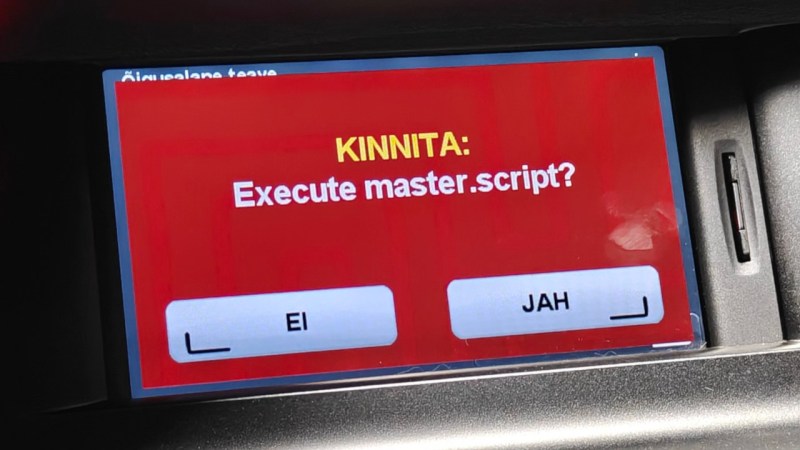
As difficult as it may be to believe, it’s not possible to adjust the time on a 2014 Renault Latitude’s in-dash navigation system unless you have an original SD card with valid map data on it. If you lose that card, or never had it in the first place because you’re not the original owner of the vehicle, you’re out of luck.
That is, unless you’re [Rasmus Moorats]. Not willing to pay for an original Renault SD card just for the privilege of adjusting the time on his vehicle’s dashboard, he set out to hack the navigation system so he could fiddle with its parameters manually.
You might think that the end result of this hack is really only interesting if you happen to own a Renault of a similar vintage, and to a point you’d be right. The part that’s worth sticking around for even if you don’t have an applicable vehicle is the fascinating process of poking and prodding at the car’s embedded Linux operating system which [Rasmus] was kind enough to document for us.
 There’s a lot of ground covered in the write-up, but the short version is that while the navigation system has the ability to load scripts from the SD card, as designed there are pretty strict limits on what said scripts can actually do. The trick for [Rasmus] was to find a way to break out of the limited sandbox.
After a number of only partially successful attempts, he finally found the solution by using the script’s built-in logging functions to overwrite the operating system’s core_pattern string which is executed whenever a process crashes. By then using a different function of the scripting language to intentionally crash a binary, he was able to execute commands of his choosing, and in turn modify the configuration file that held the time data.
If you’ve ever found yourself trying to hack your way through a locked down embedded Linux system, we’re willing to bet at least a few of the tricks [Rasmus] outlines here could come in handy. As for hacking obstinate in-dash navigation and entertainment systems, it gets even harder on more modern vehicles.










Hea töö!
Tänud!
Is that the medianav unit pre gprs/app store revision? I reflashed mine with menarus firmware and the dealership kept trying to revert it to medianav oem firmware by reflashing during routine servicing because I’d enabled the optional extra reversing camera without paying for the option and updated maps myself without paying them 150e to apply a single update. Menarus gave you a filesystem browser and tools to do other things too.
After a few years of this & once it was outside the warantee, I just ripped the medianav out and replaced it with a android headunit with specific shroud, the oem is a ancient underpowered arm soc and crashes quite often. For the price of the android unit, it transforms the usability of the infotainment system into a modern equivalent and ergo gives the car a new lease of life feature wise, and all the stalk controls worked flawlessly, gps suddenly became reliable and it had many many more features.
As for later renaults with the later gprs rlink system and the app store, just vote with your wallets and dont buy them.
I need this for my flat’s doorbell which has slowly been drifting since it’s ±2010 installation (which is weird because it also keeps track of grid frequency, as we could see in the 2018 Kosovo-Serbia grid frequency dip). Such that it was installed when daylight saving time was in effect and now is almost on standard time.
My parents have two ovens, each with their own clock. They keep one on DST, the other on savings, and put a fridge magnet over the wrong one.
An interesting hack, but owning a recent car—especially a Renault—is just asking for trouble.
First, I don’t own a Renault, which already spares me from a whole host of mechanical and electrical issues.
Furthermore, I ripped out the OEM head unit—which was a piece of junk—and replaced it with a proper one.
As for the clock, I simply configured the new head unit to display the RDS time; that way, I don’t have to worry about clock settings, nor daylight saving time changes either.
As a bonus, I replaced the secondary display with a CAN bus unit, which allows me to access and manage diagnostics myself, without needing a painful visit to a mechanic, which didn’t happen since I own this car.
And as for GPS navigation—I don’t need it; I have a functioning brain…
Reminds me of one of my old cars where I got tired of clock drifting away due to the unreliable battery, went to a flea market and bought a $8 watch, which I strapped to the rearview mirror. Unlike the original clock, which was VFD, and car had to be turned on to see the time, the $8 watch showed time (and date) and came with the built-in LE lightup.
Make me think I should have hunted down one of those Casios that are solar-powered “atomic watches” that not only recharge, but set themselves while at it. I think Casio GW series.
The article mentions:
“Sure enough, I discovered the LOG command, which let me truncate a file (defined with #define LOGFILE log.txt) and write a single line to a file of my choosing.”
Anyone explain how that would work? Is #define used by any shell of the Linux shells?
Ok, found it. The custom parser, that the author reversed, supports #define.
“ I reversed ttn, the binary responsible for parsing this script…”
Something very similar happened to me. SD card was missing in Nissan Leaf 2018. Every single settings was stored on the SD card. Including the time zone, bluetooth conected phones etc.
Fortunatelly, I was able to clone a card from my friend’s car. And it worked.