
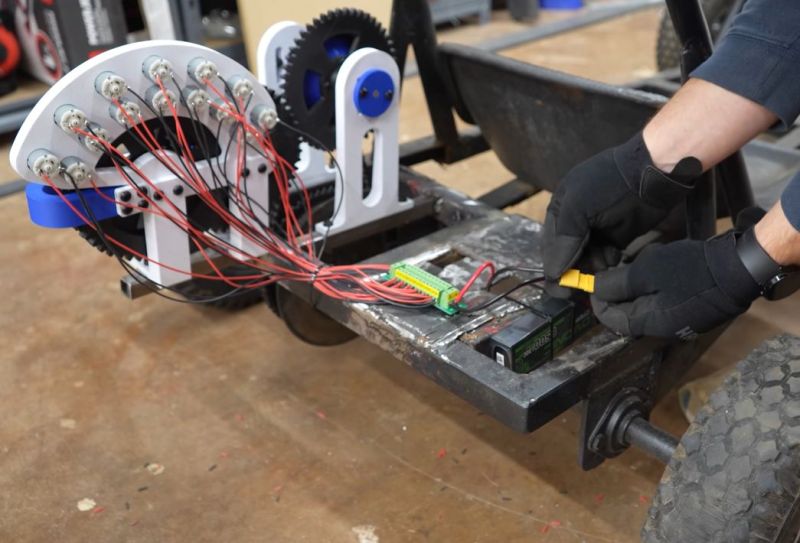
Where Archimedes said that he could move the Earth given a large enough lever and a suitable fulcrum, [Current Concept] decided that he could give his own spin on this quote by swapping the lever and fulcrum for a tiny $1 DC brushed motor and a very large gearing ratio.
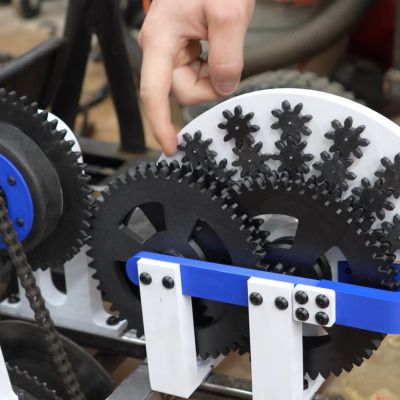
In addition to 3D printing a compound gearbox with the requisite 1,243:1 gear ratio, the video also covers the joys of getting a ‘Craigslist special’ go-kart for about the same price as the electric motor and having to undo many very special modifications.
With that done, the newly printed gearbox was installed, along with the single DC motor to drive it all. This actually managed to propel the go-kart, at a pace that would impress even a snail, so for the next phase instead of a single motor a total of fourteen were used, all adding their tiny bit of torque into the gearbox.
Although one has to keep in mind that the gearbox and chain mechanism will also take its slice of the provided energy along with other inefficiencies, one still cannot beat the laws of physics. Much like Archimedes’ lever powered by a piddly human, the conversion of RPM into torque for these small motors was never going to get you that zippy go-kart experience.
Which isn’t to say that someone shouldn’t totally put some BLDC motors to the task and see how fast a go-kart can be made to move using those and an optimized gearbox.












RAID drive.
LCD display.
What?
Imagine a Beowulf cluster of these go-karts!
RAIM?
2nd-hand car starter motor + 2nd-hand car battery = catapult kart.
Saw one that had a truck starter motor and 24V battery: it did 70mph in seconds! A little bit faster than my Sinclair C5!!!
That’s what I always tell myself I’m going to do with the bucket of starter motors in the garage
Another foolish and impractical follow-up idea:
Instead of having them a bunch of tiny motors all ganged together and running at the same rpm, have different sets of motors driving different parts of a cascading planetary gearset, somewhat like in the transmission on a prius. Each motor (or motor set) could be driven at whatever RPM and direction is optimal, giving you a pseudo-CVT capable of more low-end torque and high-end speed than chaining the motors in series.
… maybe. Or it might just add unnecessary weight and complexity and points of failure.
back in the esk8 days, they called this “dual uneven drive” or something similar. the idea was torque from the lower rpm motor and top speed from the higher rpm motor.
its not really worth it, makes more sense to use two higher rpm motors
14x $1 funny toothbrush motors when there already is mass market solution for this.
Andrew Camarata went thru a bunch of kids Ride-On EVs some time ago, put speed controllers in them which burned out motors. Had to go back, rip out controllers and replace motors. https://www.youtube.com/watch?v=l4LzXRCDgAY&t=1177s Whole $10 per Rs550 motor, $15 with gearbox.
Electric isn’t as cool as a h2O2 mono propellant rocket driving a gas turbine. (Apologies for not being able to find the original web page and video)
https://m.youtube.com/watch?v=Jm79PKoWY7M