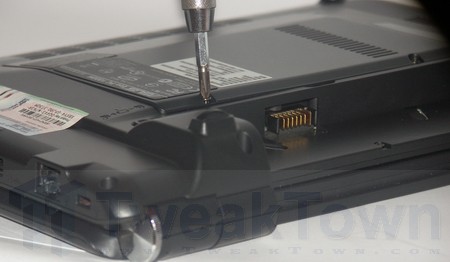
The people at TweakTown completely disassembled a new Eee PC 1000H and documented the entire process. Aside from showing you the side effects of too much tech fetish and not enough regular fetish, the article reveals all the parts of the new Eee, with a few surprises inside. Although it’s an Eee PC, it’s very different from all of its predecessors.
One of the things the teardown shows is that several parts are far more modular than previous Eee PC models. The hard drive, for example, is a standard Seagate Momentus which is made for desktop systems; it can easily be swapped out. Another easily swapped component is the 1GB SIMM from ASint.
Although their (ahem) stripping process was a bit unconventional, a lot of interesting information was yielded from this teardown. Keep ’em coming, TweakTown, just be sure to clean off your tool when you’re done.
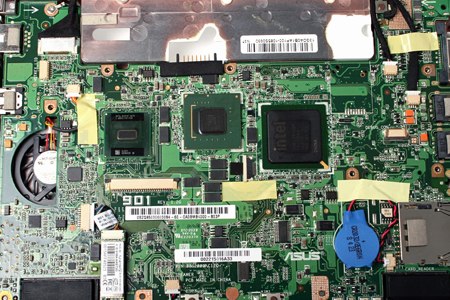
The folks from bit-tech have done us a great service by tearing open the Eee PC 901. Under the keyboard is a large metal plate that acts as the processor’s heat sink. The 4GB SSD card is not soldered to the board this time around. There is some empty space labeled IDE3 and solder points that say 3GCard, which definitely deserve further investigation. The oddest thing they found was a button with no indication to its purpose. It looks like a good machine and we hope to see more Eee PC hacks in the future.
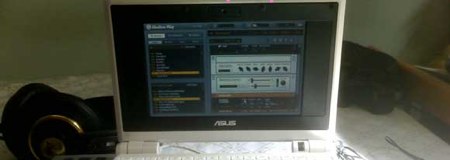
Create Digital Music has been watching the Asus Eee PC closely. The laptop’s portable nature and low price-cheaper than a turntable-have made them desirable to both producers and performers. CDM has collected links to many people that are figuring out how to leverage the lightweight rig. [Dan Stowell] put together a tutorial for SuperCollider, the real time audio synthesis engine. The machine is good for simple text based tracker software too. On the Windows side, a lot of software, like Guitar Rig, can be enabled with just a little display driver hacking. This really makes us wonder when we’ll see the first Eee PC keytar mod.
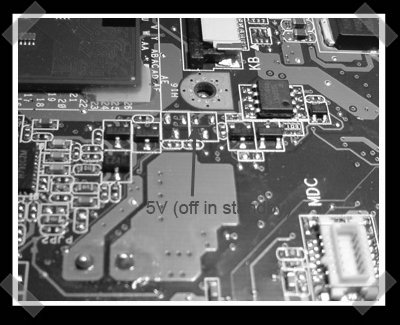
There isn’t anything hacked into it yet, but [tnkgrl] spent some time hunting around her Eee PC for some handy hackable extras. I’d been ignoring them, but now I want one. Oh yes, I do. Hit the writeup for details, but [tnkgrl] identified some semi un-used USB connections, an accessible 5v supply and a spare mini-pcie slot that seems to disable the SSD when it’s in use. The currently unusable mini-pci slot is actually pretty intriguing.
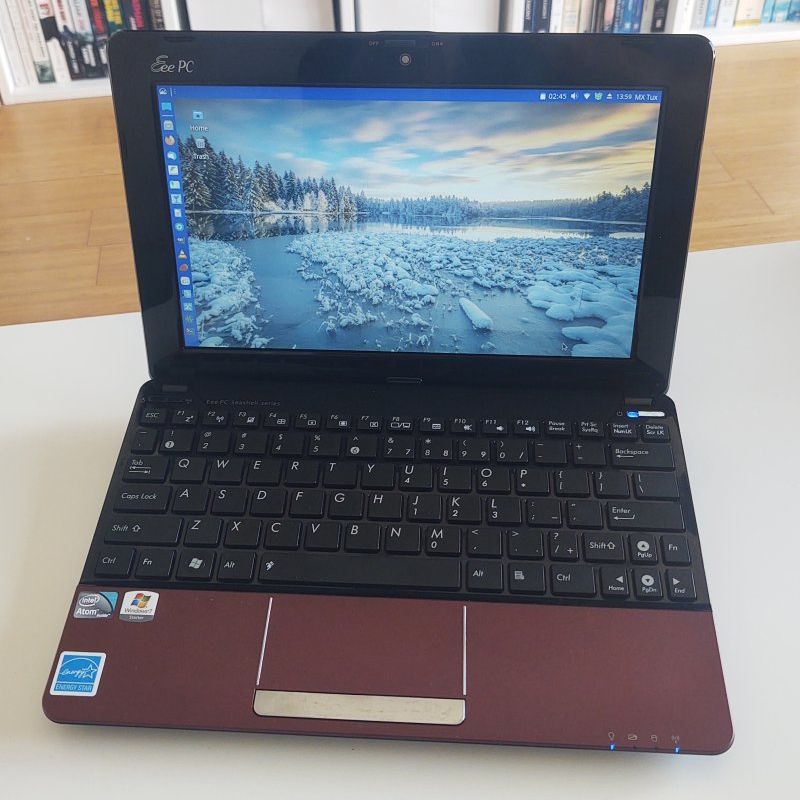
Welcome back to 2010 and the Asus eeePC Netbook, Seashell series. (Credit: Igor Ljubuncic)
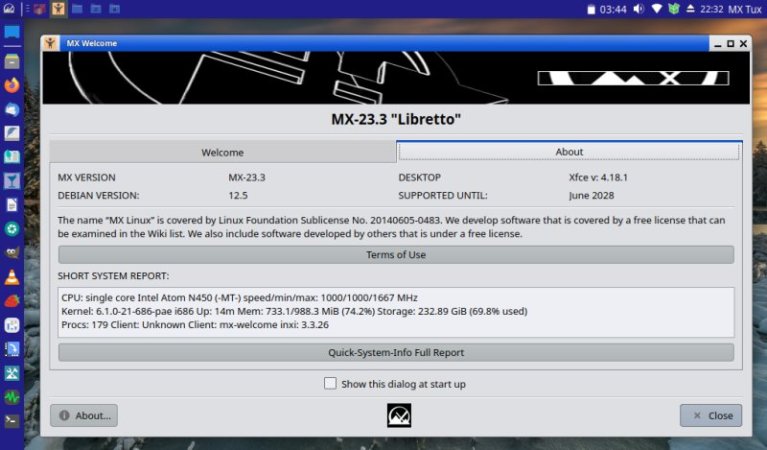
It’s often said these days that computers don’t become outdated nearly as quickly as they did in the past, with even a decade-old computer still more than capable of handling daily tasks for the average person. Testing that theory, [Igor Ljubuncic] revisited the Asus eeePC which he purchased back in 2010. Although it’s not specified exactly which model it is, it features an Intel Atom N450 (1 core, 2 threads) running at 1.67 GHz, 1 GB of 667 MHz DDR2 and a 250 GB HDD, all falling into that ultra-portable, 10.1″ Netbook category.
When new, the netbook came with Windows 7 Starter Edition, which [Igor] replaced with Ubuntu Netbook Remix 10.04, which was its own adventure, but the netbook worked well and got dragged around the world on work and leisure assignments. With increasingly bloated updates, Ubuntu got replaced by MX Linux 18, which improved matters, but with the little CPU struggling more and more, [Igor] retired the netbook in 2019. That is, until reviving it recently.
Upon booting, the CMOS battery was of course empty, but the system happily continued booting into MX Linux. The Debian update repositories were of course gone, but changing these to the archive version allowed for some (very old) updates. This raised the question of whether modern Linux would even run on this ancient Atom CPU, the answer of which turned out to be a resounding ‘yes’, as MX Linux still offers 32-bit builds of its most recent releases. A 15 minute upgrade process later, and a 2 minute boot later, the system was running a Linux 6.1 kernel with Xfce desktop.
As for the performance, it’s rather what you expect, with video playback topping out at 480p (on the 1024×600 display) and applications like Firefox lacking the compact density mode, wasting a lot of screen space. Amazingly the original battery seems to still deliver about half the runtime it did when new. All of which is to say that yes, even a ‘low-end’ 2010-era netbook can still be a very usable system in 2024, with a modern OS.
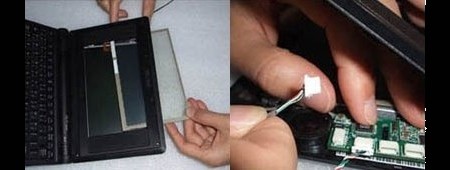
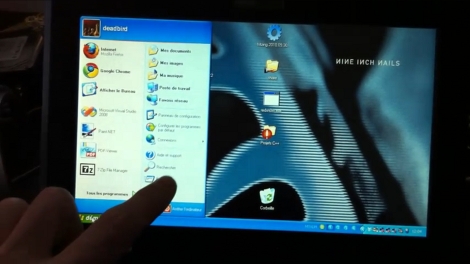
The hardware comes in two parts. There’s the transparent film that covers the screen and the driver board that reads the inputs. The film itself has an adhesive layer on the back that sticks to the LCD panel. But to install it you first must remove the panel from the bezel. You’re also going to need a place to house the driver board. [Deadbird] somehow found enough room inside the case for the controller, but he had to remove the keyboard and motherboard to set it in place. This translates to a complete disassembly of your eeePC. But if you’re used to touch-sensitive devices, and have ever found yourself touching an LCD monitor and wondering why the computer is not following the link, this may be worth it to you. You can see the final product in a clip after the break.