Running A Desktop PC Off AA Alkaline Cells

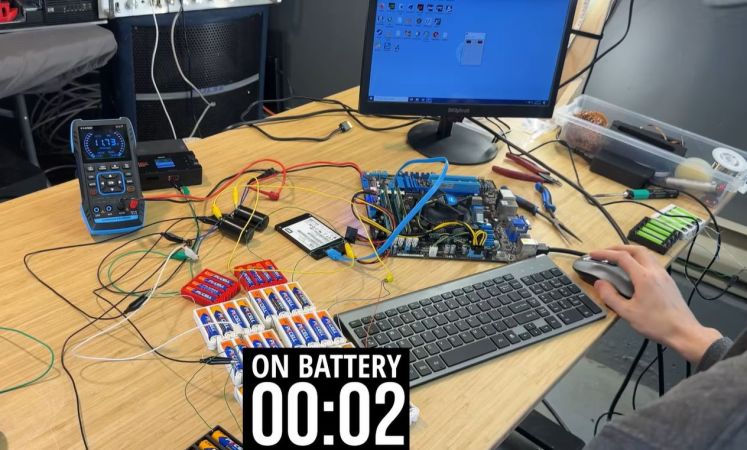
Everyone is probably familiar with the concept of battery-powered devices, but generally, this involves a laptop with a beefy battery pack and hardware optimized for low power draw. You could also do the complete opposite and try to run a desktop PC off alkaline AA cells, as [ScuffedBits] recently did out of morbid curiosity. Exactly how many alkaline cells does it take to run a desktop PC for any reasonable amount of time?

One nice thing about using batteries with a desktop PC is that you can ditch the entire AC-DC power conversion step and instead use a DC-DC adapter like the well-known PicoATX and its many clones. These just take in 12 VDC and tend to have a fairly wide input voltage range, which is useful when your batteries begin to run out of juice. In this case, just above 10 VDC seemed to be the cut-off point for the used DC-DC adapter.

In the end, [ScuffedBits] used what looks like 56 alkaline AA cells connected in both parallel and series, along with two series-connected 6,800 µF, 40V electrolytic capacitors to buffer the spikes in power demand, after early experiments showed that the cells just cannot provide power that quickly. Although admittedly, the initial thin wiring didn’t help either. With alkaline rather than carbon AA cells, improved wiring, and some buffer capacitors, it turns out that you can indeed run a desktop PC off AA cells, if only just about long enough for a small game of Minesweeper.

Amusingly, the small LCD monitor used in the experiment drew so little power that it happily ran on eight NiMH cells for much longer, highlighting just how important power conservation is for battery-powered devices. We wonder if you could marry this project to a battery project we saw and end up with something practically portable?

Continue reading “Running A Desktop PC Off AA Alkaline Cells”

Cooking A Turkey With 880 AA Batteries

Cooking a turkey right is serious business this time of year. With major holidays on the line, there’s no room for error – any mistake can leave guests disgruntled and starving. [Stephen Farnsworth] took a risk, though, and attempted to cook a turkey using AA batteries.

The allure of the AA for such a task is precisely because it’s such a poor choice. Designed for portability rather than high power output, it was never designed to be the energy source for a major cooking job. To get things over the line, [Steve] busted out the math to figure out how many batteries would be required. This involved computing cooking efficiencies, battery thermal performance, and the specific heat of the bird itself. With the numbers coming together a 300W slow cooker was put on duty, in order to avoid over-draining the batteries.

With 880 AAs loaded into a custom carrier, [Steve] hooked up the power meter and the cooker and kept a close eye on the temperatures. After a couple of hours, the battery pack started to heat up, so additional cooling was brought in to avoid fire. At just before the six hour mark, the turkey was cooked through and ready to eat. Estimates are that the batteries still had plenty of capacity to keep going for a few hours yet, too.

It’s not a fast or effective way to cook a turkey, but it’s certainly achievable. We fully expect [Steve] to submit the coin-cell turkey cook-off next year, too. Remember, a little engineering always helps, especially in the kitchen. Video after the break.

Continue reading “Cooking A Turkey With 880 AA Batteries”

Pocket High Voltage Generator Becomes Great Test Tool

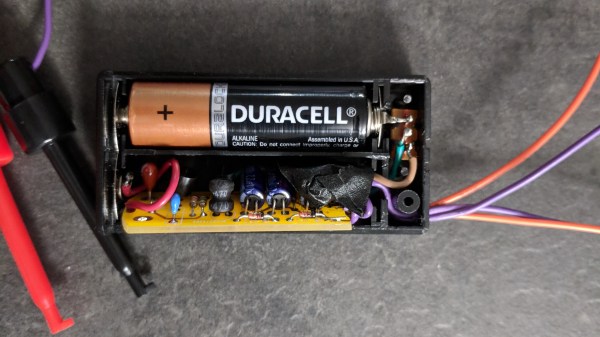
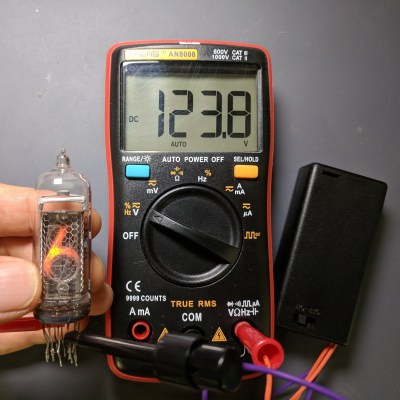
[The LED Artist] often found a need for a relatively high voltage (100 to 200 Volt) but low current DC power supply, and it turns out that a small HV generator that uses a single AA cell only took about an hour to make. The device ended up being a pretty handy tool for testing things like LED filaments (which have a forward voltage of over 60 V), or even neon and nixie tubes.

The device’s low current means that nixie and neon elements won’t light up very brightly, but they will light up enough to verify function and operation. [The LED Artist] reports that touching the output terminals of the generator only causes a slight tingling sensation.



Open-circuit voltage generated from a single AA cell is about 200 V, but that voltage drops rapidly under any kind of load. Even regular LEDs can be safely lit with the circuit, with less than a milliamp being supplied at the two to three volts at which most regular LEDs operate.

[The LED Artist] fit the device into a two-AA battery holder, with a single AA cell on one side and the circuit in the other, and says it’s one of the more useful tools they’ve ever made. LED filaments are fairly common nowadays, but if they intrigue you, don’t forget that [Mike Harrison] covered everything you need to know about experimenting with them.