Apple II Weather Display (part 3)

In parts 1 and 2, I discussed the important parts of what is going on the PC side with lua. While not 110% detailed I hope it gave you an idea on how the data is processed so the Apple II computer could quickly digest it. Now its time to see what happens at the other end of the serial cable. I am using basic, but its not 100% off the rom Applesoft basic, that would be even slower, so I am using a compiler and a fast graphics driver. Both are from “The Beagle Compiler” which was produced by the ever awesome Beagle Bro’s software company, and though still under copyright, the publishers have given permission for use of their software (within reason I don’t think you will get very far selling it).

Continue reading “Apple II Weather Display (part 3)”

Apple II Weather Display (part 2)

In part one of the Apple II weather display I quickly went over how data is fetched and phrased. Now its time to do something with it in part 2. In the order of functions I do the text parts first, and though its very similar to the process that the radar image goes through, its in monochrome and a bit simpler to explain. Before I go into how it works I should explain how I am dividing the Apple II’s screen.

Continue reading “Apple II Weather Display (part 2)”

Apple II Weather Display (part 1)

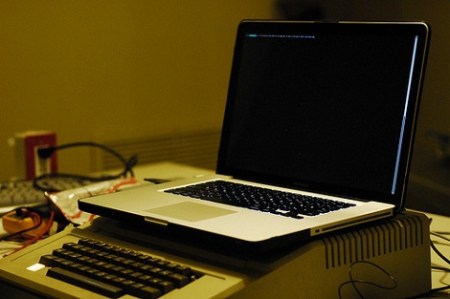
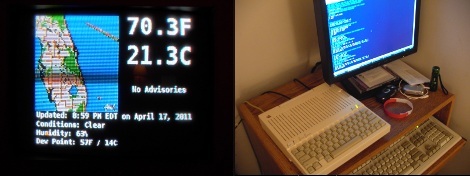
Due to computer issues I had to rob some parts from my “electronics” computer, which wasn’t bad, since I was not working on anything at the time and I felt a software project itch. I also wanted to do something with my Apple //c, which resides on my computer desk, so this ghetto brute force “solution” to use the 25 year old computer as a weather display came about.

In a nutshell there is the Apple II, a serial cable, and a PC running linux mint 10 and a handful of command line utilities. My specific Apple is the fist revision of the //c which means its got a buggy rom and the serial port(s) can be troublesome, the best speed I was able to get was 600 baud with just basic, though every other model could probably go a little faster.

On the linux side, wget downloads html and the radar image from Weather Underground’s mobile site, which is not a perfect source, but its easy. A lua script phrases text and graphics into string patterns that the Apple II can handle as keyboard input, and its sent down a serial cable where it is drawn on screen in basic.

Yea its pretty darn slow … it typically takes about eight to twelve minutes to redraw the screen, which is not all that horrid (imo) considering what is going on, but anyone with a more serious take on this could find numerous ways to optimize it, I just wanted to see what it would look like.

Join us after the break for a short video and to read all the details about how this all works!

Continue reading “Apple II Weather Display (part 1)”

Make An Arduino Talk To You

arduino_speech_synthesis

One of the highlights from the Music Hack Day in Berlin was the Arduino singing “Daisy Bell”. If you don’t know, this is an homage to the HAL 9000 in the movie 2001: A Space Odyssey; an artificial intelligence that was taught the song in its first steps toward self awareness culminating in an attempt to kill its masters.

It’s unlikely an Arduino will every make it to the point of attempted homicide but with the available code you can find out. Sample code and an explanation of human synthesis is now available through the Cantarino project. The project facilitates the use of phonemes from the SAM Apple II synthesizer to build wave forms that make up recognizable speech on the Arduino platform. The code illustrates how to select and link together speech sounds from the library. Check out the video after the break and then get to work on your own speech synthesis. We’re waiting for someone to put together the theme song from the 1980’s Transformers cartoon. Good luck! Continue reading “Make An Arduino Talk To You”