
Skip to content
Logo

Hackaday

  • Home
  • Blog
  • Hackaday.io
  • Contests
  • Submit
  • About

capsela

1 Articles

Building Your Bots The 1980s Way

November 25, 2016 by Jenny List 29 Comments

There are many kits available to today’s hobbyists who wish to try their hand at producing simple computer-controlled robots. Small concoctions of servos and laser-cut acrylic, to which boards such as the Arduino, Raspberry Pi, or Beaglebone can easily be fitted.

In the 1980s though this was a market that was yet to be adequately served. The sheer size of the many 8-bit machines of the day meant they could not be incorporated in your robot, and interfacing to them was a bit more challenging than the easy-to-use GPIOs of their modern counterparts. Then the mechanical hardware of a small robot was something that had not been easily and cheaply packaged for the constructor, making building a physical robotic platform a significant task in itself.

[Jeffery Brace] and [Evan Koblentz] write for IEEE Spectrum about their work at New York City’s World Maker Faire back in October, making a pair of small robots using only components and computers available in the 1980s.
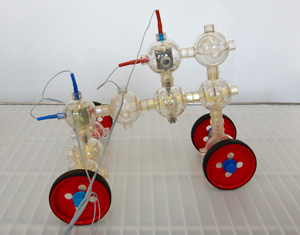
Charlie the robot
Charlie the robot

[Charlie] is a robot based on the Capsela construction system, a toy consisting of interlocking plastic spheres containing different functions of shafts, gears, and motors. There was a Robotic Workshop kit for Capsella that featured a Commodore 64 interface, and it is through this means that [Charlie]’s three motors are controlled. It includes a ROM that extends Commodore BASIC with extra commands, which allow the robot to be easily controlled.
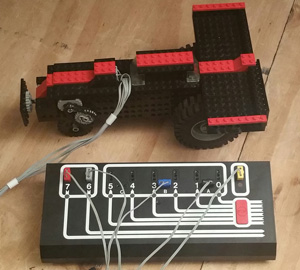
Artie the robot, with Dacta box in foreground

Meanwhile [Artie] is a Lego robot, using the Dacta TC Logo, a kit sold for the educational market and available at the time with interfaces for the PC and the Apple II. They had a Dacta control box but not the Apple II card to go with it, so had to make do with a functional replica built on a prototyping card. As the name suggests, this was programmed using Logo, and came with the appropriate interpreter software.

Both robots are reported to have been a success in terms of working in the first place, then demonstrating the 1980s technology and providing entertainment and engagement with the faire’s visitors.

We have covered numerous Lego robots over the years, as a search of our site will confirm. But this is only the second time we’ve featured a Capsela project, the first being this Arduino rover from 2011. [Mike] mused why we don’t see Capsela more often, and the same sentiment is true today. Do you have a Capsela set gathering dust somewhere that could make a robotic project?

Via Hacker News.

Posted in classic hacks, Robots HacksTagged apple II, basic, capsela, commodore 64, lego, logo, robot

Search

Never miss a hack

Follow on facebook Follow on twitter Follow on youtube Follow on rss Contact us

Subscribe

If you missed it

  • Hunting Submarines Via Gravity Is A Tough Errand

    26 Comments
  • Remember When Flash Drives Were Going To Make Your PC Faster?

    37 Comments
  • Magnets Are Bad For Hardware Again

    37 Comments
  • Between-Device Sharing Still Sucks

    117 Comments
  • How Search Engines Enabled Finding Needles In A WWW-Sized Haystack

    16 Comments
More from this category

Our Columns

  • AMOC And The Planet-Wide Impact Of Ocean Currents

    4 Comments
  • Linux Fu: The Bluetooth Regression

    19 Comments
  • Hackaday Links: May 24, 2026

    5 Comments
  • Amazing Stories

    5 Comments
  • Hackaday Podcast Episode 370: Softer Cyberdecks, A Simulated Clutch, And An Overstuffed Mailbox

    1 Comment
More from this category

Search

Never miss a hack

Follow on facebook Follow on twitter Follow on youtube Follow on rss Contact us

Subscribe

If you missed it

  • Hunting Submarines Via Gravity Is A Tough Errand

    26 Comments
  • Remember When Flash Drives Were Going To Make Your PC Faster?

    37 Comments
  • Magnets Are Bad For Hardware Again

    37 Comments
  • Between-Device Sharing Still Sucks

    117 Comments
  • How Search Engines Enabled Finding Needles In A WWW-Sized Haystack

    16 Comments
More from this category

Categories

Our Columns

  • AMOC And The Planet-Wide Impact Of Ocean Currents

    4 Comments
  • Linux Fu: The Bluetooth Regression

    19 Comments
  • Hackaday Links: May 24, 2026

    5 Comments
  • Amazing Stories

    5 Comments
  • Hackaday Podcast Episode 370: Softer Cyberdecks, A Simulated Clutch, And An Overstuffed Mailbox

    1 Comment
More from this category

Recent comments

  • Gus Mueller on Three Arduinos Team Up To Make 80s-Style Computer
  • pauldaoust on Linux On Android Provides Inexpensive, Powerful Computing
  • Greg A on Linux On Android Provides Inexpensive, Powerful Computing
  • LordNothing on Hunting Submarines Via Gravity Is A Tough Errand
  • pauldaoust on Linux On Android Provides Inexpensive, Powerful Computing
  • pauldaoust on Linux On Android Provides Inexpensive, Powerful Computing
  • syc4p3cM on Linux On Android Provides Inexpensive, Powerful Computing
  • syc4p3cM on A Bicycle Built On An Italian Renaissance Tech Base
  • Jakob on A Benchtop Neutron Generator For The Home Reactor
  • syc4p3cM on A Bicycle Built On An Italian Renaissance Tech Base
Logo
  • Home
  • Blog
  • Hackaday.io
  • Video
  • Submit A Tip
  • About
  • Contact Us

Never miss a hack

Follow on facebook Follow on twitter Follow on youtube Follow on rss Contact us

Subscribe to Newsletter

Copyright © 2026 | Hackaday, Hack A Day, and the Skull and Wrenches Logo are Trademarks of Hackaday.com | Privacy Policy | Terms of Service | Digital Services Act | Do not sell or share my personal informationCookie Management
Powered by WordPress VIP
 

Loading Comments...








