Analog Robot Navigates Around The Workshop With Ease

556_wall_following_robot

Many of the robots we feature here are driven by some sort of microcontroller, whether it be an Arduino, Launchpad, Picaxe, etc. Rarely do we see a robot however, using analog circuits to perform higher-level functions typically relegated to those more complex controllers. Instructables user [hasn0life] built such a robot recently, which he entered into a contest at his college. After hearing about the 555 design contest from a friend, he tweaked his project and created a wall-following robot using a 556 timer.

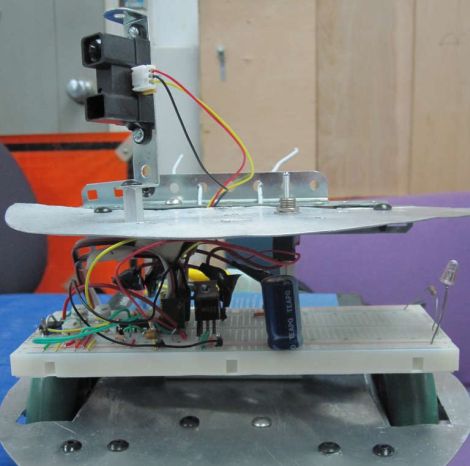
The robot is fairly simple when you take a close look, though that does not take away from the elegance of his design. A single IR sensor is used to detect objects in the robot’s periphery, guiding the robot along. When the robot gets too close to a wall, one wheel reverses, pulling the robot away. Once the robot has moved a sufficient distance, the other wheel is reversed in order to straighten out the robot. Then, both wheels work in concert to get the robot moving forward.

Take a look at the video below to watch the robot navigate its way around his workshop, and if you are interested in learning more about analog robotics, check out this post from a few days back.

Continue reading “Analog Robot Navigates Around The Workshop With Ease”
Pint-sized Nixie Display Fits Neatly In Your Pocket

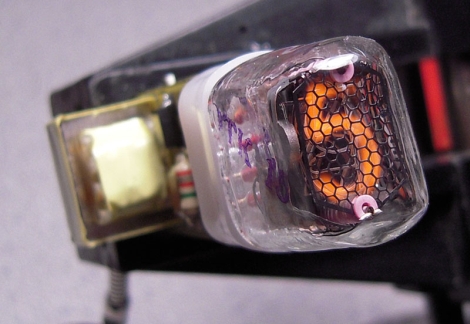
[Brett] has had Nixie tubes on the brain ever since being introduced to them by a good friend of his. He decided that building a Nixie-based key chain would be the best way to familiarize himself with the technology, while also giving him a project to enter in the 555 Design Contest. He dug up the smallest Nixie tube he could find that displayed digits, and got down to business.

The biggest obstacle he ran into was figuring out how he would provide the high voltage required to light the Nixie tube. He eventually built a transformer circuit driven by a 555 timer, using a small 12v battery as his power source. Once everything was up and running on a breadboard, he designed and etched some PCBs, then soldered everything together.

The end result is a nifty little key chain that flashes the number 5 when a button is pressed – pretty appropriate for the 555 contest. It’s a great looking project, though we’re still not 100% sure what we think about a naked high voltage circuit residing in our pocket.

Keep reading for a pair of videos documenting the key chain’s construction and operation.

Continue reading “Pint-sized Nixie Display Fits Neatly In Your Pocket”

Endless Fun With LED Dominoes

le_dominoux

Toppling dominoes is great fun for about 30 seconds at a time, when you are not busy setting them up for another run. [Randy] thought it was about time they got an electronic makeover to allow for constant, immediate gratification. Armed with a few simple electronic components, he has created Le Dominoux.

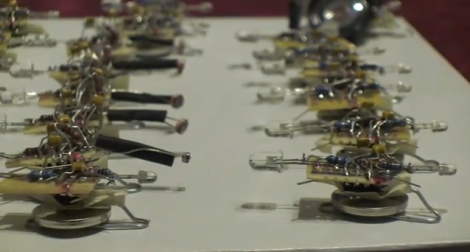
These LED-based electronic dominoes are actually quite simple to build. Each basic Le Dominoux is constructed on a small square of protoboard and consists of either a photo cell or phototransistor, a 555 timer, and an LED, all powered by a coin cell battery. The 555 timer, which is configured as a one-shot, is triggered when the photosensitive component on the back side of the domino is exposed to a bright enough light. The LED on the front end of the domino is then illuminated one time. This process is the electronic equivalent of a single domino toppling over.

He has constructed several variants of the Le Dominoux to act as flashing triggers, for outputting sound, as well as for turning tight corners. These variants allow the dominoes to be configured in many different ways, creating self-sustaining light shows. If anyone is looking for a fun project to introduce kids to electronics, this would definitely be it. Stick around to see a video of Le Dominoux in action – we bet you can’t stop watching it.

This is of course [Randy’s] entry in the 555 Design Contest, which ends tonight at midnight EST.

[Thanks Jeri]

Continue reading “Endless Fun With LED Dominoes”

Bluetooth-enabled Talking Chicken

bluetooth_chicken

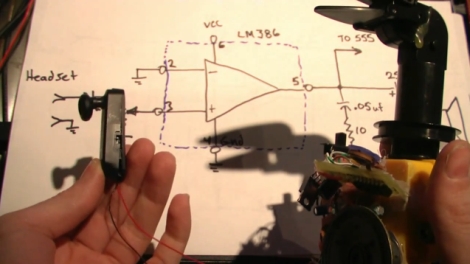
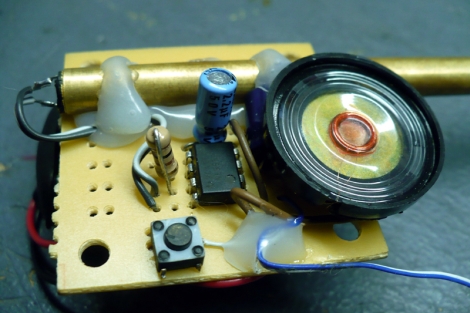
[Jeri Ellsworth] sent us a video walkthrough of a hack she did a few years ago using a toy chicken with a motor operated mouth. She wired up a Bluetooth headset’s audio output to a LM386 audio amplifier, which drives the speaker she added to the chicken. The output of the audio amplifier was also connected to a 555 timer in bistable mode to activate the motorized mouth. The motor simply opens the mouth when activated, allowing the built-in spring to snap it shut when the 555 is reset.

Obviously Jeri didn’t send us an old project just for kicks, she wanted to remind all of our readers that the 555 Design Contest comes to a close tomorrow night, March 1st at 11:59 EST. If you haven’t submitted an entry yet, get something started while there is still time!

Keep reading to see Jeri give a quick video overview of her talking Bluetooth chicken.

Continue reading “Bluetooth-enabled Talking Chicken”

Fun Slide Whistle Synth Toy

slide_synth

[Dino] recently sent us some info on his latest project, a 555 timer-based slider synthesizer. The synth was built to emulate the sound made by playing a slide whistle, and also as an entry into the 555 Design Contest, which is quickly coming to a close. If you’re not familiar with a slide whistle, just spend a few minutes on YouTube looking for clips of Sideshow Bob – it’s ok, we’ll wait.

The circuit is pretty simple, though the implementation is quite clever. While traditional slide whistles require the user to blow in one end, this electronic version operates using a LED and photo cell. When the main switch is closed, the 555 timer is activated, and a tone is produced. The pitch of the tone is controlled by the LED as it slides in and out of the tube. The more light that hits the photo cell, the higher the pitch, and vice versa.

Continue reading to see a quick demonstration of [Dino’s] slide synth, and be sure to check out his other 555 contest entry we featured a short while back.

Continue reading “Fun Slide Whistle Synth Toy”

Santa-pede Contest Winners

We received several fantastic entries. We laughed, we cried, we stared at our monitors in confusion, it was fantastic. Now we’re here to announce the winners of the Santa-Pede contest.

If you recall, the rules were pretty simple. Aquire a dancing santa (or other holiday dancing annoying toy thingy in the same fashion), tear it apart, build something that walks out of the pieces. We were aware that most of these have a very similar setup with one or two servos and a bit of plastic. That way everyone has a similar starting point.  We were amazed at what was done with so little.

Keep reading to find out who one each of the three categories: Most over-done,  best walker with no extra parts, and best presentation.

Continue reading “Santa-pede Contest Winners”

Alien Life Form Synth Toy

space_bug_in_a_bottle

We were sent [Dr. Offset’s] most recent project, a kid’s toy that is half sculpture/half noisemaker, but 100% cool. The device uses several 555 Timers and is his entry into the 555 Design Contest, which wraps up in just a few days. To really enjoy his creation, you need to suspend disbelief for a moment, and indulge the space fantasy he creates. In other words, let yourself be a kid again, if only for a few minutes.

What he has built is a containment unit for an alien life form found during an outer space exploratory mission. The creature has fused its organic bits with electronic components in order to survive in the stark, empty world it used to call home. The containment unit allows you to zap the “bug” with various frequencies to see how it reacts. The “bug” is light sensitive, so it always offers a varying experience, day or night.

It’s definitely one of the most artistically creative entries into the 555 Design Contest we have seen yet. Continue reading to see a thorough walkthrough and demonstration of his project.

[Thanks Rich Decibels]

Continue reading “Alien Life Form Synth Toy”