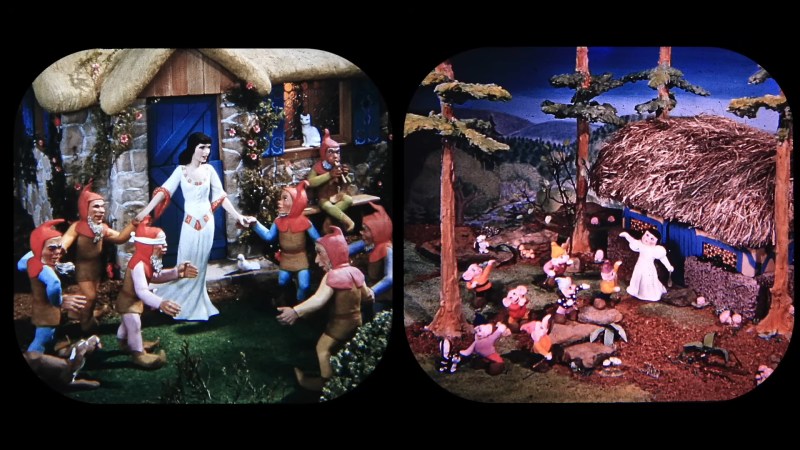
An image of a miniature diorama of Snow White and the Seven Dwarves. On the left is a more detailed 1/6 scale model with a tall, dark haired Snow White and dwarves with red caps and tan tunics. The image on the right is of a much smaller and less detailed set of miniatures. The figures's proportions are a little more uncanny and feel like a low budget Disney rip-off.

How Did They Make View-Master Slides?

The basics of producing a stereophotograph of real life places were well-established by the time the View-Master arrived, but producing images of imaginary scenes was a bit more involved. [View Master Travels and Peter Dibble] took a look at how the fairy tale and media tie-in reels may have been made.

Starting with simple dioramas, View-Master eventually developed an entire team to work on fairy tales. One of the most influential members was sculptor [Florence Thomas]. She was instrumental in updating many of the original fairy tale reels from small scale miniatures to 1/6 scale dioramas for the scenes. Unfortunately, the department was eventually cut and all the original miniatures thrown away.

Before VCRs, View-Master was the primary way people could interact with their favorite TV shows and movies when they weren’t being broadcast. TV shows could be photographed while in production in Hollywood with a stereo camera giving great visual detail. Some cartoon and movie reels were less engaging, having been made from promotional images, giving more of a paper cutout appearance rather than “real” 3D. In either case, many of these visual techniques have been lost with little documentation on how they were achieved.

We previously covered [View Master Travels and Peter Dibble]’s History of the View-Master and how you can digitize the disks for posterity.

Continue reading “How Did They Make View-Master Slides?”

Real Robot Makes Debut In Programming Game

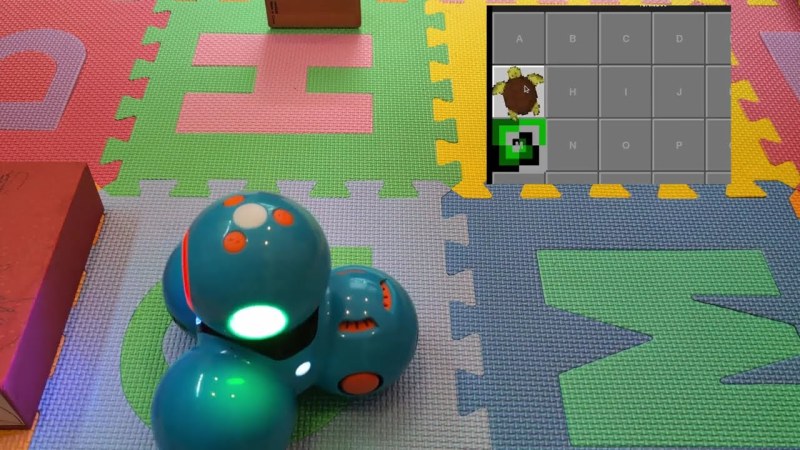
Sometimes the right tool for the right job appears almost out of nowhere. That was certainly the case for [Jonathan] who came across an unusual but well-designed robot at a secondhand shop. The robot needed a bit of work to get back into a usable condition, but after that it was ready for use. For such a unique machine, it needed a unique place to work as well, so in this build [Jonathan] uses it as a real robot to recreate a popular board game meant to teach programming to children.

In the original board game, called Robot Turtles, there are no actual robots. Instead, players use cards to control turtles to reach objectives in much the same way that a programmer would solve a similar problem with a computer. A board game with such a name almost demands a robot, so [Jonathan] found a larger playing surface in the form of soft matting blocks, each with a number or letter, that can be assembled into a grid. To make the game, he built a Python application on top of the interface he reverse-engineered in a previous build. It handles the robot interface, control, input, and a PyGame GUI. The game can either be played in real-time, or the robot’s moves can be queued.

In addition to keyboard input, the bot can also be controlled by putting cards from the actual board game itself on an NFC reader he made. [Jonathan] has a four-year-old at home, so he hopes that all of these projects will have an impression and encourage experimentation and discovery of computers and programming.

Continue reading “Real Robot Makes Debut In Programming Game”

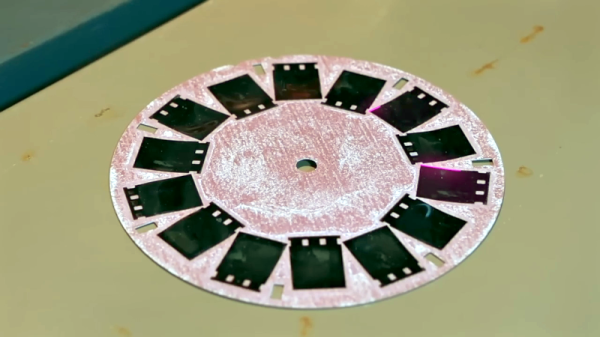
The History Of The View-Master

We are going to bet that as a kid, you had a View-Master. This toy has been around for decades and is, more or less, a handheld stereoscope. We never thought much about the device’s invention until we saw a recent video from [View Master Travels and Peter Dibble]. It turns out that the principle of the whole thing was created by the well-known [Charles Wheatstone]. However, it was piano repairman [William Gruber] who invented what we think of as the View-Master.

[Gruber] didn’t just work on normal pianos, but complex player pianos and, in particular, the pianos used to record player piano rolls. He was also, as you might expect, a stereo photography enthusiast. Many of the ideas used in automating pianos would show up in the View-Master and the machines that made the reels, too. In the 1930s, stereoscopes were not particularly popular and were cumbersome to use. Color film was also a new technology.

Continue reading “The History Of The View-Master”

Digital Etch-A-Sketch Also Plays Snake

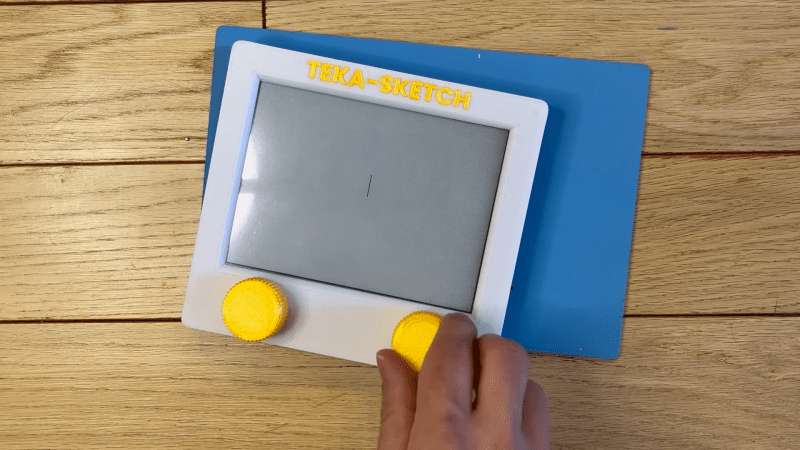
The Etch-A-Sketch has been a popular toy for decades. It can be fun to draw on, but you have to get things right the first time, because there’s no undo button. [Tekavou] decided to recreate this popular toy in digital form instead to give it more capabilities. 

The build relies on an Inkplate e-paper screen as a display, which is probably as close you can get in appearance to the aluminium dust and glass screen used in an Etch-a-Sketch. The display is hooked up to an ESP32 microcontroller, which is charged with reading inputs from a pair of rotary encoders. In standard drawing mode, it emulates the behavior of an Etch-A-Sketch, with the ESP32 drawing to the e-paper display as the user turns the encoders to move the cursor. However, it has a magical “undo” feature, where pressing the encoder undoes the last movement, allowing you to craft complex creations without having to get every move perfect on your first attempt. As a fun aside, [Tekavou] also included a fun Snake game. More specifically, it’s inspired by NIBBLES.BAS, a demo program included with Microsoft QBasic back in the day.

We’ve seen all kinds of Etch-A-Sketch builds around these parts, including this impressive roboticized version. Video after the break.

Continue reading “Digital Etch-A-Sketch Also Plays Snake”

3D Print A Drill-Powered Helicopter Toy Because It’s Simply Fun

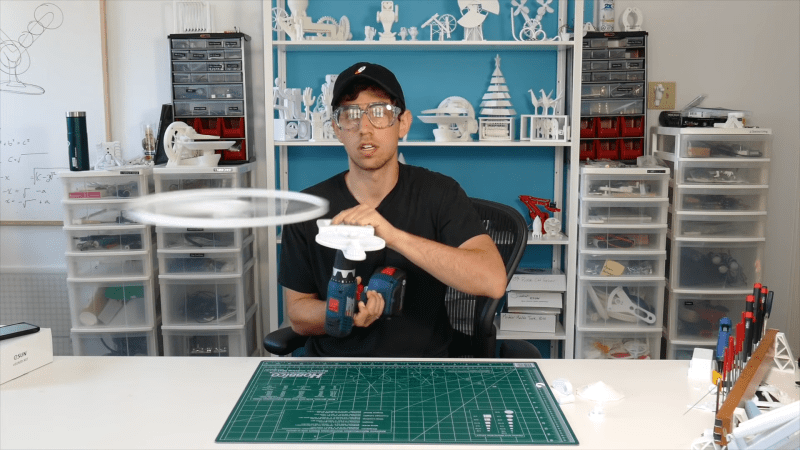
These days, you can get a fully remote-control helicopter that you can fly around your house for about $30. Maybe less. Back in the day, kids had to make do with far simpler toys, like spinning discs that just flew up in the air. [JBV Creative] has built a toy just like that with his 3D printer. It may be simple, but it also looks pretty darn fun.

The design is straightforward. It uses a power drill to spin up a geartrain, which in turn drives a small disc propeller. Spin the propeller fast enough and it’ll launch high into the air. The geartrain mounts to the drill via the chuck, and it interfaces with the propeller with a simple toothed coupler. Alternatively, there’s also a hand-cranked version if you don’t have a power drill to hand.

Launching is easy. First, the drill spins the propeller up to speed. Then, when the drill’s trigger is released, it slows down, and the propeller spins free of the toothed coupler, with the lift it generates carrying it into the sky.

Files are available online for those interested. We could imagine this toy could make the basis for a great design competition. Students could compete to optimise the design with more effective gear ratios or better airfoils. We’ve seen similar designs before, too. Video after the break.

Continue reading “3D Print A Drill-Powered Helicopter Toy Because It’s Simply Fun”

Toy Gaming Controller Makes The Big Leagues

Some of the off-brand video game consoles and even accessories for the major brands can leave a lot to be desired. Whether it’s poor build quality or a general lack of support or updates, there are quite a few things on the market not worth anyone’s time or money. [Jonathan] was recently handed just such a peripheral, a toy game controller originally meant for a small child, but upon further inspection it turned into a surprisingly hackable platform, capable of plenty of IoT-type tasks.

The controller itself was easily disassembled, and the functional buttons within were wired to a Wemos D1 Mini instead of the originally-planned ESP32 because of some wiring irregularities and the fact that the Wemos D1 Mini having the required amount of I/O. It’s still small enough to be sealed back inside the controller as well, powered by the batteries that would have powered the original controller.

For the software, [Jonathan] is using MQTT to register button presses with everything easily accessible over Wi-Fi, also making it possible to update the software wirelessly. He was able to use it to do a few things as proof-of-concept, including playing a game in PyGame and controlling a Sonos speaker, but for now he’s using it to control an LED sculpture. With something this easily modified, though, it would be pretty straightforward to use it instead for a home automation remote control, especially since it is already set up to use MQTT.

Continue reading “Toy Gaming Controller Makes The Big Leagues”

Upgraded Toy Guitar Plays Music

Getting the finishing details on a Halloween costume completed is the key to impressing friends and strangers alike on the trick-or-treat rounds. Especially when it comes to things like props, these details can push a good Halloween costume to great with the right touches. [Jonathan]’s friend’s daughter will be well ahead of the game thanks to these additions to a toy guitar which is part of her costume this year.

The toy guitar as it was when it arrived had the capability to play a few lackluster sound effects. The goal here was to get it to play a much more impressive set of songs instead, and to make a couple upgrades along the way as well. To that end, [Jonathan] started by dismantling the toy and investigating the PCBs for potential reuse. He decided to keep the buttons in the neck of the guitar despite their non-standard wiring configuration, but toss out the main board in favor of an ESP32. The ESP32 is tasked with reading the buttons, playing a corresponding song loaded on an SD card, and handling the digital to analog conversion when sending it out to be played on the speaker.

The project doesn’t stop there, though. [Jonathan] also did some custom mixing for the songs to account for the lack of stereo sound and a working volume knob, plus he used the ESP32’s wireless capabilities to set the guitar up as a local file server so that songs can be sent to and from the device without any wires. He also released the source code on the project’s GitHub page for anyone looking to use any parts of this project. Don’t forget there’s a Halloween contest going on right now, so be sure to submit the final version of projects like these there!

Continue reading “Upgraded Toy Guitar Plays Music”