
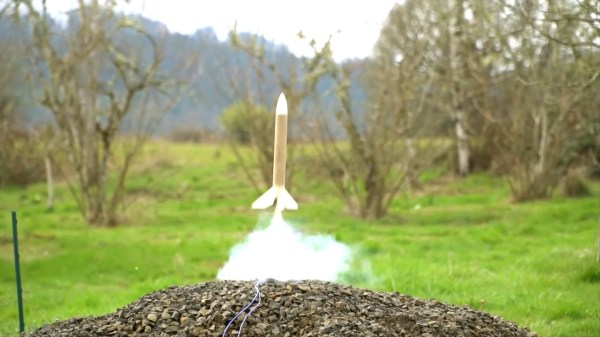
A small rocket is shown launching into the sky, with a trail of smoke leading into the mount of a black pipe. Four large plastic pieces are falling away from below the rocket.

Tube Launch Boosts Rocket’s Performance

If you want improve a model rocket’s performance, all the common options come with serious trade-offs: you could increase the motor’s size, which raises safety issues, or you could cut down on weight, which limits the possible payload. [Con Hathy] was therefore intrigued by the design of the Arcas sounding rockets, which with the aid of a gas-fed launch tube could reach an altitude of 100 km. Even in models without a gas generator, a launch tube apparently boosted performance, an effect which [Con] was able to replicate in a much smaller model rocket.

In theory, as the rocket engine fires, it should pressurize the tube behind the rocket, providing an extra boost out of the tube. To test this, [Con] 3D printed a test rocket, launched it both from a standard rail and from a tube, and compared the results. During tube launches, a printed sabot fit around the rocket and formed a seal with the launch tube. The results were surprising: the tube-launched rocket actually performed substantially worse than a rail launch. After building a simulation, [Con] found that, as the rocket moves down the tube, the volume of tube it needs to back-fill with gas increases faster than the engine puts out exhaust; it was pulling a slight vacuum behind it, slowing itself down.

To solve this, [Con] decreased the diameter of the launch tube. To let the rocket fit into the tube, he also modified it to use pop-out stabilizer fins which wrap around the rocket while in the tube. The sabot was also shrunk, and had foam added to improve the seal between it and the rocket. For this second test, [Con] also connected a pressure sensor to the base of the launch tube. The results on the second launch were much better: according to an altimeter, it managed to fly 72% higher. Based on the pressure sensor’s data, a longer tube could have squeezed out still more performance, but this still demonstrated the principle quite well.

We’ve seen a tube-launched rocket before, though not with such a performance focus.
Continue reading “Tube Launch Boosts Rocket’s Performance”

From Table to Orbit: Salt

Saving Martian Colonists Using Table Salt And Rocket Science

Imagine for a moment that you are a member of an early Mars colony. You’re stranded, and the only way to get a message home is to launch a radio well above the surface. To make matters worse, you’ve got no rockets! It was this thought experiment that has motivated [Thoisoi2] to experiment with making a rocket motor using only ingredients and methods available to your average Martian colonist. The methods he has chosen can be seen in the video below the break.

If you skipped Rocketry 101, a quick refresher might help: Rockets work by burning a fuel in an enclosed chamber and then expelling it at high speed in one direction. To get the fuel to burn more quickly (and therefore adding more oomph to the angry end) a complement to the fuel called an Oxidizer is added. It serves to create an oxygen rich environment for the fuel to burn in. It’s the same reason a oxy-propane torch burns hotter than propane by itself.

Sugar Fuels Go Boom
The Sugar Powered Rocket Motor says “Boom!”

Firstly, a stranded Martian would need rocket fuel. If you recall the 1999 movie October Sky, four high school kids used table sugar as their fuel. You might also recall that those tended to get all explody. This volatility caused [Thoisoi2] to eschew sugar as a fuel in favor of a fuel that would also be available to any Martian colonist but be far less likely to cause Rapid Unplanned Disassembly.

What about the oxidizer? In October Sky, the boys experimented with Potassium Chlorate. This is commonly used in rockets but may be more difficult to obtain for your average Mars colonist. But, it turns out that Potassium Chlorate and Sodium Chlorate which can be prepared from table salt will work equally. It’s quite a bit more involved than that however.

Simply adding salt and fuel does not a rocket motor make. The nuances, the science, and the chemistry are all laid out in the wonderful video that [Thoisoi2] has put together, and we are sure you’ll enjoy it as much as we did.

You’ll also get to find out if our stranded Martian ever makes it home or if his potato farming was for naught.

We’d also like to echo the warning in the video: This is an experiment that is pretty dangerous, so don’t try this at home! Definitely try it at somebody else’s house first. Or on the surface of Mars.

Recently Hackaday covered another great attempt at making a rocket motor at home, although this one was a bit less successful, but every bit as interesting! Continue reading “Saving Martian Colonists Using Table Salt And Rocket Science”