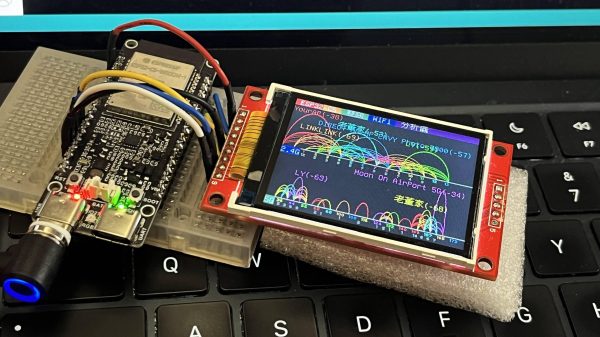
Build A Pocket-Sized Wi-Fi Analyzer

Wi-Fi! It’s everywhere, and yet you can’t really see it, by virtue of the technology relying on the transmission of electromagnetic waves outside the visual spectrum. Never mind, though, because you can always build yourself a Wi-Fi analyzer to get some insight into your radio surroundings, as demonstrated by [moononournation].

The core of the build is the ESP32-C5. The popular microcontroller is well-equipped for this task with its onboard dual-band Wi-Fi hardware, even if the stock antenna on most devboards is a little underwhelming. [moononournation] has paired this with a small rectangular LCD screen running the ILI9341 controller. The graphical interface is drawn with the aid of the Arduino_GFX library. It shows a graph of access points detected in the immediate area, as well as which channels they’re using and their apparent signal strength.

If you’re just trying to get a basic read on the Wi-Fi environment in a given locale, a tool like this can prove pretty useful. If your desires are more advanced, you might leap up to tinkering in the world of software defined radio. Video after the break.

Continue reading “Build A Pocket-Sized Wi-Fi Analyzer”

The ESP32-C5, Finally Espressif Goes Dual-Band

The ESP32 series of microcontrollers have been with us for quite a few years now, providing a powerful processor and wireless connectivity for not a huge outlay. We’ve seen a bunch of versions over the years with both Tensilica and RISC-V cores, but so far the ones with radios have all only serviced 2.4 GHz WiFi. That’s about to change to include 5GHz with the new C5 variant though, and [Andreas Spiess] has been lucky enough to get his hands on a prototype dev kit

It’s very similar to the C6, which we’re already used to beyond the dual-band 2.4GHz and 5GHz radio from a software point of view. The C5 is so new that the company has yet to incorporate the new chip into the Arduino IDE. He shows it working and detecting both networks though, and speculates a little about its eventual marketing.

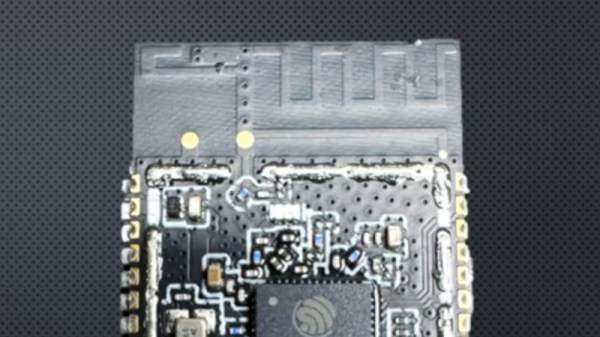
Interesting to us is the dual-band antenna, with branches for both frequencies on the same PCB. We’d be interested to see the real-world performance of this, and also whether they produce a version with separate outputs for each band. The full video is below the break. In the meantime, watch out for this chip appearing on the market.

It’s not the only Espresif chip we’re anticipating at the moment.

Continue reading “The ESP32-C5, Finally Espressif Goes Dual-Band”