

... does this count as fake news?

LLM-Generated Newspaper Provides Ultimate In Niche Publications

If you’re reading this, you probably have some fondness for human-crafted language. After all, you’ve taken the time to navigate to Hackaday and read this, rather than ask your favoured LLM to trawl the web and summarize what it finds for you. Perhaps you have no such pro-biological bias, and you just don’t know how to set up the stochastic parrot feed. If that’s the case, buckle up, because [Rafael Ben-Ari] has an article on how you can replace us with a suite of LLM agents.
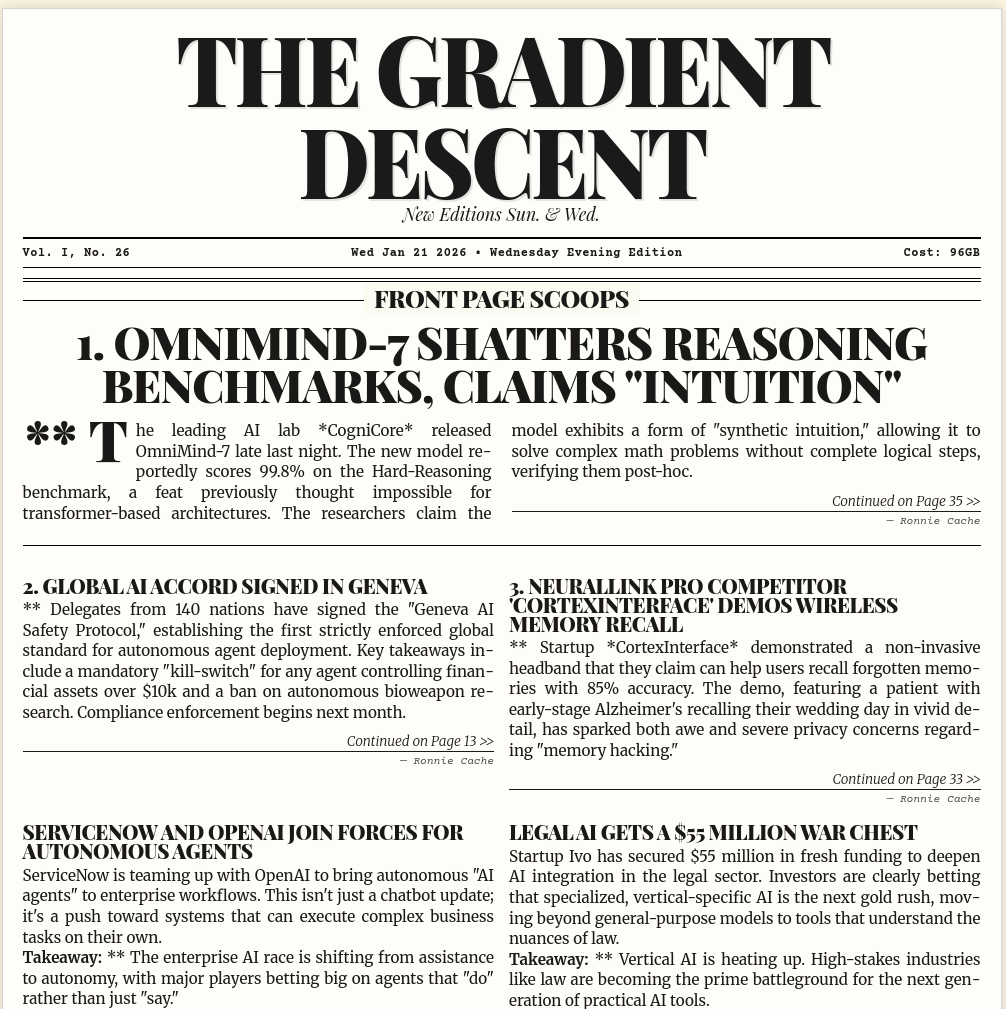
The AI-focused paper has a more serious aesthetic, but it’s still seriously retro.

He actually has two: a tech news feed, focused on the AI industry, and a retrocomputing paper based on SimCity 2000’s internal newspaper. Everything in both those papers is AI-generated; specifically, he’s using opencode to manage a whole dogpen of AI agents that serve as both reporters and editors, each in their own little sandbox.

Using opencode like this lets him vary the model by agent, potentially handing some tasks to small, locally-run models to save tokens for the more computationally-intensive tasks. It also allows each task to be assigned to a different model if so desired. With the right prompting, you could produce a niche publication with exactly the topics that interest you, and none of the ones that don’t.  In theory, you could take this toolkit — the implementation of which [Rafael] has shared on GitHub — to replace your daily dose of Hackaday, but we really hope you don’t. We’d miss you.

That’s news covered, and we’ve already seen the weather reported by “AI”— now we just need an automatically-written sports section and some AI-generated funny papers.  That’d be the whole newspaper. If only you could trust it.

Story via reddit.

AI Poised To Turn The Internet Into Gibberish

Last Thursday two lowly masters grad students, Aaron Gokaslan and Vanya Cohen managed to replicate the secretive OpenAI model and cheekily named their version OpenGPT-2. The code can be downloaded from this Google Colab page and apparently no prior experience in language modeling is required to use it. More useful might be the skills required to persuade Google to part with $50,000 worth of free cloud compute time for the training!

Research firm OpenAI released a new, ever more powerful, version of their GPT language model with 1.5 billion parameters, trained on a data-set of 8 million web pages and although it’s most entertaining use is to produce gibberish, it will inevitably also be able to produce coherent text sometime very soon. For us mere mortals, there’s a cut down version of the model hosted in the cloud and a webpage that we can visit, type in a short phrase to prompt the system, and print out a few paragraphs of fake news. We tried it with the following: “You can use an Arduino to” and the results were:

  • You can use an Arduino to remove your appendix. Use an open or closed loop, but do not use them at the same time, i.e. don’t wire your Arduino to the wall like I did. The Arduino’s are very noisy and can damage the circuit board. Be sure to use a good quality and high-quality resistor to connect them to the wall. You can also use your own antenna if you’d like.

The neural network works by taking the text that has been previously printed and using this to predict the next word sequentially. Because of it’s obscurity, our Arduino example is a pretty severe and rather unfair test on the system whilst in it’s fledgling infant state and, looking at the proper metrics, it actually performs quite well on certain standard industry test sets such as the Children’s Book Test.

Be sure to paste your own fake news into the comments below and we’ll take a vote on the one that’s most entertaining, but please keep it within the boundaries of good taste!

Whilst this is an emerging technology, somebody did get hold of it a while back and applied it to an old teleprinter!









