Robot Waits For No Man When Recharging

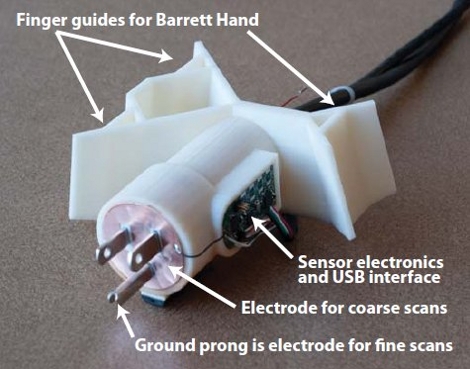
Yikes, that power connector certainly wasn’t designed by Apple. Ugly as it may be, it’s the charging cable for a robot and acts as a sensor that allows the robot to properly align and plug into a power receptacle.

We’re going to go off on a tangent for just a second. We often think of the Rat Things from Snowcrash when considering robot power. They were nuclear powered (or something) and instead of recharging required constant cooling. Those day’s aren’t exactly around the corner but we think they’ve been realized in the lawn mowing robots that have a little nests to recharge in. Base stations work but they require the machine to return to the same place, or to have multiple charging stations.

The point is, this specialized cable makes base stations for robots obsolete. Now a robot can plug into any outlet it can get near, a great thing for robots roving large facilities. After the break you can see a video of this process. The robot arm zeros in by scanning horizontally and vertically and measuring the magnetic field put out by the AC in the wires of the outlet. Take a look, it’s a pretty neat piece of engineering.

Continue reading “Robot Waits For No Man When Recharging”

McLVDT: A Straw-based Sensor

We saw [Kevin’s] home-built Linear Variable Differential Transformer in a YouTube video last week and wanted to know more. We’re in luck, he agreed to share all the details as well as a bunch of information on these sensors. An LVDT is used to measure distance along a straight path. Unlike a linear optical encoder, this method uses measurements of inductance between two electrical coils to judge the distance.

[Kevin] used some magnet wire wrapped around two straws of different diameter to fabricate his sensor. A signal generator is connected to the primary coil and the resulting signal induced in the secondary coil is measured to reveal the change in physical position. Check out the video after the break to see the results.

It’s not hard to get your hands on a McDonald’s straw (hence the name ‘Mc’LVDT), a smaller inner straw, and a few feet of magnet wire. This will be a fun one to try when those dark winter days start to get to you.

Continue reading “McLVDT: A Straw-based Sensor”