Ask Hackaday: Troll Physics Super Deluxe Edition

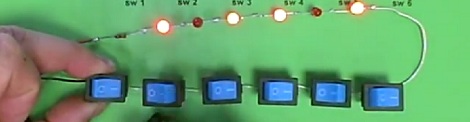
Here’s a brain bender for you: YouTube user [Fredzislaw100] put up a video of six LEDs and six switches wired up in series. After soldering a resistor and 9V battery connector, the first switch turns on the first LED, the second switch turns on the second LED, and so on for the rest of the circuit.

We’ve seen this trick before from [Fredzislaw100], only this time he’s moved up from 3 LEDs to 6. In the reveal of the previous trick, [Fredzislaw] built two AC power supplies inside a nine volt battery connector; one high frequency and one low frequency. The low frequency AC line powers the first two LEDs with the help of diodes in the switches and LEDs. The high frequency AC line turns on the third LED with the help of an inductor inside an LED. Apparently [Fredzislaw] still has some soldering skills to show off; the circuit powering this trick is most likely the work of a soldering god.

From a close viewing, it looks like LEDs are wired up in pairs, i.e. LED 1 works the same as LED 2, LED 3 works the same as LED 4, etc. We’ll let Hackaday readers argue it out in the comments as to how this trick is possible.

Tip ‘o the hat to [Th0m4S] for sending this one in.
Keeping An Old 8mm Projector Alive With High-power LEDs

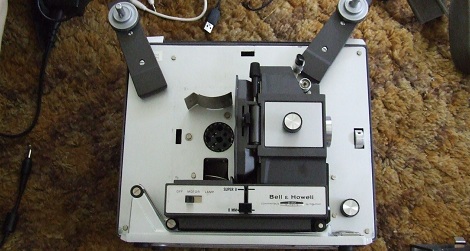
There’s a certain mystique about old home movies and 8mm film; whether it’s footage from a family gathering from 40 years ago or a stop-motion animation you made when you were 12, there’s an immediacy for film that the VHS tapes from your family’s first camcorder can’t match. [Teslas Moustache] has been getting into 8mm cameras and projectors, so when he came across a 8mm/super 8 projector that needed a bulb, he knew he had a worthwhile project on his hands.

To replace the burnt-out and very expensive to replace incandescent bulb, [Teslas] sourced a very bright star LED from Jameco. This 1 Watt LED puts out more than enough light to project a frame of film onto a screen and fortunately doesn’t get as hot as the stock bulb.

To power the LED, [Teslas] used a cell phone charger powered from the 120 VAC incandescent socket to supply the requisite 5 Volts at 1 Amp (Ohm’s Law works on coffee) power for the LED. Right now, there’s still the matter of fabricating a nice enclosure to mount the LED and charger in the bulb socket, but once [Teslas] figures that out, he’ll have a very nice 8mm projector on his hands.

Power Index Window Display Turns Buildings Into LED Matrices

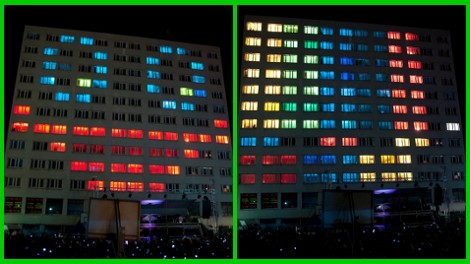
What started off as a fun project using light bulbs picked up some sponsorship and is going on tour. This project now uses LED modules controlled on the 2.4 GHz band to turn buildings into full color displays. It’s the product of students at Wrocław University of Technology in Poland. The group is something of an extra-curricular club that has been doing this sort of thing for years. But now they’ve picked up some key sponsorships which not only allowed for upgraded hardware, but sent the group on a tour of Universities around Europe. Who would’ve thought you could go on tour with something like this?

Much like the MIT project we looked at in April, this lights up the dark rooms of a grid-like building. It does go well beyond playing Tetris though. The installation sets animations to music, with a custom animation editor so that you can submit your own wares for the next show. Don’t miss the lengthy performance after the break.

Continue reading “Power Index Window Display Turns Buildings Into LED Matrices”

Ironman Replica Twofer

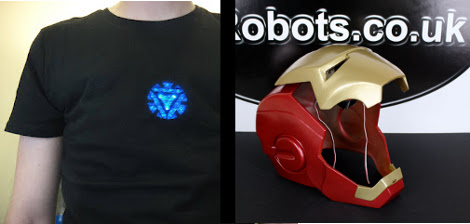
We think it’s a bit to late to show up for a screening of The Avengers in full costume, but an arc reactor T-shirt would be pretty cool. [4ndreas] built a chest strap that looks much like [Tony Stark’s] chest-mounted power source. It has a 3D printed enclosure which hosts the ATmega8 and 22 LEDs which provide the pulsing goodness. The thin cellphone battery helps to keep the size of the package to a minimum and a strategically placed hole in a black T-shirt completes the look. It’s even bright enough to shine through the fabric of this black T-shirt.

But if you insist on head-to-toe regalia you’ll appreciate [James Bruton’s] Ironman suit replica build. Not only does he look the part, but he’s trying to build as much functionality into the project as possible. Most recently he finished the helmet. It’s got a motorized faceplate and LED edge-lit eye plates to impress hackers and cosplay fans alike.

Find video of both projects after the break.

Continue reading “Ironman Replica Twofer”

Macetech’s LED Glasses Prototype

While there was no mention of it on their blog, [Garret] from mace tech was spied wearing some pretty cool looking LED glasses at MakerFaire last weekend. This morning, we noticed a Lytro gallery of the glasses and they look pretty cool (as a toy, not a fashion accessory). For those who haven’t played with Lytro, you can click around and refocus the image. Neat right? Back to the glasses.

Someone who we’re guessing is [Garret] spoke up on Reddit this morning explaining some tech specs and dropping a video of them in action.

The shades are a 20×6 matrix (with some pixel missing of course) driven by SPI from an integrated Arduino-compatible in the right temple. There is a Lithium-Polymer battery on the left temple. You can charge the glasses through USB, and download new code to it over the same connection. A button on the right temple allows switching between modes or auto cycling animated patterns.

Mother’s Day Heart Chaser

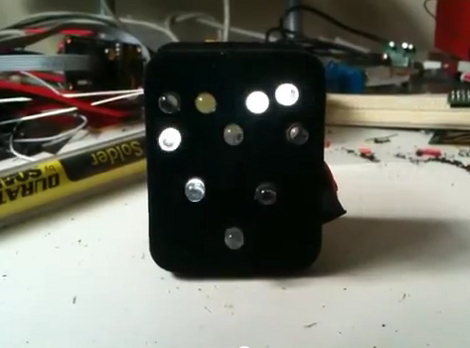
[Robert Mibus] took on a project which his kids could present to Mom on Mother’s Day. It’s an LED heart built into a ring or necklace box. The series of white LEDs are animated in a chase pattern. The project let [Robert] push his comfort boundaries by moving past a stock Arduino board.

Inside you’ll find an ATtiny85. He picked up the chip to try running Arduino sketches on smaller hardware. But the total of five available I/O pins presented an issue with driving the LEDs. Ten LEDs are used here and even a standard multiplex display would need no less than seven to control them without additional chips or the need for Charlieplexing. His solution was to drive two opposite LEDs at once, which cuts the need down to his five available pins.

Once he got it all soldered together he realized that he had made a coding error. But a few soldered wires let him reflash it in place using ISP.

Continue reading “Mother’s Day Heart Chaser”

Building A Bigger Bar Graph

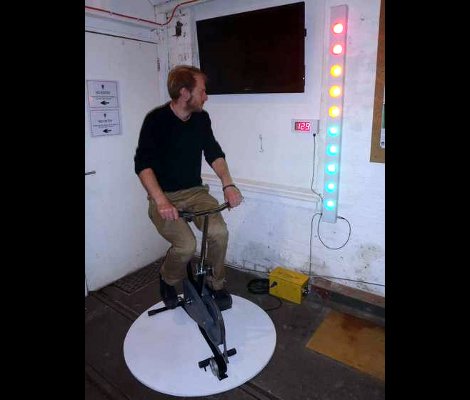
Take a gander at the Giant LED bar graph which [Chunky Hampton] recently completed (from this image we don’t think the nick name suits him). It’s simple both mechanically and electrically, but we love the look and think it would be a nice addition to your home, hackerspace, or as a children’s museum exhibit (we’re looking at you [Mr. Porter]).

The enclosure is a hunk of PVC electrical conduit. It’s got to be one of the largest sizes, but still should be found at most home stores. The base mounts easily and the cover snaps into place. [Chunky] used a hole saw to create the openings for the LED modules. They’re circular boards with multiple single-color LEDs on them. A common power bus feeds the high side of each bit, while a couple of transistor ICs controlled by 595 shift registers address them on the low side. From there just use any controller you wish, but in this case it’s an Arduino.

[Chunky] uses the meter to display power output from his stationary bicycle generator. But he also put together a little Larson Scanner demo which you can see after the break.

Continue reading “Building A Bigger Bar Graph”