A Light-Following Pong Game

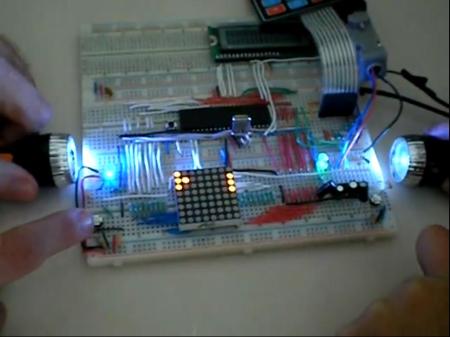
Although not everyone has the ability to make a hacked Pong game Like [Marcelo], even fewer have the ability or the creativity to come up with the elaborate hack that he did. The basic premise of his game is a version of pong played on a breadboard with a 8×8 matrix of LEDs. The controls are really what sets this hack apart. Instead of using a paddle controller or normal switches, small flashlights are used to control the on-screen (on-LED matrix) paddle. This is accomplished using a series of photoresistors and a PIC processor.

Innovative as this would be by itself, [Marcelo] decided to make a program in Flash to display the action on a computer.  Communication is done serially, and C# is used to translate everything as Flash doesn’t natively work with a serial connection.

Another innovation is that there are two LEDs connected on either side powered via pulse width modulation. The lights get dimmer as one player is about to lose. Check out [Marcelo’s] pong game after the break!
Continue reading “A Light-Following Pong Game”

Spinning UV Light Writer

uv_light_writer_ring

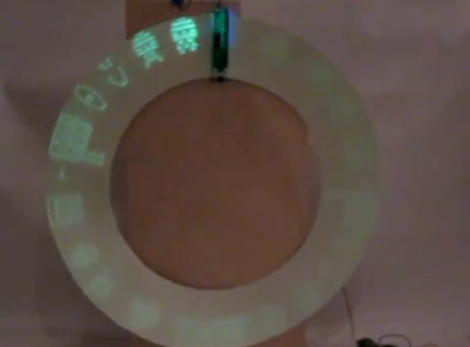
[David] has always wanted use UV LEDs to write on a phosphorescent surface ever since saw an article about it on Make. He accidentally purchased UV LEDs when he meant to buy purple ones, so he figured that his mistake was all the reason he needed to give UV light writing a try.

He built a PIC16F628 UV POV board using the LEDs, and while manually swiping the writer across various glow in the dark surfaces was cool, he wanted to keep the POV board stationary, moving the writing medium instead. He bought some phosphorescent vinyl, but found that it wasn’t too flexible, meaning he could not use a conveyor belt approach for his display. One day it dawned on him that a vinyl ring might work pretty well, and using a motor from an old cassette player, he constructed the UV writer you see above.

It seems to work pretty well despite a small flaw in the UV ring, and while [David] is happy with the results, he already has plenty of ideas in mind for the second revision.

Check out the video of his UV light ring in action after the jump.

[Thanks, Riley]

Continue reading “Spinning UV Light Writer”

Playing Snake With A TV Remote

[vinod] sent in his replica of a Snake game, the game to play on old Nokia dumb phones.

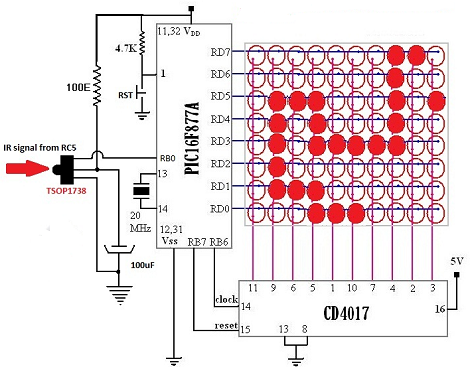
The build is based on a PIC16F877 microcontroller just like previous Snake builds we’ve seen, but [vinod] didn’t use physical buttons in his build. Instead, he used a Philips infrared TV remote to control the game. The infrared controller only takes up one pin on the microcontroller, as opposed to the 4 pins of the easiest four button setup. [vinod] also threw in a simple one-transistor level converter so Snake can be played with a PC via RS-232. With the PIC code included in the build, it’s a great build that reminds us of a more civilized age.

The video of [vinod]’s snake game in action is posted after the break, but we noticed that the snake is allowed to ‘warp around’ the sides of the LED matrix. Some people might consider that cheating but that can be fixed by changing a few lines of code.

Continue reading “Playing Snake With A TV Remote”

kraftwerk_inspired_led_tie

Kraftwerk Inspired LED Tie

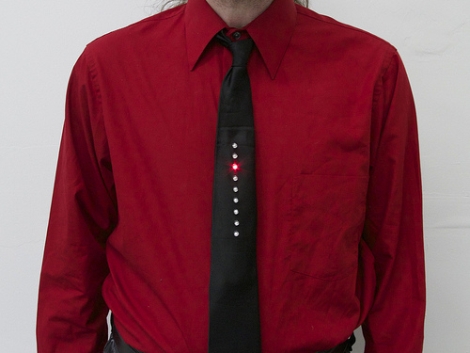
If you didn’t land the job after your last interview, it might have been because you were not wearing this sweet Kraftwerk-inspired necktie. Although our own [Caleb Kraft] insists that this recent creation by the folks over at Evil Mad Scientist Laboratories is a tribute to him, [Ralf Hütter and Florian Schneider] beg to differ.

The inspiration for the tie actually comes from Kraftwerk’s 1977 video for “The Robots”, in which the band wore black ties with embedded scrolling LEDs. The effect is very similar to that of a Larson Scanner, though Kraftwerk’s ties light the LEDs in a single direction and do not fade in and out.

EVMSL has released a firmware update to the Larson Scanner they sell in their shop that replicates the Kraftwerk effect, and they also put together a quick tutorial showing how you can construct your own coin cell-powered LED tie. We’re not suggesting that anyone rush out and buy their kit, as it can be replicated fairly easily – we just thought it was pretty cool.

So, if you’re looking for a retro-inspired Halloween costume, search no further – Evil Mad Scientist Labs has you covered.

Continue reading for a video demo of their tie, as well as the original video that inspired it.

Continue reading “Kraftwerk Inspired LED Tie”

Awesome Fiber Optic LED Viking Helmet

octobrite_led_mohawk_helmet

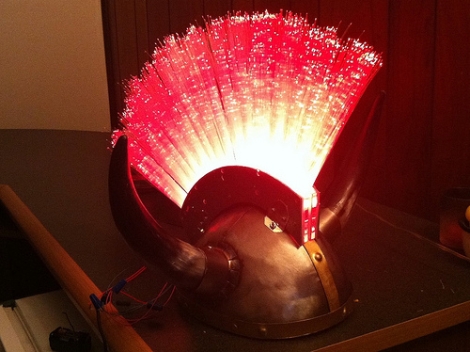
[Garrett] over at MaceTech was approached by a friend who needed a light-up mohawk installed on a Viking helmet, and he needed it ASAP.

Now, [Garrett] does tons of work with LEDs but it’s not every day you are asked to construct a sound-responsive LED mohawk. He had all sorts of LEDs and other bits on hand, but finding the fiber optics that would make up the mohawk itself took a bit of time.

After a bit of searching, he located some cheap bulk fiber optic toy wands, and got busy cutting them apart to remove the fiber bundles. The fibers were glued into a laser cut plastic assembly, where they were paired with a handful of OctoBrite CYANEA modules [Garrett] had on hand. He bought a handful of components from SparkFun, including an Arduino Pro Mini to control the device, as well as an electret mic and graphic equalizer chip to handle the audio input/filtering.

He wrapped up the code portion of the mohawk and handed it off to his friend, who says that the “helmet is +99 to epic awesomeness”, which sounds like a ringing endorsement to us.

[via BuildLounge]

Check out the video below to see the fiber optic mohawk helmet in action.

Continue reading “Awesome Fiber Optic LED Viking Helmet”

Revolights Keep You Safe While Riding At Night

revolights_bike_headlight_taillight

Bicycling at night can be a potentially hazardous endeavor for several reasons, but primarily because well, it’s dark. Inattentive drivers, weather, and other factors aside, the most important thing you can do to keep yourself safe is to ensure that you can see and that you are seen by others.

Revolights, an invention put together by [Kent Frankovich, Adam Pettler, and Jim Houk], is an ingenious way of accomplishing both of those things. The ring-shaped system attaches to nearly any bike tire, and includes LEDs that shine like a car’s head and taillights. A magnet attached to the bike’s fork triggers the onboard microcontroller to light only 4 LEDs at a time, letting persistence of vision take care of the rest.

We think it’s a great idea, and clearly others do as well. With nearly a month left on their Kickstarter page, they have nearly doubled their initial funding goal.

Check out the video presentation on their Kickstarter page to get a better look at the Revolights project.

[Thanks, medix]

Wireless Fiber Optic Mood Lighting

ceiling_mounted_starfield

There’s something calming about looking up into the night sky and seeing an array of shining stars off in the distance. [Marou] is a big fan of stargazing, but sometimes conditions are not optimal, so he decided to bring the stars inside.

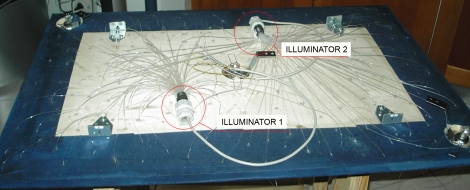
His idea was to build a ceiling lamp that didn’t bask the room with light, but rather one that reproduced the peaceful twinkle of the night sky. He covered a wooden table with dark fabric and drilled a ton of tiny holes into the surface. He fitted the holes in the table with two big bundles of optical fibers since one bundle couldn’t quite cover the entire thing.

To light the cables, he built a pair of 4-LED illuminators, which contain red, blue, green, and white LEDs. Each light source is controlled via an Arduino which takes its direction from [Marou’s] infrared remote.

While the idea isn’t new, the implementation is pretty cool. At first we were expecting a small lamp, but anchoring an entire table to the ceiling as a light panel is definitely something we hadn’t seen before.

If you want to build something similar in your own living room, [Marou’s] Arduino code is free for the taking.