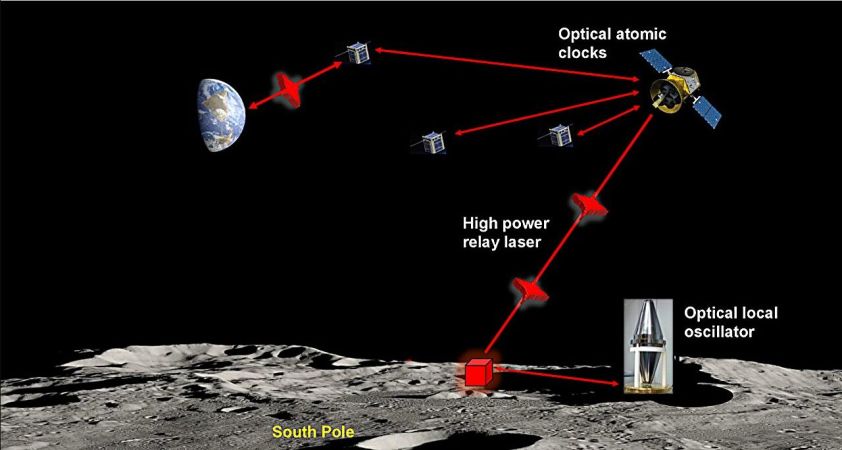
Phase-coherent lasers are crucial for many precision tasks, including timekeeping. Here on Earth the most stable optical oscillators are used in e.g. atomic clocks and many ultra-precise scientific measurements, such as gravitational wave detection. Since these optical oscillators use cryogenic silicon cavities, it’s completely logical to take this principle and build a cryogenic silicon cavity laser on the Moon.
In the pre-print article by [Jun Ye] et al., the researchers go through the design parameters and construction details of such a device in one of the permanently shadowed regions (PSRs) of the Moon, as well as the applications for it. This would include the establishment of a very precise lunar clock, optical interferometry and various other scientific and telecommunication applications.
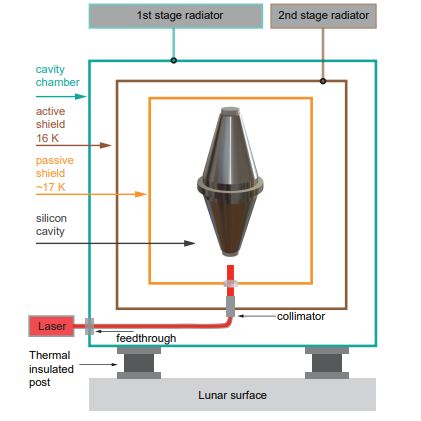
Although these PSRs are briefly called ‘cold’ in the paper’s abstract, this is fortunately quickly corrected, as the right term is ‘well-insulated’. These PSRs on the lunar surface never get to warm up due to the lack of an atmosphere to radiate thermal energy, and the Sun’s warm rays never pierce their darkness either. Thus, with some radiators to shed what little thermal energy the system generates and the typical three layers of thermal shielding it should stay very much cryogenic.
Add to this the natural vacuum on the lunar surface, with PSRs even escaping the solar wind’s particulates, and maintaining a cryogenic, ultra-high vacuum inside the silicon cavity should be a snap, with less noise than on Earth. Whether we’ll see this deployed to the Moon any time soon remains to be seen, but with various manned missions and even Moon colony plans in the charts, this could be just one of the many technologies to be deployed on the lunar surface over the next few decades.