
Slim Type For Small Screens, With PixelFonts

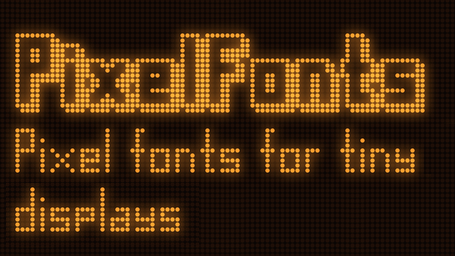
Small displays are affordable and easy to use, but their size can present a challenge. To help address this, [mcer12] created PixelFonts, a family of condensed fonts designed specifically for low-resolution displays, making sure every line holds as much text as it can fit.

PixelFonts works alongside either the AdafruitGFX or U8g2 libraries; one writes to the display using the common syntax of the chosen library, and the font itself comes from PixelFonts. Text can be displayed in regular and 3D shadowed versions, as well as in a wide variety of heights and weights. There’s support for accented letters, albeit only in lowercase due to space constraints. Want to make some changes? Every font comes with a BDF file to make alterations as widely accessible as possible.

Making the most of every pixel is important with small displays, but there’s more than one way to do so. For example, when it comes to color LCDs, subpixel rendering can improve legibility of small fonts; another way to get the most out of limited display sizes.
Subpixel Rendering For Impossibly Small Terminal Text

When it comes to text, how small is too small? The experts say a six point font is the minimum for readability, but as [James Bowman] shows us, you can get away with half of that. 

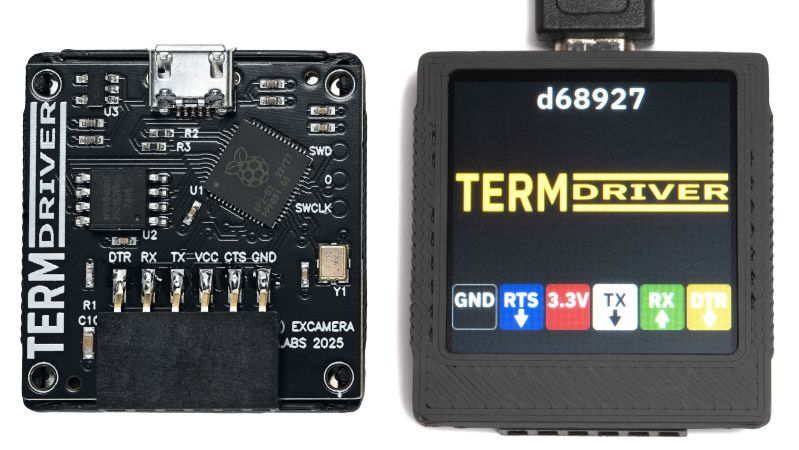
The goal is to produce a 40-character display on a 24 mm x 24 mm LCD that has a resolution of 240 x 240 to show a serial terminal (or other data) on the “TermDriver2” USB-to-Serial adapter. With 24 lines, that’s a line per millimeter: very small text. Three points, to be precise, half what the experts say you need. Diving this up into 40 columns gives a character cell of six by nine pixels. Is it enough?

Continue reading “Subpixel Rendering For Impossibly Small Terminal Text” →

I Am The Midnight Message Board What Messages At Midnight

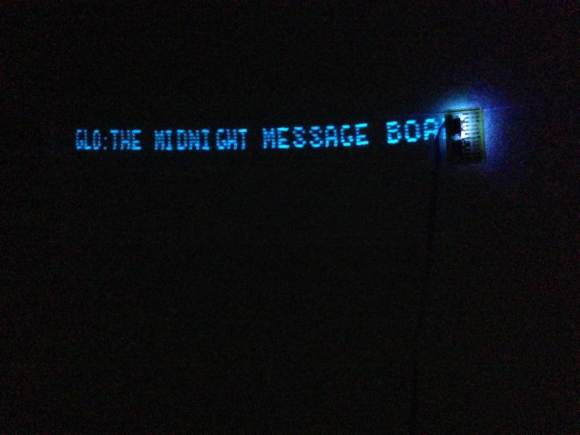
Photoluminescent stars on your bedroom wall or ceiling are pretty cool, though the stationary shapes can become boring. [Adi] felt this way, too. While doodling with a bright white light on some glow in the dark vinyl, it occurred to him that this could make for an interesting display. He set about making GLO, the midnight message board and RSS display.

[Adi]’s light writer uses 12 UV LEDs on a linear axis powered by a stepper motor to write RSS headlines, Twitter trends, or custom text on his wall. He finds the slow fade of the text very soothing to fall asleep by, and it’s easy to see why. The LED array imprints a section of a character consisting of a 6×5 bit pattern. The 12 LEDs are split into two groups, so it can write two lines at 45-50 characters each. [Adi] designed his own pixel font for this project, and advises that only upper case letter forms be used.

[Adi]’s write-up is quite admirable and comprehensive. In the circuit build section, he advises that the LEDs must be very close to the vinyl for optimum results, but that they should protrude farther than the shift registers so the chips don’t rub the vinyl. Of course you could opt for more intense light sources, like laser. See it in action after the break.

Continue reading “I Am The Midnight Message Board What Messages At Midnight” →









