

Prolog Via Pokémon

Like many people who read Hackaday, we are fairly fluent in a number of computer languages, but we have to admit it is easier to pick up languages that look like they group with things like Fortran. Sure, modern languages have all sorts of features, but the idea that you have a text file that executes in some order, variables, statements, and so on runs through most popular languages, but not all of them. Lisp and its variants are a different way of looking at things. And then there’s Prolog. [Alexander Petros] has an interesting way of explaining Prolog as a Pokémon game.

Prolog was “the next big thing” when AI meant expert systems. It is more of a specialized database where you define facts and rules that the computer can infer answers to queries. For example, if the facts say that Paul and Anna both have Mary as a parent, and a rule says that people with the same parent are siblings, then a query asking whether Paul and Anna are siblings will indicate that they are.

Continue reading “Prolog Via Pokémon”

C+P: Combining The Usefulness Of C With The Excellence Of Prolog

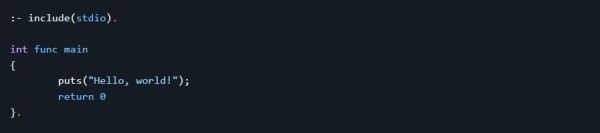
In a move that will absolutely not over-excite anyone, nor lead to any heated arguments, [needleful] posits that their C Plus Prolog (C+P for short) programming language is the best possible language ever. This is due to it combining the best of the only good programming language (Prolog) with the best of the only useful programming language (C). Although the resulting mash-up syntax that results may trigger Objective-C flashbacks, it’s actually valid SWI-Prolog, that is subsequently converted to C for compilation.

Language flamewars aside, the motivation for C+P as explained in the project’s README was mostly the exploring of macros in a system programming language. More specifically, by implementing a language-within-a-language you can add just about any compile-time feature you want including – as demonstrated in C+P – a form of generics. Even as a way to have a bit of fun, C+P comes dangerously close to being a functional prototype. Its main flaw is probably the lack of validation and error messages, which likely leads to broken C being generated.

Also mentioned are the Nim and Haxe languages which can be compiled (transpiled) to C or C++, which is somewhat of a similar idea as C+P, as well as cmacro (based on Common Lisp) and the D language.








