 In the world of scientific publishing there are many reasons why a paper can be retracted, but generally there is an obvious and clearly communicated reason for doing so. Thus when [Yves Gingras] – a historian of physics – and [Mahdi Khelfaoui] – a colleague – noticed recently that two 1940s papers by [Max Planck] had been quite recently retracted, this resulted in an eyebrow-raising double-take, before naturally publishing their investigation’s findings on arXiv.
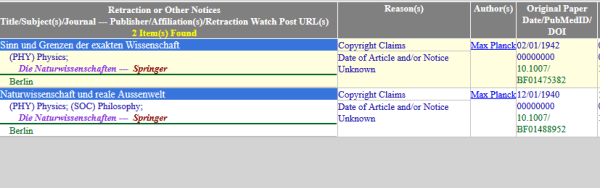
They first became aware of this courtesy of the site Retraction Watch and their list of ‘Retractions by Nobel Prize winners‘, which had the authors do a spit-take when they saw [Max Planck] listed. This page led them to a total of two database entries, as listed above. One is for a 1940 paper, the other for a 1942 paper, only five years before [Planck]’s death.
As for the provided reasons, both articles were struck with a generic ‘copyright violation’, which at the very least seems somewhat puzzling, and started both authors of this recent investigation on their journey. What they found was less of a nefarious plot and more of an accidental black hole that had formed when scientific journals began to digitize papers.
The original journal that [Planck]’s papers were published in was absorbed like so many into Springer Nature, where an automated system then tried to sort through all the papers, including the usual detecting of copyright issues. With these papers predating the era of convenient DOIs and the more standard forms of citing related works, said automated system appears to have become rather confused and hurt these papers in its confusion.
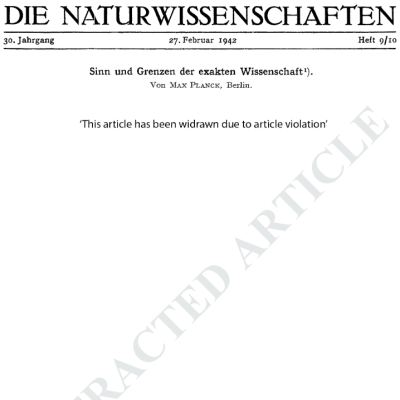
From the side of Springer Nature there has so far been no commentary on this, and as of writing the original papers are still listed as withdrawn. Although one can still read the original scanned papers via the Internet Archive, such as here the 1940 paper, it’s disturbing to see that automated systems have apparently been let loose on these veritable archives of scientific and academic history, heedless of the damage inflicted along the way.
Although after fifteen years these two retractions were finally noticed, the more harrowing question is probably just how many papers from potentially less well-known authors were quietly scuttled. If this can happen to [Planck]’s works, it would appear that nobody is safe, including legends like [Bohr], [Einstein] and so many others.