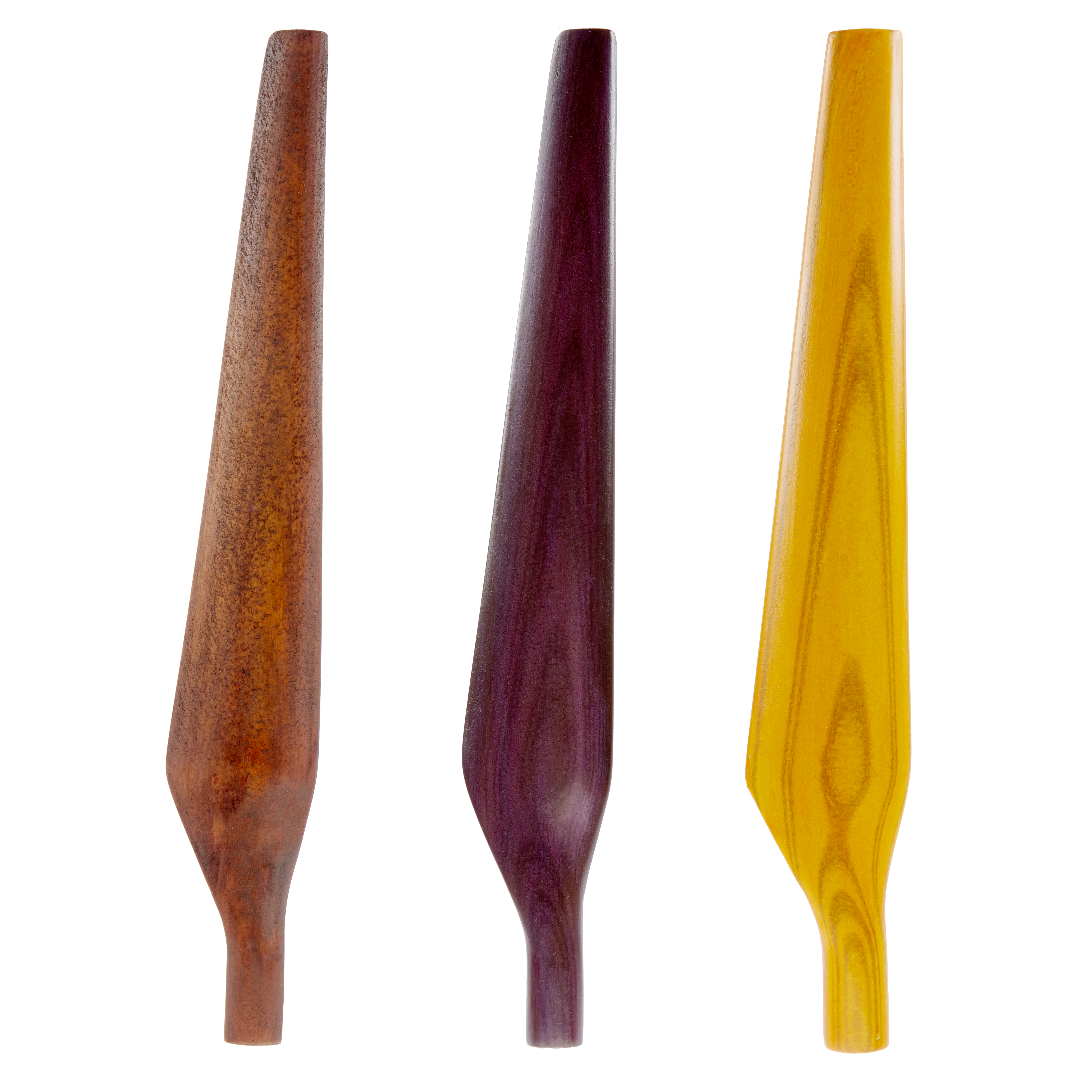
Heating A Woodshop With Sawdust

Most carpenters and woodworkers find themselves with the problem of disposing of all the sawdust they create when performing their craft. There are lots of creative solutions to this problem, such as adding it compost, using it as groundcover in a garden, adding it as filler in a composting toilet, or pressing it into bricks to burn in a stove. All of these have their uses, but involve either transporting the sawdust somewhere or performing some intermediate step to process it. [Greenhill Forge] wanted to make more direct use of it so he built this stove which can burn the sawdust directly and which provides enough heat for his woodshop.

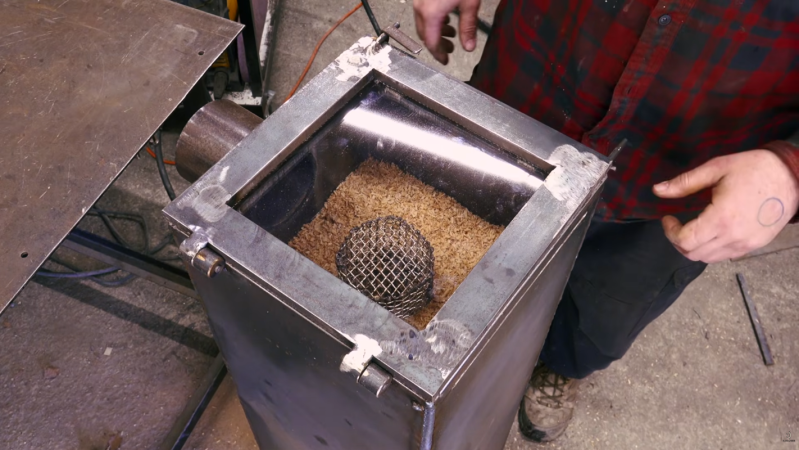
The design is based on one which is somewhat common in Japan and involves building a vessel with a central tube for airflow, with the sawdust packed around it. The tube is made from a hardware cloth or screen to allow air to reach the sawdust. The fire is lit from the top, closed, and then allowed to burn through the stack. [Greenhill Forge] welded the entire stove from various pieces of sheet metal and bar stock, with a glass plate at the top of the stove to close off the fire and a baffle to control the airflow and rate of burn.

Initially, [Greenhill Forge] thought that the fire would burn from the top down, but this turned out to create a smoldery, messy fire instead of a hot, clean burn. Eventually, though, an ember fell down to the bottom and let the stack burn from the top up, and then it started generating serious heat. He estimates that with around 5 kg of sawdust burning for three hours that it’s about equivalent to a 6 kW stove. While a woodworker might not have enough sawdust to run this stove every day, it could be good to have on hand to use once every few weeks when the sawdust builds up enough. [Greenhill Forge] has been hard at work building unique wood burning stoves lately, like this one we recently featured which generates and then uses charcoal as fuel.
Continue reading “Heating A Woodshop With Sawdust”

Workshop Dust Manifold Spreads The Suction Around

Let’s say you’re doing lots of woodwork now, and you’ve expanded your workshop with a few big tools. You’re probably noticing the sawdust piling up awfully quick. It would be ideal to have some kind of collection system, but you don’t want to buy a shop vac for every tool. This simple manifold from [Well Done Tips] is the perfect solution for you.

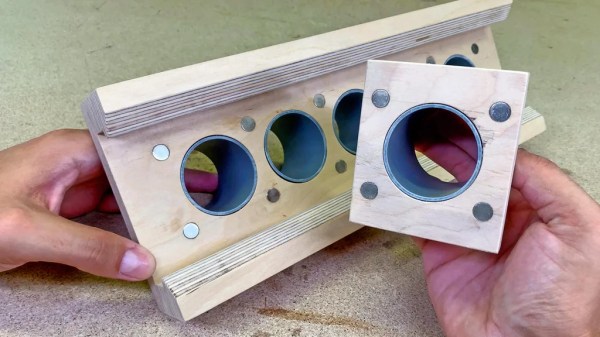
It’s a basic rig at heart, but nonetheless a useful one. It consists of a plywood frame with a shuttle that slides back and forth. The suction hose of your shop vac attaches to the shuttle. Meanwhile, the frame has a series of pipes leading to the dust extraction ports of your various tools around the shop. When you power up a tool, simply slide the manifold to the right position, and you’re good to go. Magnets will hold it in place so it doesn’t get jostled around while you work.

It’s a much cheaper solution than buying a huge dust extraction system that can draw from all your tools at once. If you’re just one person, that’s overkill anyway. This solution is just about sized perfectly for small home operators. Give it a go if you’re tired of sweeping up the mess and coughing your lungs out on the regular. Video after the break.

Continue reading “Workshop Dust Manifold Spreads The Suction Around”

Sawdust Printer Goes Against The Grain By Working With Wood Waste

Wood-infused filament has been around for awhile now, and while it can be used to create some fairly impressive pieces, the finished product won’t fool the astute observer. For one thing, there’s no grain to it (not that every piece needs to show grain). For another, you can’t really throw it on a fire for emergency heating like you could with actual wood.

But a company called Desktop Metal has created a new additive manufacturing process for wood and paper waste called Forust (get it?) that gets a lot closer to the real thing. It might be an environmental savior if it catches on, though that depends on what it ends up being good for.

The company’s vision is to produce custom and luxury wood products — everything from sophisticated pencil cups to stunning furniture, and to take advantage of the nearly limitless geometry afforded by additive manufacturing. Forust uses the single-pass binder jetting method of 3D printing to lay down layers of sawdust and lignin and then squirt out some glue in between each one to hold them together.

Although Desktop Metal doesn’t mention a curing process for Forust in their press release, post-processing for solidity and longevity is the norm in binder jetting, which is usually done with ceramic or metal-based materials.

Let’s talk about those wood grains. Here’s what the press release says:

Digital grain is printed on every layer and parts can then be sanded, stained, polished, dyed, coated, and refinished in the same manner as traditionally-manufactured wood components. Software has the ability to digitally reproduce nearly any wood grain, including rosewood, ash, zebrano, ebony and mahogany, among others. Parts will also support a variety of wood stains at launch, including natural, oak, ash, and walnut.

Beauty and workability are one thing. But this will only be worthwhile if the pieces are strong. This is something that isn’t too important for pencil holders, but is paramount for furniture. Forust’s idea is to ultimately save the trees, but how are they going to get sawdust and lignin without the regular wood industry — they want to be circular and envision recycling of their goods at end-of-life into new goods

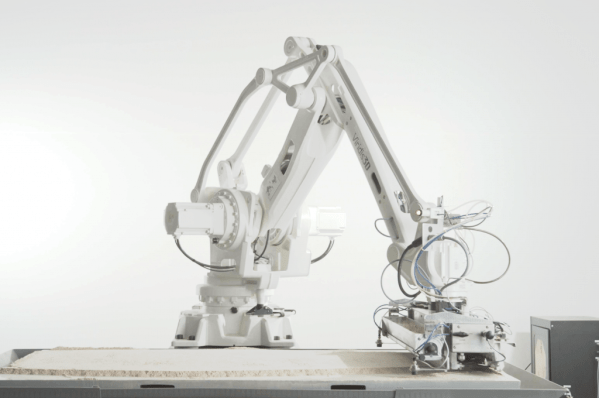
We wondered if the wood waste printer would ever become a thing. You know, there’s more than one way to print in sawdust — here’s a printer that stacks up layers of particle boards and carves them with a CNC.

Images via Forust