
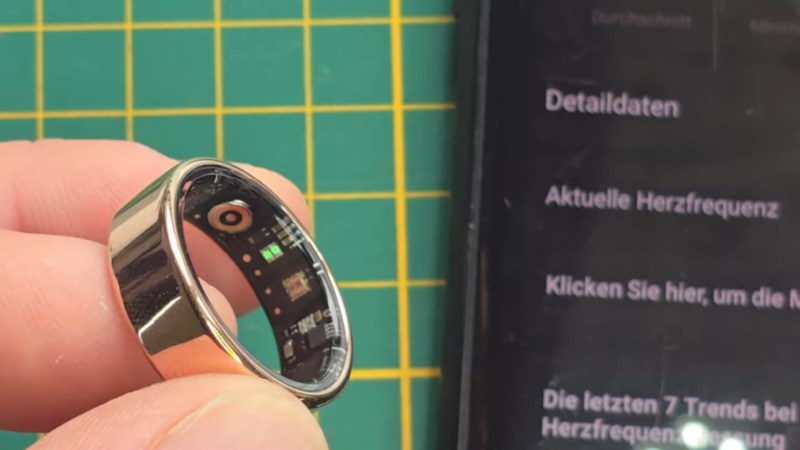
A closeup of the ring, inner electronics including a lit green LED seen through the inner transparent epoxy, next to the official app used to light up the LED for a demo.

New Part Day: A Hackable Smart Ring

We’ve seen prolific firmware hacker [Aaron Christophel] tackle smart devices of all sorts, and he never fails to deliver. This time, he’s exploring a device that seems like it could have come from the pages of a Cyberpunk RPG manual — a shiny chrome Bluetooth Low Energy (BLE) smart ring that’s packed with sensors, is reasonably hacker friendly, and is currently selling for as little as $20.

The ring’s structure is simple — the outside is polished anodized metal, with the electronics and battery carefully laid out along the inside surface, complete with a magnetic charging port. It has a BLE-enabled MCU, a heartrate sensor, and an accelerometer. It’s not much, but you can do a lot with it, from the usual exercise and sleep tracking, to a tap-sensitive interface for anything you want to control from the palm of your hand. In the video’s comments, someone noted how a custom firmware for the ring could be used to detect seizures; a perfect example of how hacking such gadgets can bring someone a brighter future.

The ring manufacturer’s website provides firmware update images, and it turns out, you can upload your own firmware onto it over-the-air through BLE. There’s no signing, no encryption — this is a dream device for your purposes. Even better, the MCU is somewhat well-known. There’s an SDK, for a start, and a datasheet which describes all you would want to know, save for perhaps the tastiest features. It’s got 200 K of RAM, 512 K of flash, BLE library already in ROM, this ring gives you a lot to wield for how little space it all takes up. You can even get access to the chip’s Serial Wire Debug (SWD) pads, though you’ve got to scrape away some epoxy first.

As we’ve seen in the past, once [Aaron] starts hacking on these sort of devices, their popularity tends to skyrocket. We’d recommend ordering a couple now before sellers get wise and start raising prices. While we’ve seen hackers build their own smart rings before, it’s tricky business, and the end results usually have very limited capability. The potential for creating our own firmware for such an affordable and capable device is very exciting — watch this space!
Continue reading “New Part Day: A Hackable Smart Ring”

Detect COVID-19 Symptoms Using Wearable Device And AI

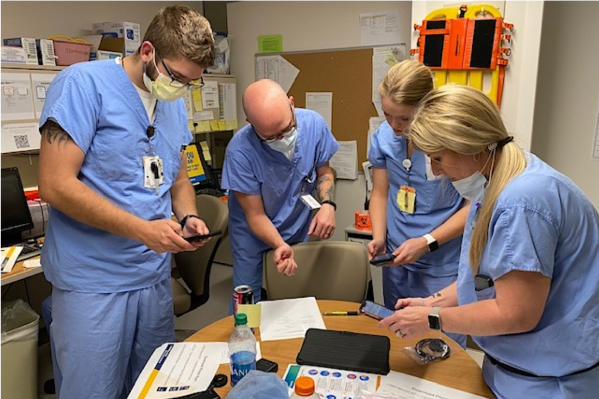
A new study from West Virginia University (WVU) Rockefeller Neuroscience Institute (RNI) uses a wearable device and artificial intelligence (AI) to predict COVID-19 up to 3 days before symptoms occur. The study has been an impressive undertaking involving over 1000 health care workers and frontline workers in hospitals across New York, Philadelphia, Nashville, and other critical COVID-19 hotspots.

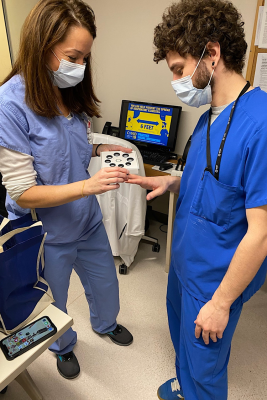
The implementation of the digital health platform uses a custom smartphone application coupled with an Ōura smart ring to monitor biometric signals such as respiration and temperature. The platform also assesses psychological, cognitive, and behavioral data through surveys administered through a smartphone application.

We know that wearables tend to suffer from a lack of accuracy, particularly during activity. However, the Ōura ring appears to take measurements while the user is very still, especially during sleep. This presents an advantage as the accuracy of wearable devices greatly improves when the user isn’t moving. RNI noted that the Ōura ring has been the most accurate device they have tested.

Given some of the early warning signals for COVID-19 are fever and respiratory distress, it would make sense that a device able to measure respiration and temperature could be used as an early detector of COVID-19. In fact, we’ve seen a few wearable device companies attempt much of what RNI is doing as well as a few DIY attempts. RNI’s study has probably been the most thorough work released so far, but we’re sure that many more are upcoming.

The initial phase of the study was deployed among healthcare and frontline workers but is now open to the general public. Meanwhile the National Basketball Association (NBA) is coordinating its re-opening efforts using Ōura’s technology.

We hope to see more results emerge from RNI’s very important work. Until then, stay safe Hackaday.









