How Long Can A Quadcopter Drone Fly On Just Solar?

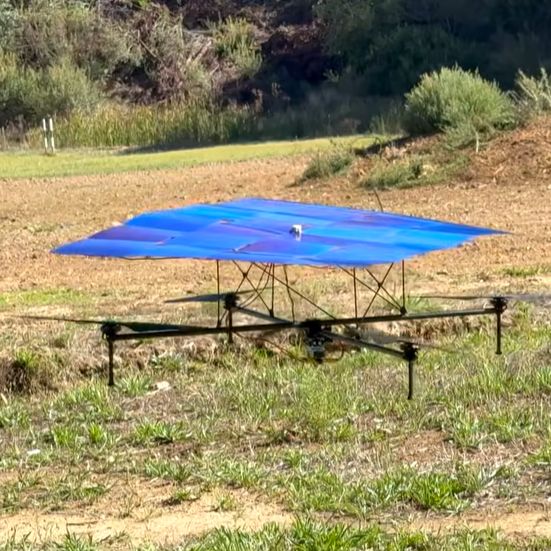
The final second prototype flying. (Credit: Luke Maximo Bell, YouTube)

The dream of fully powering everything from aircraft to cars on just the power generated from solar panels attached to the machine remains a tempting one, but always seems to require some serious engineering including putting the machine on a crash diet. The quadcopter that [Luke Maximo Bell] tried to fly off just solar power is a good case in point, as the first attempt crashed after three minutes and wrecked its solar panels. Now he’s back with a second attempt that ought to stay airborne for as long as the sun is shining.

Among the flaws with the first prototype were poor support for the very thin and fragile PV panels, requiring much better support on the carbon fiber frame of the drone. To support the very large solar array, the first drone’s arms were made to be very long, but this interfered with maneuvering, so the second version got trimmed down and the array raised above the frame. This saved 70 grams of weight from the shortened tubs, which could then be added to the new panel supports.

After an initial test flight resulted in a crash when the PV output dropped, the need for a small battery buffer was clear, so this was added, along with a reduction of the array to 4×7 panels to get the same 20V as the battery. The array also had to be reinforced, as the thin array was very wobbly in addition to making it impossible to fly with any significant wind.

Continue reading “How Long Can A Quadcopter Drone Fly On Just Solar?”
A tiny solar-powered robot that even works indoors

Tiny BEAM Robot Smiles Big At The Sun

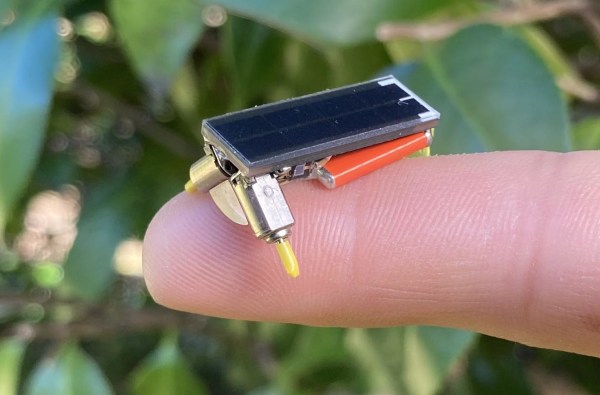
What have you been working on during the Great Chip Shortage? [NanoRobotGeek] has been living up to their handle and building BEAM robots that are smaller than any we’ve seen before. What are BEAM robots, you say? Technically it stands for Biology Electronics Aesthetics and Mechanics, but basically the idea is to mimic the movement of bugs, usually with found components, and often with solar power. Here’s a bunch of tutorials to get you started.

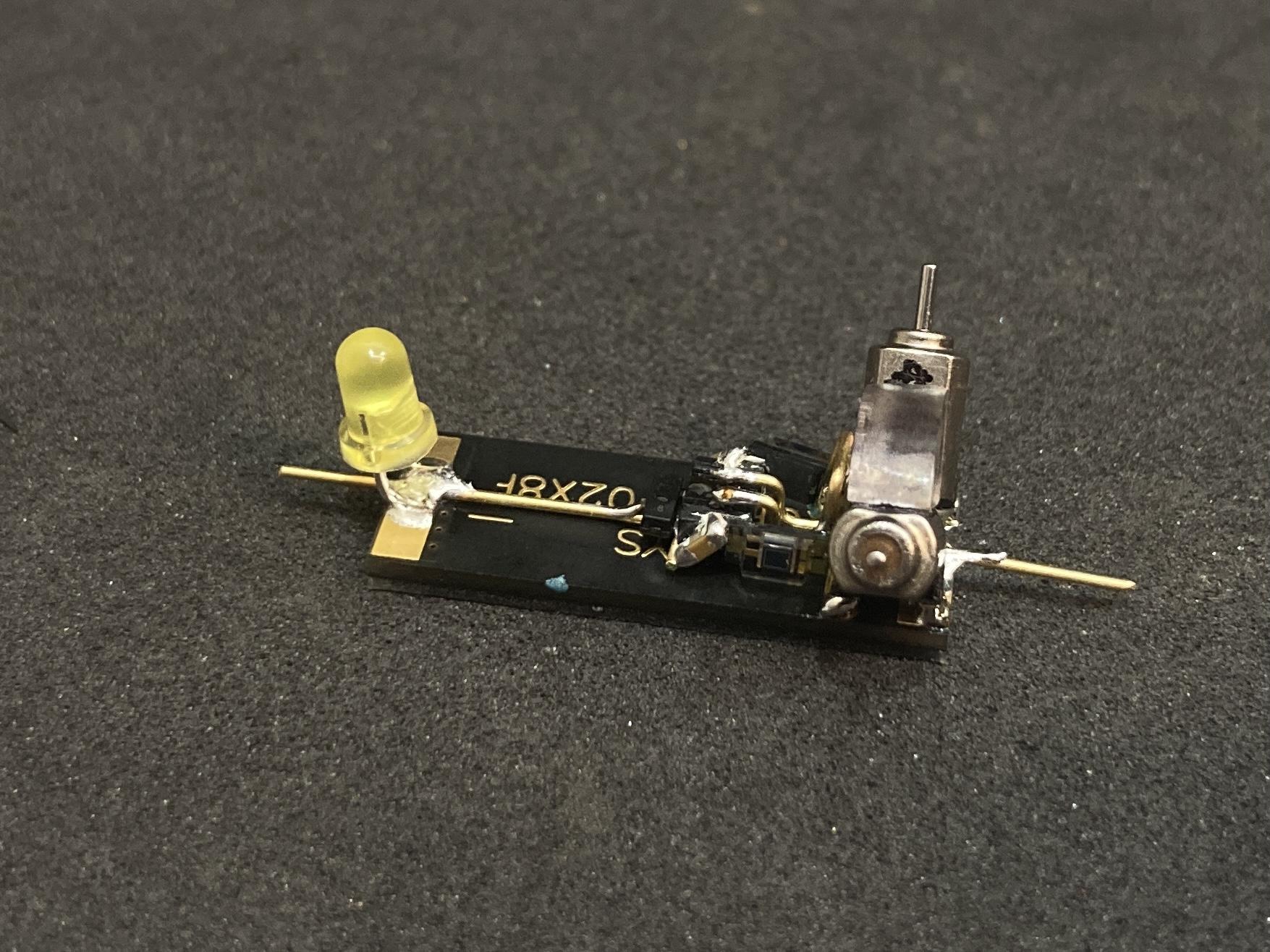
The underbelly of what might be the world's smallest BEAM robot.
This was before the large, flat storage capacitor came and covered everything up.

This here is an example of a photovore or photopopper — it moves toward light using simple logic by charging up a capacitor and employing a voltage monitor to decide when there’s enough to run two tiny vibration motors that make up its legs and feet.

[NanoRobotGeek] started in a great place when they found these 25% efficient monocrystalline solar panels. They will even make the bot move indoors! If you want to build one of these, you can’t beat [NanoRobotGeek]’s guide. Be sure to watch it toddle around in the demo video after the break.

We love to see people work at all different scales. Last time we checked in with [NanoRobotGeek], they had built this solar-powered ball-flinging delight.

Continue reading “Tiny BEAM Robot Smiles Big At The Sun”

Rover Runs Slow And Steady On Solar Power

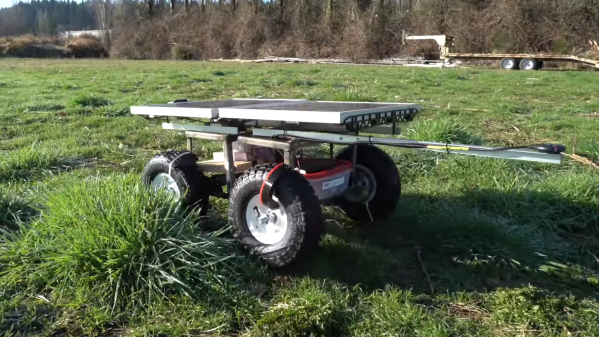
The solar panel technology we have available today doesn’t really lend itself to practical everyday transport. But when speed isn’t a concern, it can make for some very interesting autonomous rovers. One example of this is [Daniel Riley] aka [rctestflight]’s solar powered rover, which he built to live autonomously at his flight testing field, crawling around whenever it has gathered enough juice from the sun.

[Daniel] has thing for autonomous craft of all types, with quite a few aircraft and boats to his name. This rover is built around a welded steel frame, with each wheel driven by a brushless geared motors via a chain. While it’s technically a skid steer, the electronic speed controls are from a quadcopter and can’t reverse, so it doesn’t turn quite on the spot.

With the rigid steel frame, any small bump in the ground would cause one wheel to lose traction. To fix this, the frame was cut in two and a pivot added in the center, allowing all four wheels to always remain on the ground. Another problem is that the wheels would sometimes dig themselves into the soft wet ground, so this, [Daniel] attached a 3D printed “hump” to each drive wheel, which helps them to climb out of any soft spots. For the next version of this rover, [Daniel] plans to use cheap DC geared motors from a Barbie jeep. They’re a bit too fast though, so he’ll be adding 3D printed cycloidal reduction gearboxes. We’re definitely looking forward to seeing here this project goes from here.

There have been a number of projects to test solar powered robots for agricultural use. We really like the idea, with its potential for long duration missions. Imagine something like this roaming the Black Rock playa in the US, the Makgadikgadi Pan in Botswana, or even the Sahara Desert, while gathering environmental data and making awesome time-lapse videos.