Examining A World’s Record From The Age Of Steam

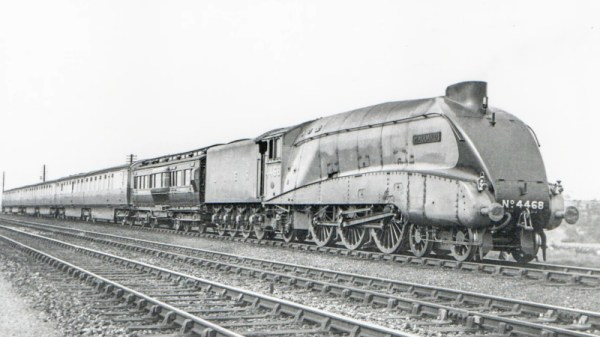
There aren’t many speed records that remain unbroken for the greater part of a century, but one of them is that of the fastest steam locomotive. As with so many such things, there’s a bit of controversy and more than one contender, but the one in the record books is the A4 Pacific, Mallard. In 1938, this locomotive thundered down an incline on the London & North Eastern Railway’s mainline in the north of England at 126 MPH. But can that number be taken as reliable? The Institute of Mechanical Engineers has a video in which they investigate.

It’s a fascinating look at the science of railway speed measurement as it existed in 1938, the record itself, and the paper dynamometer roll which recorded it. We’ve placed the video below the break, and in it, we see an in-depth analysis of the noise and inconsistencies in the recording, and see them come to the conclusion that a safer figure to quote would be 124 MPH.

Our assessment is that, of course, the LNER wanted to squeeze every morsel of publicity from it in a game of one-upmanship with their arch-rivals in the London Midland and Scottish railway, so it’s likely that their use of a momentary figure makes sense in that light. Even the best-laid 1930s jointed track would have been bumpy compared to modern continuous rail, and we are guessing that the ancient clerestory dynamometer car would hardly be as smooth-riding as a modern express coach. The achievement of measuring at all with mechanical instruments in such an environment at those speeds would have been tricky, to say the least. It leaves us wondering whether 1930s electronics could have produced some kind of trackside measurement device, but perhaps the LNER trusted their mechanical instruments more. Perhaps the Pennsylvania Railroad should have followed its example.

Continue reading “Examining A World’s Record From The Age Of Steam”
Breaking Land Speed Records With An RC Car

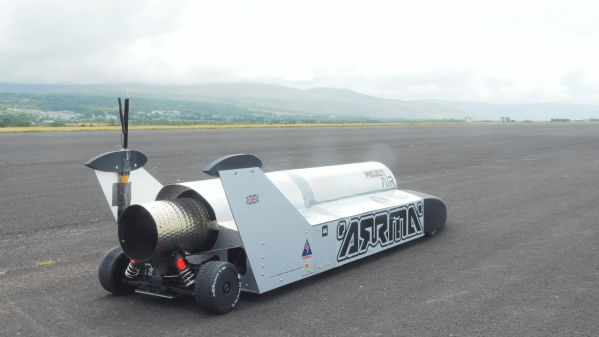
Building and running a land speed record car is an expensive business that requires incredibly wealthy benefactors. Doing it on a smaller scale with a radio control car is still pricy, but more within the reach of the individual. [ProjectAir] has been working on just that, and recently set out to break records with a car of his own design.

The car runs a Jetcat 220 engine capable of delivering 220 newtons of thrust, built into a custom aluminium chassis with streamlined bodywork. Early runs saw it reach 112 km/h, but the goal was to push it beyond 150 km/h to break the standing Guinness World Record.

With an RC event running on a local runway, [ProjectAir] had the venue and opportunity to make an attempt. It was tough going, with the car throwing off its nosecose in one run, while rough weather brought further struggles. Strong crosswinds played a role in a violent crash on the car’s fastest pass, which ripped the car apart and destroyed the engine. However, in the end, it had done enough to secure a record at over 152 km/h, even if its later faster efforts didn’t officially count.

It’s clear that the car has come a long way since [ProjectAir’s] initial efforts in 2022, and we can’t wait to see where the project goes next. Video after the break.

Continue reading “Breaking Land Speed Records With An RC Car”

You Might Be Cool, But You’re Not Gas Turbine Motorcycle Cool

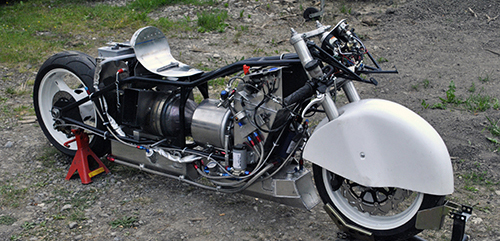
For the last four and a half years, [Anders] has been working on a motorcycle project. This isn’t just any old Harley covering a garage floor with oil – this is a gas turbine powered bike built to break the land speed record at Bonneville.

The engine inside [Anders]’s bike is a gas turbine – not a jet engine. There’s really not much difference in the design of these engines, except for the fact that a turbine dumps all the energy into a drive shaft, while a true jet dumps all the energy into the front bumper of the car behind this bike. [Anders] built this engine from scratch, documented entirely on a massive 120 page forum thread. Just about everything is machined by him, bolted to a frame designed and fabricated by him, and with any luck, will break the land speed record of 349 km/h (216mph) on the salt flats of Bonneville.

As with all jet and turbine builds, this one must be heard to be believed. There are a few videos of the turbine in action below, including one where the turbine drives the rear wheel.

Continue reading “You Might Be Cool, But You’re Not Gas Turbine Motorcycle Cool”

Building A Bike For 100 Miles Per Hour

bike


As a kid, [Tom] followed all the automotive land speed record attempts on the Bonneville Salt Flats. The cars used in these attempts were all built by guys in their garages, and as a bicycle frame builder, [Tom] is keenly aware of the land speed record for bikes. One thought leads to another, and [Tom] decided he would see how fast one of his frames could go.

Aside from a gigantic gear for his custom bike, [Tom] also needed a little help from a friend. The current land speed record on a bicycle was done by drafting behind a drag racer. [Tom] doesn’t have a drag racer, or a wide expanse of flat open ground in his native England, so he did the next best thing: drafting behind a Ford Zephyr on an abandoned WWII airstrip.

On the runway, [Tom] was able to get his bike up to 80 miles an hour. Wanting to see how fast he could go in ideal conditions, the bike was taken to the garage, put on a pair of rollers, and measured as it was brought up to speed. With a lot of effort, [Tom] was able to get up to 102 miles per hour, incredibly fast for something powered by human muscle.