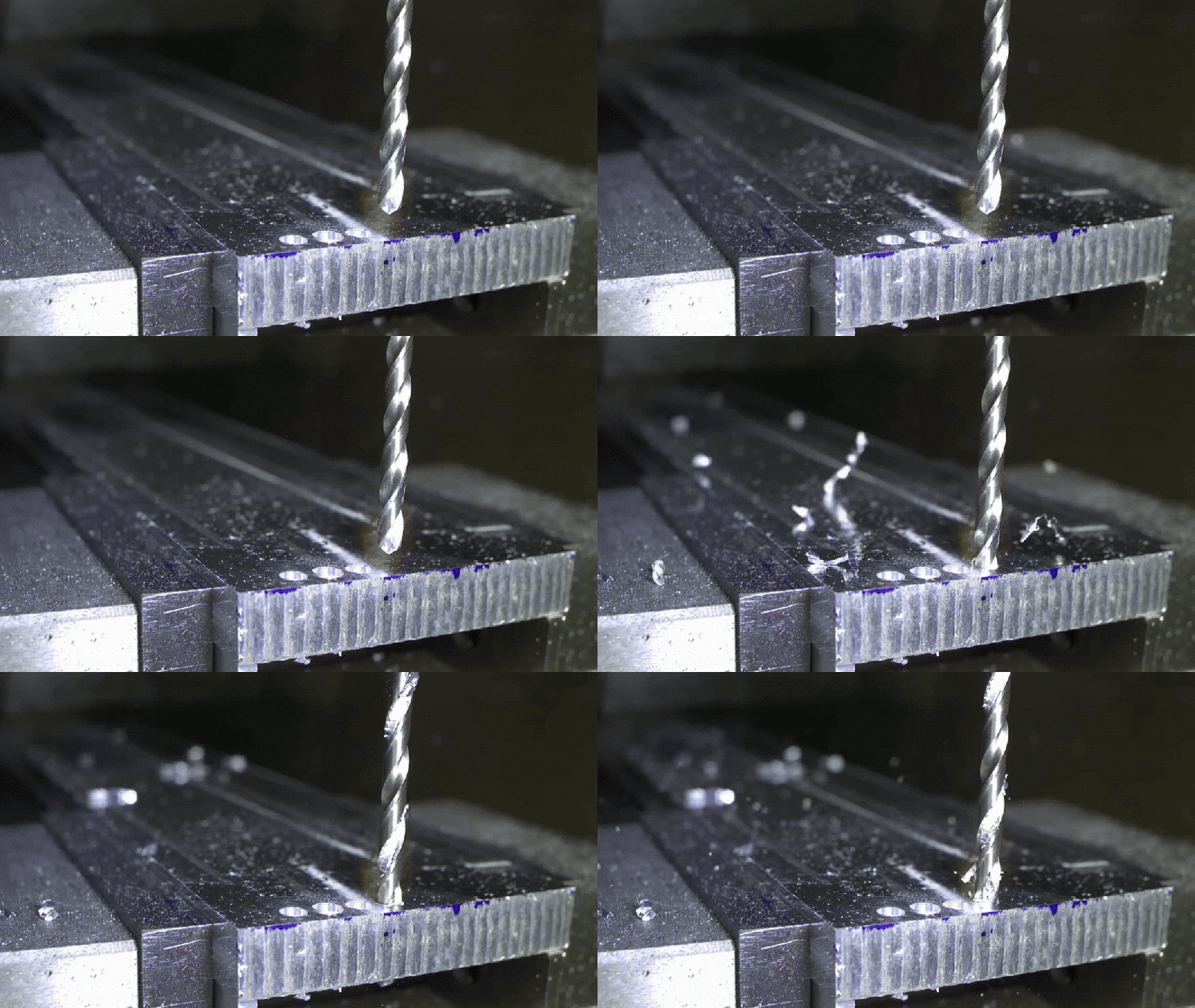
A drill bit, not apparently rotating, descends toward a block of aluminium and throws up aluminium shavings as it passes through the block.

Freeze Moving Tools With A Stroboscopic Camera

If you take a video of a spinning wheel, you’ll probably notice that the spokes appear to turn more slowly than the wheel is actually rotating, and sometimes in the wrong direction. This is caused by a near match in the frame rate of the camera and the rate of rotation of the wheel – each time the camera captures a frame, the wheel has rotated a spoke into nearly the same position as in the last frame. If you time the exposures carefully, as [Excessive Overkill] did in his latest video, this effect can seemingly freeze moving objects, such as a fan or saw blade.

Most cameras only allow relatively coarse, fixed adjustments to frame rate, making it difficult to synchronize the shutter to an object’s motion. To get around this, [Excessive Overkill] used an industrial camera (previously used in this aimbot), which has fine frame rate control and external triggering. He connected the external trigger to a laser sensor, which detects a piece of retroreflective tape every time it passes by (for example, on one blade of a fan). When the laser sensor sends a signal, it also triggers a powerful LED flash. The flash is so powerful that dark materials create a hum when exposed to it, as pulses quickly heat the material, but each pulse is also so brief that the flash board doesn’t require any cooling.

Continue reading “Freeze Moving Tools With A Stroboscopic Camera”
Stop Motion With The Time Glove

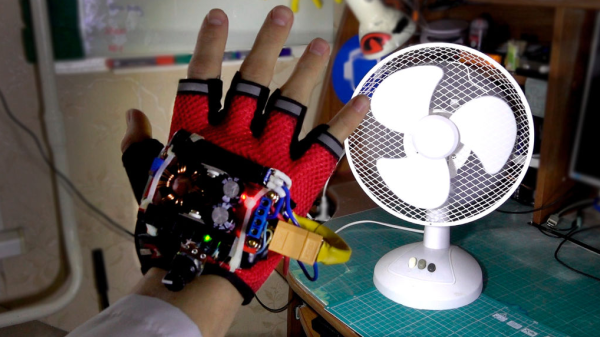
What do you get when you put an ultra-bright LED in the palm of a glove, and strobe it controlled by an accelerometer? A Time Control Glove! In creator [MadGyver]’s own words, it’s “just a stroboscope with frequency adjustment” but the effect is where all the fun is.

The Time Control Glove uses the stroboscopic effect, which many of us have seen used in timeless water drop fountains where the strobe rate makes drops appear to change speed, freeze in place, and even change direction. [MadGyver] made the entire assembly portable by putting it into a glove. An on-board accelerometer toggles the strobe in response to a shake, and the frequency is changed by twisting the glove left or right. The immediate visual feedback to the physical motions is great. The whole effect is really striking on the video, which is embedded below.

Continue reading “Stop Motion With The Time Glove”

RGB Stroboscopic Guitar Tuning

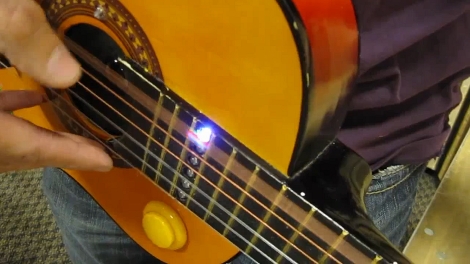
This is [Michael Ossmann’s] RGB LED stroboscopic guitar tuner. If his name is familiar that’s because we mentioned he’d be giving a talk with [Travis Goodspeed] at ToorCon. But he went to DefCon as well and spent the weekend in his hotel room trying to win the badge hacking contest.

Despite adversity he did get his tuner working. It’s built into a toy guitar that he takes on road trips with him. By adding a row of RGB LEDs between two of the frets he can use the vibration frequency of an in-tune string to flash the three different colors. If the string is not in tune the three colors will dance around but matching it with the LED frequency produces a stable color. He then uses that big yellow button to advance to the next string. See his demonstration after the break.

This is basically a built-in plectrum tuner that uses one LED package instead of two.

Continue reading “RGB Stroboscopic Guitar Tuning”